

I’ll be honest: on my first morning in Hangzhou I almost slept through it. The plan was West Lake at sunrise, then coffee. But a friend texted “go to Lingyin Temple before the crowds, trust me,” and I’m glad I did. Within ten minutes of stepping through the mountain gate, the noise of the city dropped away and I was standing under a thousand-year-old cypress, listening to the low rhythm of a wooden fish drum drifting out of the hall. Lingyin Temple isn’t just one of China’s most important Buddhist monasteries — it’s a working, breathing place of worship tucked into a forested valley at the foot of Feilai Peak, and the carved stone grottoes along the stream are older than the temple itself. If you’re building a Hangzhou itinerary, this is the one stop I’d protect with a hard block of time.
Why Lingyin Temple Earned Its Name
The name translates, roughly, to “Temple of the Soul’s Retreat” — and you feel the logic of it the moment you walk in. It was founded in 326 AD by an Indian monk named Huili, who reportedly looked at the craggy limestone peak across the stream and declared the mountain must have “flown here” from India (more on that legend below). The monastery grew into one of the greatest centers of Chan (Zen) Buddhism in the country, and although fire and war destroyed the original wooden structures more than once, what stands today has been rebuilt and expanded across the Tang, Song, Ming, and Qing dynasties.
What I found surprising as a first-time visitor is the scale. This isn’t a single hall you peek into and leave. It’s a string of grand courtyards climbing up the hillside — the Hall of the Heavenly Kings, the Mahavira Hall with its massive gilded Sakyamuni, then higher still to the Medicine Buddha Hall and the pagoda-studded ridge behind. Give yourself at least two hours, and more if you like to linger.
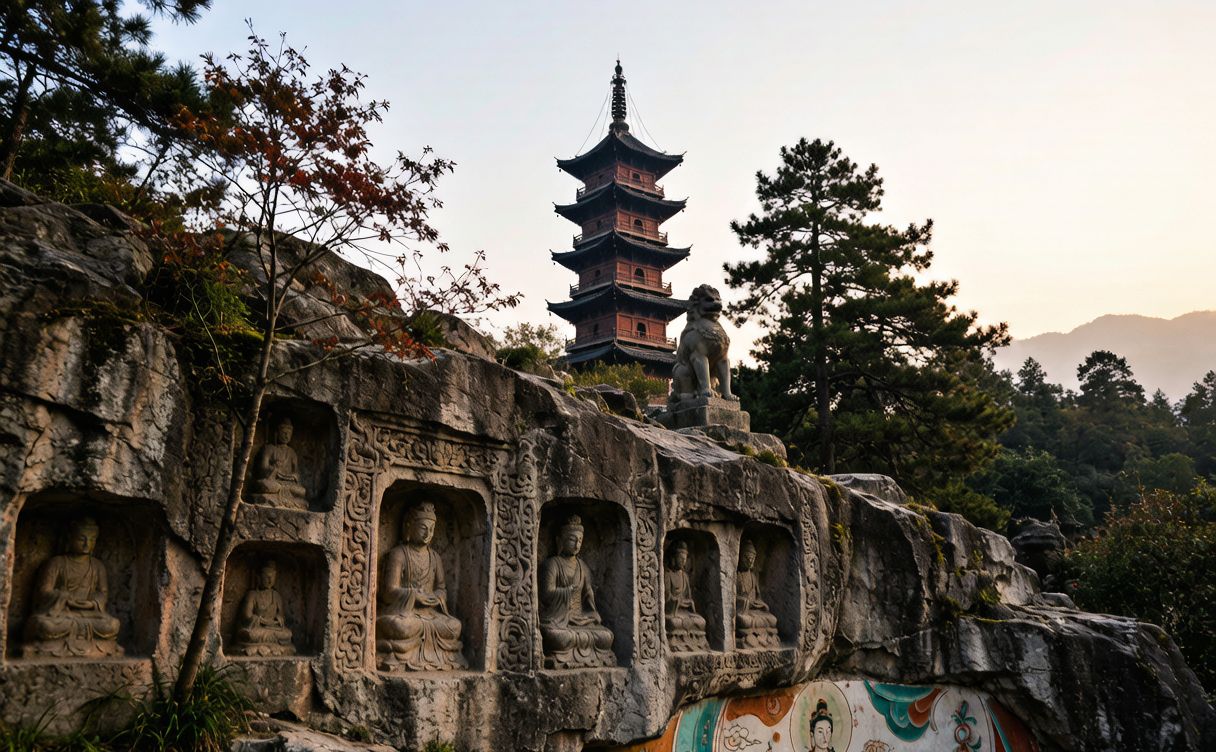
Feilai Peak and the Grotto Statues You’ll Pass First
Here’s the thing most day-trippers miss: the ticket you buy actually covers two separate experiences, and the first one isn’t the temple at all. Before you reach the monastery you walk along a cool, mossy stream at the base of Feilai Peak (飞峰, “Peak That Flew Here”), and the limestone cliffs on both sides are carved with more than 340 Buddhist statues. These aren’t later additions — the earliest date to the Five Dynasties period (10th century), with the richest cluster from the Yuan dynasty.
I spent longer among the grottoes than I expected. The carvings are weathered but intimate: a serene Maitreya with his round belly and laughing face, rows of arhats tucked into natural fissures, a slender Avalokiteshvara with eleven heads. Because they’re outside and shaded by trees, the light is soft and green, and there are no ropes or glass barriers — you stand a few feet from a 700-year-old face. If you only have an hour, spend half of it here. The contrast between the open-air stone carvings and the incense-heavy wood halls up the path is part of what makes Lingyin special.
If you’re interested in how these compare to China’s other great rock-cut sites, our guide to the Yungang Grottoes in Datong covers the cave-temple tradition in far more monumental scale, but Feilai Peak is the better place to feel the carvings as something quiet and personal.
The Legend of Ji Gong (and Why Locals Love Him)
No visit makes sense without meeting Ji Gong (济公), the temple’s most famous adopted son. He was a real 12th-century monk — Daoji — who lived rough, drank wine, ate meat, and generally refused to behave like a proper cleric, all while performing acts of startling kindness and clever tricks. Over the centuries he morphed into a folk hero: half saint, half trickster, the patron of the unfairly treated. You’ll see his statue in the Hall of the Heavenly Kings, and there’s a whole subsidiary hall (Ji Gong Hall) devoted to him near the back of the complex.
I’ll admit I rolled my eyes a little at the gift-shop Ji Gong dolls — until I watched an elderly woman place a stick of incense at his shrine and quietly ask him for help with a grandchild’s exams. That’s the side of Lingyin that guidebooks undersell: it’s not a museum. People come here to pray, and Ji Gong is who they talk to when they need a problem solved that doesn’t fit a form.
A Route That Actually Works
After two visits I’ve settled on an order that avoids the worst of the crowds and the worst of the uphill sun:
- Arrive at opening (around 7:00–7:30 am). Buy the combined ticket at the entrance (Feilai Peak + temple). The early hour is the single biggest upgrade to this visit.
- Walk the stream and Feilai Peak grottoes first, left to right, before the tour buses unload around 9:30.
- Enter the temple proper through the mountain gate, pausing at the open-air Sakyamuni statue in front of the Hall of the Heavenly Kings — it’s one of the largest carved stone Buddhas in the region.
- Climb the central axis hall by hall, then detour to Ji Gong Hall and the cliffside caves higher up.
- If you have energy, follow the trail behind the monastery up to the pagodas and the tea-terrace viewpoint. On a clear day you can see the edge of West Lake.
The whole loop is walkable and there’s no need for a guide if you’d rather wander, but a few English-signposted panels explain the key halls. I went unguided the first time and guided the second; the guide was worth it mainly for the Ji Gong stories.
Pairing Lingyin Temple with West Lake
Lingyin sits about 15–20 minutes northwest of West Lake, and the two pair beautifully in one day: temples and mountains in the morning, the lake’s soft scenery in the afternoon. I’d do Lingyin first (cool, shaded, early), have lunch in the nearby Longjing tea-village area, then drift down to the lake for a boat ride and a walk along Su Causeway. The combination captures both sides of Hangzhou — its spiritual, forested hills and its famous, polished water.
For timing and walking routes around the lake itself, our West Lake Hangzhou guide lays out the causeways, islands, and sunset spots in detail. And if you want the broader picture — how many days to spend, where to base yourself, and what else is worth the trip — the full Hangzhou travel guide is the place to start planning.
Practical Tips: Tickets, Hours, Getting There
A few things I wish I’d known before the first visit:
- Two tickets, one doorway. There’s a single entrance plaza, but you’ll be offered a “scenic area” ticket (Feilai Peak grottoes only) and a “combined” ticket (grottoes + temple). Take the combined one. The temple-only ticket sold at a second gate further up is more expensive and doesn’t include the grottoes you’ll have already walked past.
- Hours. The scenic area generally opens around 7:00 am and the temple halls close in the late afternoon (roughly 5:00–6:00 pm depending on season). Arrive early; by midday the main courtyard is packed.
- Getting there. From the city, buses 7 and Y2 run from near West Lake, or a taxi / ride app from Hangzhou’s center takes 20–30 minutes. If you’re staying out near the lake, it’s an easy morning hop.
- Dress and behavior. Shoulders and knees covered are appreciated inside the halls. Photography is fine in the courtyards and grottoes, but indoors around the main Buddha statues, follow the locals and keep your camera down — and never photograph people mid-prayer without asking.
- Incense. You can buy sticks at the entrance; lighting three at the big cauldrons is the standard gesture. It smells extraordinary on a damp morning.
Compared with Beijing’s grand Lama Temple, Lingyin feels less formal and more embedded in nature — if you’re doing a multi-city trip, our Beijing Lama Temple guide is a good contrast for seeing how Tibetan-style Buddhism shows up in the capital.
When to Go
Spring (March–May) and autumn (September–November) are the easy winners: mild, green, and not sweltering. I went in late October and the maple leaves along the stream were turning, which made the grottoes glow. Avoid the first week of May and the first week of October (national holidays) unless you enjoy shoulder-to-shoulder crowds. Summer is lush but hot and humid; winter is cold, quiet, and occasionally snow-dusted, which is genuinely lovely if you have the place nearly to yourself.
For the bigger seasonal picture across the country, our China bucket-list attractions roundup helps you sequence a trip so you hit each region at its best.
A Note on the History You’re Standing In
One thing that stuck with me: Lingyin has been continuously rebuilt for roughly 1,700 years, and every era left something. The Yuan-dynasty grotto faces, the Qing timber halls, the modern restoration work — it’s a layered record you can read just by looking up. The monastery is also tied to the broader spread of Buddhism along the eastern silk and tea routes, and Hangzhou became, for stretches of the Song dynasty, one of the most cosmopolitan cities in the world. Standing in that quiet valley, it’s not hard to see why a monk in the 4th century decided this was where his soul should retreat.
If you’re building a wider China route around temples, tea, and old towns, you might enjoy pairing Hangzhou with nearby Suzhou — its classical gardens are under an hour away by high-speed train and make a natural two-city loop.
Final Thoughts
Lingyin Temple rewards the early riser and the slow walker. Go before the buses, walk the grottoes while the light is still slanting through the trees, light a stick of incense even if you’re not Buddhist (it’s about the gesture, not the doctrine), and climb high enough to look back down at the rooftops and the peak across the stream. Then, when your legs are tired, slide down to West Lake and let the city’s softer side take over. It’s the Hangzhou day I recommend to everyone who asks — and the one I’d repeat tomorrow.
For official opening times, ticket prices, and seasonal events, check the Hangzhou tourism portal before you go, since schedules shift around holidays.