

I almost skipped the Beijing Lama Temple. It wasn’t on my original list — I’d come for the Great Wall and the Forbidden City, the obvious hits — and a friend had to drag me to the subway’s Yonghegong stop on a grey November morning. Ten minutes after stepping through the first gate, I was standing under a 26-meter sandalwood Buddha, incense smoke curling past my face, and a monk’s low chant rumbling through the rafters. I stopped thinking about my itinerary. The Beijing Lama Temple — called Yonghegong, the “Palace of Peace and Harmony” — is the most active Tibetan Buddhist monastery in Beijing, China, and unlike the polished museums nearby, it’s a working temple where people still come to pray. This guide is what I wish I’d known before that first visit: the layout, the must-see statues, how the incense prayer actually works, and the practical tips that save you time and money.
Key Takeaways
– The Beijing Lama Temple (Yonghegong) was a Qing imperial palace before it became a Tibetan Buddhist monastery in 1744 — part palace, part temple.
– The headline sight is the Maitreya Buddha carved from a single sandalwood log, 26 meters tall, listed in the Guinness records.
– Incense prayer is the heart of a visit: buy a bundle at the gate (¥50–¥100), light three sticks, and make your wish at the open courtyard burners.
– Tickets are ¥25 (2026); it opens 9:00–16:30 and is busiest on the 1st and 15th of the lunar month.
– Pair it with the Confucius Temple next door and the nearby Temple of Heaven for a full day of Beijing’s sacred sites.
What Is the Beijing Lama Temple (Yonghegong)?
The short version: it’s the grandest Tibetan Buddhist lamasery in Beijing, China, sitting on the north–south axis a few kilometers northeast of the old city center. The longer version is more interesting. It began in 1694 as the residence of a Qing prince — the future Yongzheng Emperor — and after he took the throne it became known as the “dragon court,” because two emperors (Yongzheng and his son Qianlong) came from here. In 1744 Qianlong converted the whole compound into a monastery, bringing in monks from Tibet, China and Mongolia and making it a bridge between the imperial court and the Buddhist world of the highlands.
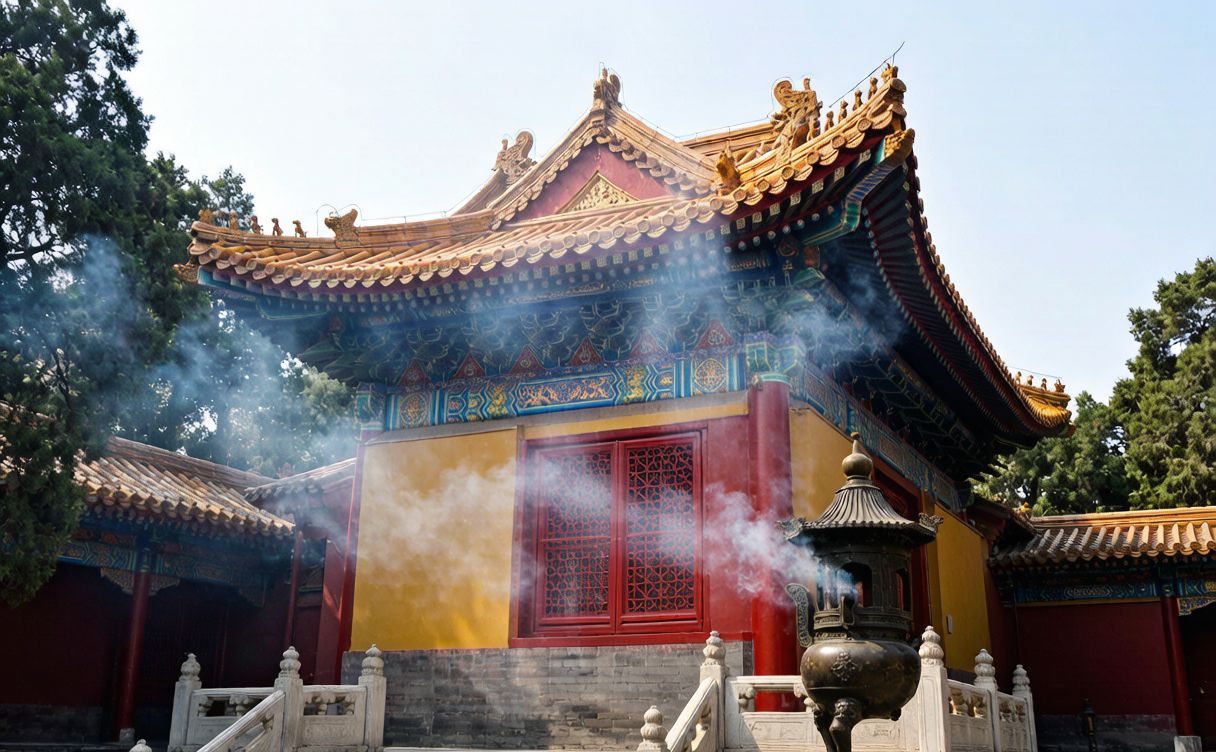
That dual identity is why the architecture doesn’t look like a typical Han Chinese temple. The roofs are topped with imperial yellow glazed tiles — a color reserved for the emperor — yet the halls are laid out and decorated in the Tibetan style, with rinpung (mandala) murals, esoteric frescoes, and statues you won’t see anywhere else in the capital. The imperial yellow tiles are why locals still call it a “gong” (palace) rather than a plain “si” (temple).
How the Visit Flows: Five Halls on One Axis
Unlike the Forbidden City’s sprawl, the Lama Temple is a straight shot — five halls along one central axis, each bigger and more sacred than the last. Two hours lets you actually look; a sprint takes forty-five minutes.
1. The Gate of Harmony and Peace (Yonghe Gate)
The first hall houses the Maitreya (Future Buddha) in the Chinese style and the four Heavenly Kings lining the sides, stomping demons and playing lutes. This is also where you’ll see your first big incense burners in the courtyard — more on those below.
2. Hall of Harmony and Peace (Yonghe Hall)
The main hall holds the three Buddhas of the past, present, and future (Kashyapa, Shakyamuni, and Maitreya), flanked by the 18 Arhats. The woodwork here is gorgeous, and the air is heavier with smoke the deeper you go. I lingered at the offering lamps, hundreds of them, each with a name tag of someone who paid for a prayer.
3. Hall of Everlasting Protection (Yongyou Dian)
This is the quieter hall, dedicated to the Medicine Buddha who is believed to cure illness. On my visit a woman was kneeling here for a long time, eyes closed. It’s a good reminder that for most visitors this isn’t a museum stop — it’s a personal errand.
4. Hall of the Wheel of Dharma (Falun Dian)
A pavilion-style hall built in the Tibetan pattern, with a bronze statue of Tsongkhapa, the founder of the Gelug (Yellow Hat) school. The murals on the walls depict his life. If you only read one plaque, read this one — it explains the school of Buddhism the monastery follows.
5. The Pavilion of Ten Thousand Happinesses (Wanfu Ge) — The Big One
This is why you came. Behind the last hall rises a three-story pavilion built specifically to hold a single statue: the Maitreya Buddha carved from one piece of white sandalwood, 26 meters of which are visible above the floor (another 8 meters are buried in the base). It was a gift from the seventh Dalai Lama in the 18th century, shipped from Tibet, China and carved in situ. It’s in the Guinness World Records as the largest carved wooden statue on earth. Stand at the base, look straight up through three floors of open balconies, and just let it land. I’d read the height before visiting and it still didn’t prepare me.
The Incense Prayer: How Locals Actually Do It
Here’s the part no photo captures. The Beijing Lama Temple is Beijing’s most popular place to pray for luck — exams, business, health, love. The rhythm is: buy incense at the stalls by the entrance (a bundle runs about ¥50–¥100), light three sticks at the big burner in the first courtyard, let them catch, then wave the smoke toward yourself (a symbolic “washing”). Hold the sticks between your palms at forehead height, make your wish, and bow. When they’ve burned down a little, place them upright in the burner.
A few things I learned the hard way:
– Don’t blow out the flames. Wave your hand or let them smolder — blowing is considered disrespectful.
– Three sticks = the standard offering, one each for the Buddha, the Dharma (teachings), and the Sangha (community). More isn’t better.
– The courtyard burners get packed on lucky days. If you want a calm moment, go on an ordinary weekday morning.
– Photography is fine in the courtyards but no photos inside the halls where statues are enshrined — signs are posted, and guards will remind you.
When to Go and How to Beat the Crowds
The temple opens at 9:00 a.m. and closes at 4:30 p.m. (last entry around 4:00). It’s a year-round spot, but timing changes the experience a lot. The busiest days are the 1st and 15th of the lunar month and Chinese New Year’s Eve, when locals flood in to burn the first incense of the year — atmospheric but shoulder-to-shoulder. For a calmer visit, come on a weekday in the late morning (after the 9 a.m. opening rush) or, better, read up on the best time to visit Beijing and aim for the cooler, clearer months of April–May or September–October.
If you’re building a Beijing plan from scratch, my Beijing first-time travel guide lays out how to cluster the Lama Temple with other northeast-side sights so you’re not crisscrossing the city.
Tickets, Getting There, and Nearby Sights
Tickets: ¥25 in 2026 (audio guide extra, about ¥20 if you want the full commentary). Kids under 1.2 m free; students and seniors get discounts with ID. Buy at the gate or through the official WeChat mini-program — there’s rarely a long queue except on peak prayer days.
Getting there: Take subway Line 2 or Line 5 to Yonghegong / Lama Temple Station (Exit F). You’ll surface almost at the entrance. It’s an easy half-day that pairs naturally with the Confucius Temple and Guozijian (Imperial Academy) just west of the gates — a tranquil, cypress-shaded complex that most tourists miss.
What’s nearby on the same axis:
– The Forbidden City is a 30-minute walk or short subway hop south — see my Forbidden City ticket guide for how to book the timed entry that sells out daily.
– The Temple of Heaven sits on the south side of the city and makes a perfect counterpoint — imperial Confucian ritual versus living Buddhist devotion. The Temple of Heaven guide covers it in detail.
– If you want the full sacred-sites day, the Summer Palace guide adds the Qing emperors’ lakeside retreat to the loop.
For the bigger picture — how the Lama Temple fits into a wider Beijing stay — browse things to do in Beijing for a ranked list of the city’s highlights.
A Note on the Buddhist Art You’re Seeing
Part of what makes the Beijing Lama Temple unlike any other stop in the capital is its esoteric (Tantric) imagery. You’ll see fierce, multi-armed protector deities, kiss-and-hug “yab-yum” figures representing wisdom and compassion, and wheel-and-deer emblems of the Dharma that don’t appear in ordinary Chinese temples. These come straight from the Tibetan Buddhist tradition, and they’re why the monastery has always been a place where the court engaged with the Buddhist cultures of the highlands and the steppe. You don’t need to be Buddhist — or even religious — to feel the weight of it. I’m neither, and I still left quieter than I arrived.
The official site of the lamasery, Yonghegong (Lama Temple), carries the current hours, ceremony calendar, and a short history in English if you want to go deeper before you go.
My Practical Tips After Two Visits
- Go early, go on a weekday. The 9 a.m. opening is peaceful; by 11 the tour buses land.
- Dress modestly. Shoulders and knees covered — it’s a working monastery, and you’ll be more comfortable inside the halls anyway.
- Budget two hours, not forty minutes. The sandalwood Buddha alone deserves twenty.
- Bring small cash for incense and offerings, though mobile pay works at most stalls.
- Combine, don’t isolate. Pair it with the Confucius Temple next door for a half-day of calm culture away from the mega-attractions.
- Don’t skip the side courtyards. The smaller shrines and the old locust trees are where the locals actually pray, and where I took my favorite photos.
Final Thought
The Beijing Lama Temple isn’t the loudest sight in the city, and it won’t dominate your camera roll like the Wall. But it’s the place I send people when they ask where Beijing feels alive rather than preserved. Somewhere between the sandalwood giant and the old woman with her three sticks of incense, the capital stops being a checklist. Go once, slowly, and let the smoke do the rest.