

Guizhou does not get the foreign visitor numbers that Yunnan or Sichuan do, which is exactly why the Baili Azalea forest is still one of the least crowded great flower landscapes in the country. This Baili Azalea guide covers what the place actually is: a protected plateau of wild rhododendron covering something close to 100 square kilometres across the counties of Qianxi and Dafang, in the north-west of Guizhou, China, at about 1,400 to 1,800 metres.
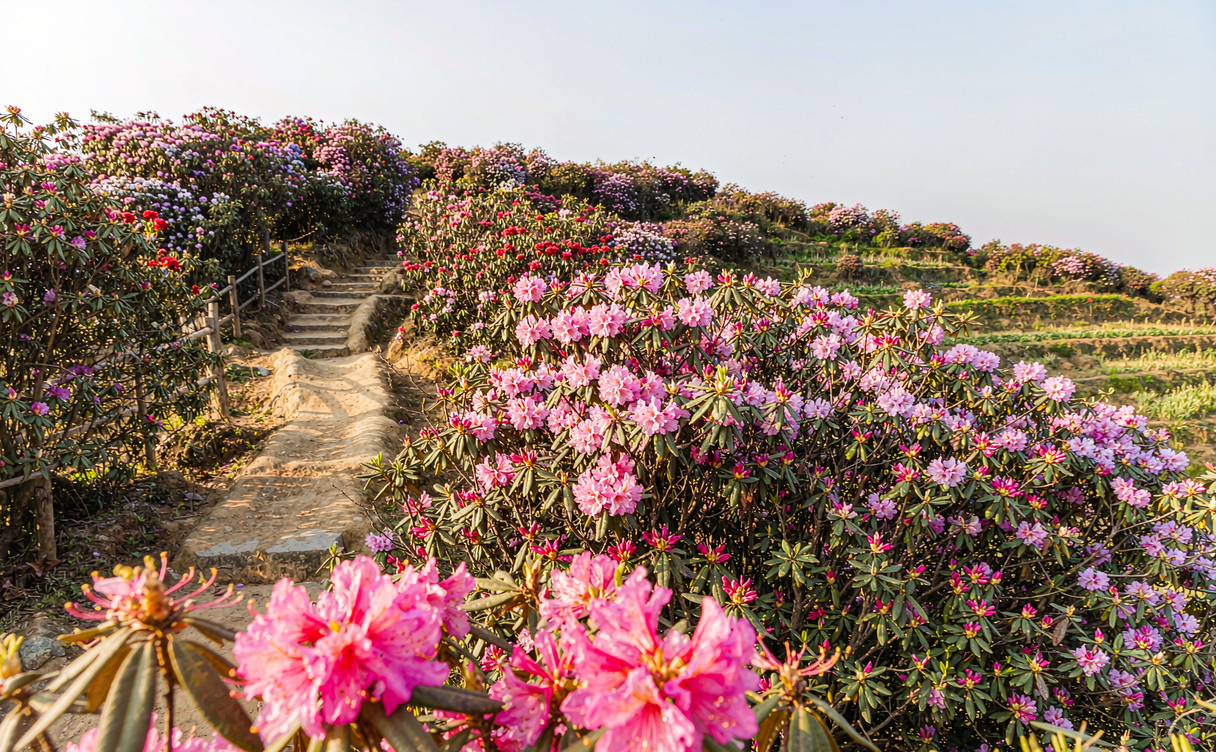
The name translates roughly as “hundred-mile azalea”, and the number is not an exaggeration. More than sixty species of wild rhododendron grow here, including the deep crimson Rhododendron delavayi that locals call the horse-rein azalea, and a few specimen trees of the azalea king that stand eight metres tall with trunks as thick as a car bonnet. Blooming runs from late March into the first week of May on the lower slopes, with the peak usually somewhere between 20 March and 10 April.
Pin your dates before anything else. A Baili Azalea guide is only useful if the weeks match the bloom, so book the train from Guiyang a month ahead if you are travelling in April, and pick a hotel in Qianxi rather than Bijie city if you want to walk to the gates.
How to Get to Baili Azalea
The honest answer to how to get to Baili Azalea is that the region has improved a lot in five years and is still easier by train than by plane.
Guiyang is the natural gateway. The high-speed line from Guiyang North to Bijie runs roughly 200 kilometres and takes around one hour twenty on the fastest services, with stations a little longer. From Bijie station it is about 40 to 60 kilometres to the scenic area depending on which gate you use, which is a one-hour drive on the new expressway.
If you are coming from Chengdu, the Chengdu–Guiyang line goes through Bijie as well, and the whole trip is around three hours. Chongqing works on the same corridor. Direct flights into Bijie Feixiang Airport exist but the schedule is thin, so most foreigners connect through Guiyang.
Two entrances matter:
- Qianxi entrance (Dujuan Lake / Azalea Lake). The one most tour buses use, with the boardwalks, the lake, and the widest flower terraces. About 50 km from Bijie city.
- Dafang entrance (Jinpo and Pudi). Further from Bijie, quieter, with the famous single azalea king tree and better walk access to the forests behind it.
If you only have one day, take the Qianxi gate. If you have three, do both.
Best Time to See Baili Azalea
Late March to early May. That is the whole answer, but the detail matters more than anywhere else in China, because the best time to see Baili Azalea moves with the weather and the altitude.
The bloom pushes uphill from the valley floor. In a warm year the low slopes near Dujuan Lake come out from around 20 March and the higher ridges in Dafang hold flowers until mid-May. In a cold or wet spring everything shifts two weeks later, and Guizhou springs are often cold and wet — the local saying “three days of sun, three days of rain” is not funny when you are standing on a boardwalk in a drizzle.
Practical guidance:
- Early to mid April. Highest chance of full bloom across both parks. Also the busiest.
- Late March. Lower slopes only, fewer visitors, and the surrounding fields still have rapeseed flower running alongside the azalea.
- Late April to early May. Upper slopes and the Dafang section, thinner crowds, higher price on some guesthouses.
- May to October. No azaleas. Nothing to see flower-wise, but the boardwalks stay open and the karst hills are green.
Rain is not a reason to cancel. It is a reason to bring a proper rain shell and shoes with grip, because the boardwalks get slick and the slopes below them turn to mud within an hour of sustained rain.
Things to Do at Baili Azalea
The list of things to do at Baili Azalea is short, because the place asks for a slow pace rather than a queue of sights. Most visitors stay four or five hours and leave satisfied; the better days run longer. The Baili Azalea forest in Guizhou, China covers a plateau of wild rhododendron that has never been formally planted, so every hillside you photograph is a natural stand.
Walk the Dujuan Lake boardwalk. Flat, easy, about two hours round trip, with the water reflecting the bloom on calm mornings. Go first thing.
Climb to the terraces above the lake. Steeper, about 300 metres of climb, and the payoff is the reason people come: hillside after hillside of red in the same direction you look.
Find the azalea king. In the Dafang Pudi section there is a protected wild rhododendron that local guides will point out. It is not a spectacle in the “photo op” sense, and that is better.
Hire a local guide for a non-boardwalk walk. Villagers around Jinpo still lead half-day treks into the secondary forest where the species mix is richer. It costs modestly and it puts money into a village that lives off the season.
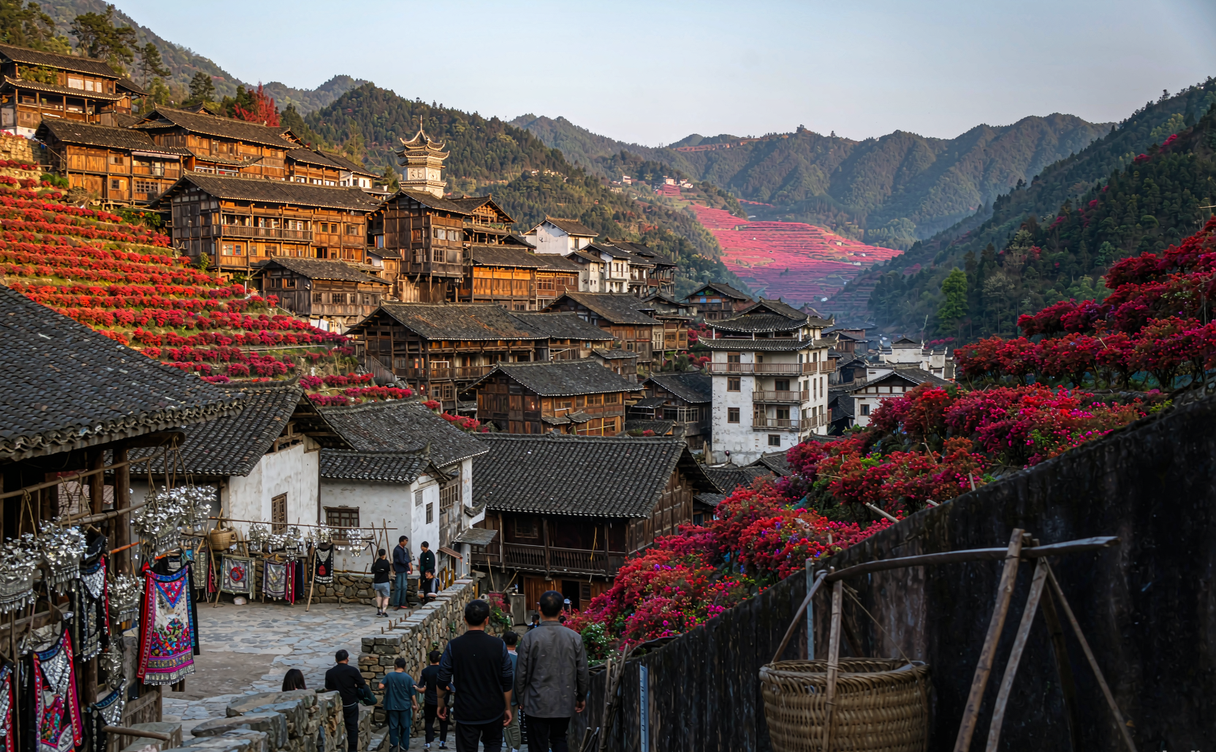
Stay for the minority ethnicity villages. Miao, Yi and Bai households live around the park edges. The Xijiang Miao village guide explains the wider Miao experience in Guizhou if you want to understand what you are passing.
Combine with a cave. Zhijin Cave, one of the largest karst cave systems in China, is about an hour from the park. Most three-day itineraries squeeze it in.
A Baili Azalea Itinerary for Three and Five Days
Here is a Baili Azalea itinerary I would recommend for a first visit.
Day 1 — Guiyang to Qianxi. Morning train to Bijie, private car to your guesthouse in Qianxi, late afternoon walk to the park boundary to check the bloom status, dinner locally.
Day 2 — Dujuan Lake and the terraces. Full day in the park. Boardwalk at seven in the morning, climb after breakfast, back for lunch, second walk late afternoon when the light goes flat and warm.
Day 3 — Dafang (Jinpo and Pudi). Second gate, the azalea king, and the quieter ridges. Return to Qianxi or move to Bijie city for the night.
Day 4 — Zhijin Cave or 九洞天. Pick one. Cave in wet weather, the river canyon in dry weather.
Day 5 — outward. Onward to Anshun and Huangguoshu Waterfall, or back to Guiyang for a flight.
If you have two more days and want the province as a whole, the Guizhou seven-day itinerary stitches this park into a longer loop.
Decide the park gates, not just the dates. Book the Qianxi guesthouse if you want a short walk to the entrance, or the Dafang side if you want to be alone on the ridges. Write down the two or three species you most want to see, then check with the park office on arrival whether they are out this week.
Where to Stay
Three options, in order of how much you actually see.
Qianxi county town. Small, busy during bloom, closer to the main gate, with a handful of hotels and a lot of guesthouses. Prices jump hard between the shoulder weeks and the peak: expect 120 to 200 RMB in early April and over 400 in the last weekend before the bloom fades.
Inside the park near Dujuan Lake. Limited and often booked out by package groups, but it removes an hour of driving each way. Ask whether the room has a window that opens and an inside bathroom.
Bijie city. Forty to sixty minutes from either gate, with proper hotels, a mall, and a real airport. Choose this if your train lands late or leaves early.
Book by phone or through a Chinese travel app, not by email, and confirm the cancellation policy. Owners here are straightforward and will tell you honestly whether the flowers are out this week — they will also tell you if they are not.
Eating in Bijie
Bijie food is underrated outside the province. The signature is the luo guo, a cast-iron griddle with a little oil in the base and a pile of chopped offal, potato, noodles and greens that you cook yourself at the table. It is social, it is greasy, and it costs around 40 to 60 RMB a head.
Other things worth ordering: beef rice noodles for breakfast, buckwheat jelly with chilli and vinegar, and a sour fish soup that uses the local sour bean starter rather than the pickled mustard greens you get in the east of the province.
If you have a day in Guiyang before or after, the Guizhou food guide lays out the province-wide staples and how to order them.
Mistakes to Avoid
Do not come in June expecting flowers and blame the guide. Season is the single biggest variable.
Do not trust a single forecast site for Guizhou in April. Local radar and a phone call to the guesthouse beat any app.
Do not buy the through-ticket for both sections on day one. The gates close at around 5:30 pm and the sections are 40 km apart; trying to see both properly in one day means a rushed afternoon and a tired evening.
Buy the foldable trail map at the gate. The Baili Azalea forest Guizhou information office sells one for about 20 RMB at both entrances and it marks the twelve marked walks, the boardwalk levels and the two viewing terraces. No phone app will do this, because the paths are not in the public mapping data.
Do not drive in without checking the expressway status. The road from Bijie to Qianxi is good; the older provincial road from Dafang is slower and passes through truck traffic.
For background on how this landscape fits the rest of the province’s geology, the UNESCO World Heritage Centre listing for China Danxia covers the red-bed country a few hours south of here, which is the same stone that gives the park its red soils. That entries chain of eroded sandstone and mineral bands is the family resemblance people notice between the two places.
Lock the dates, book the Qianxi room, and keep one spare day in your Baili Azalea itinerary in case the bloom arrives late. If you have a week instead of three days, add Fanjing Mountain and end the trip in Zhenyuan ancient town.
The Baili Azalea forest is at its best in the two weeks when the whole hill is one colour and the air smells like wet earth and blossom. It is not a polished attraction and it does not try to be. Come for the flowers, walk slowly, and give the boardwalk a full morning rather than an hour, and the trip will hold its shape long after the last petal drops.