

Most first-time visitors to Tibet, China fly into Lhasa, spend a few days getting used to the altitude, and then see only the Potala Palace and the Yarlung Zangbo valley before flying home. That is a safe plan and a perfectly good one, but it leaves the eastern half of the plateau almost untouched. This Ranwu Lake guide is written for travellers who have room for one more leg on the road east, because the lake at Ranwu gives you more landscape per hour than almost anywhere else in the region.
Ranwu Lake lies in Chamdo Prefecture at roughly 3,850 metres, on National Highway G318 about 260 kilometres east of Nyingchi. The water is that shocking turquoise because a glacial lake holds fine rock flour in suspension; the sun angle decides whether the surface reads as milk blue, deep green, or pale grey. Snow peaks of the Namcha Barwa and Gyala Peri massif sit behind it, and on a clear morning the whole range turns the colour of peach flesh before the light goes hard by ten o’clock.
Book your eastern Tibet, China leg before you commit to a fixed loop. Pick a window in late spring or early autumn, arrange a vehicle with a driver who has taken G318 more than a handful of times, and check whether the sections near Zayu are open. Everything else in this Ranwu Lake guide follows from those three decisions.
Where Ranwu Lake Sits, in Real Distances
Ranwu Lake, China, is a long, narrow body of water about 26 kilometres from end to end and up to five or six kilometres wide, dammed by glacial debris at its lower end. Ranwu Lake Tibet, China sits at the eastern junction of Chamdo Prefecture, and Ranwu Lake near Nyingchi is roughly a 260 km drive east of the regional city on National Highway G318. Two rivers feed it and one spills out of it, and that arrangement is why the shoreline shifts shape every few hundred metres as you drive.
The town of Ranwu — usually called Ranwu Town or Ranwu village — sits at the southwestern end where the road crosses the outflow. Baxoi (Badong) is the big junction town about 60 km west. Zayu (Chayu) county town is roughly 90 km further east, and it is the last place with a full supermarket before the road turns south into the Yarlung Zangbo canyon.
Distances that actually matter for planning:
- Nyingchi (Bayi) to Ranwu: around 260 km, five to seven hours by car on G318, longer if the road is under repair.
- Lhasa to Ranwu: roughly 700 km, typically two days with an overnight stop. Most drivers split it at either Nyingchi or a midway village.
- Ranwu to Midui Glacier viewing platform: about 20 km south on a side road, then a short walk.
- Ranwu to Zayu: about 90 km, two to three hours.
How to Get to Ranwu Lake
There is no airport at Ranwu and no railway station nearby, so every route here ends in a car. That is true of how to get to Ranwu Lake in practice: you either drive yourself with a Chinese licence (hard for foreigners to obtain) or, far more sensibly, charter a vehicle with a local driver for the whole stretch.
The road in from the west is G318, the old corridor most people still call the Sichuan route into eastern Tibet, China. It is paved and passable in a normal SUV in good weather, but it is also a working road: landslides in the wet season, short closures, occasional convoy delays at checkpoints. If you want the train leg anyway for the altitude acclimatisation it provides, read the train guide for Tibet, China first, because the rail line north to Qinghai stops well short of here and will only get you as far as Lhasa.
Three realistic ways in:
1. From Nyingchi (east entrance). Standard for most people. Fly into Nyingchi Mainling Airport, spend a night or two there, then drive G318 east. It is the gentlest altitude ramp in eastern Tibet, China.
2. From Lhasa over the passes. Longer and higher. Permits and a tougher first day; the Lhasa travel guide for Tibet, China is worth reading before you set dates.
3. As part of a Sichuan loop. Coming from Kangding or Shangri-La on the china-sichuan-tibet-highway-guide route, which is a spectacular but long way in.
Things to Do at Ranwu Lake
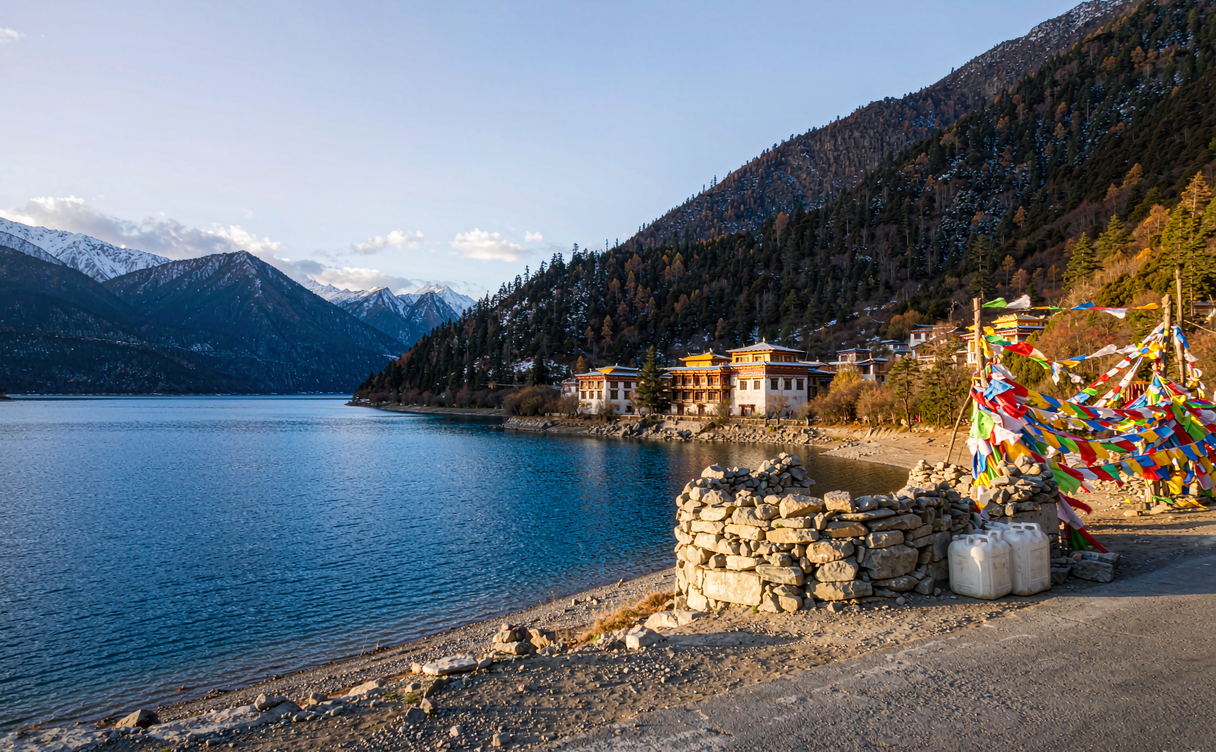
The list of things to do at Ranwu Lake is shorter than the scenery suggests, and that is the point. This is a place you drive around slowly rather than tick off a queue of attractions.
Drive the entire lakeside road. G318 follows the shore for most of the lake’s length. Pull over at the open gravel points; there are no formal car parks at several of the best views, just wide shoulders.
Go up to the rock platform above the lake. Locals call it a viewing platform; it is really a promontory of glacial till about 100 m above the water. It is the shot everyone leaves with and it takes ten minutes to walk up.
Walk to the moraine at the western end. Where the lake narrows, you can scramble onto the ridge that dams it. Go at dawn, and do not go alone with heavy rain coming.
Add a glacier day. Midui Glacier, about 20 km south, hangs down close to the road and is one of the easiest glacier views in eastern Tibet, China. The Laigu glacier group near Zayu is more remote and far more dramatic.
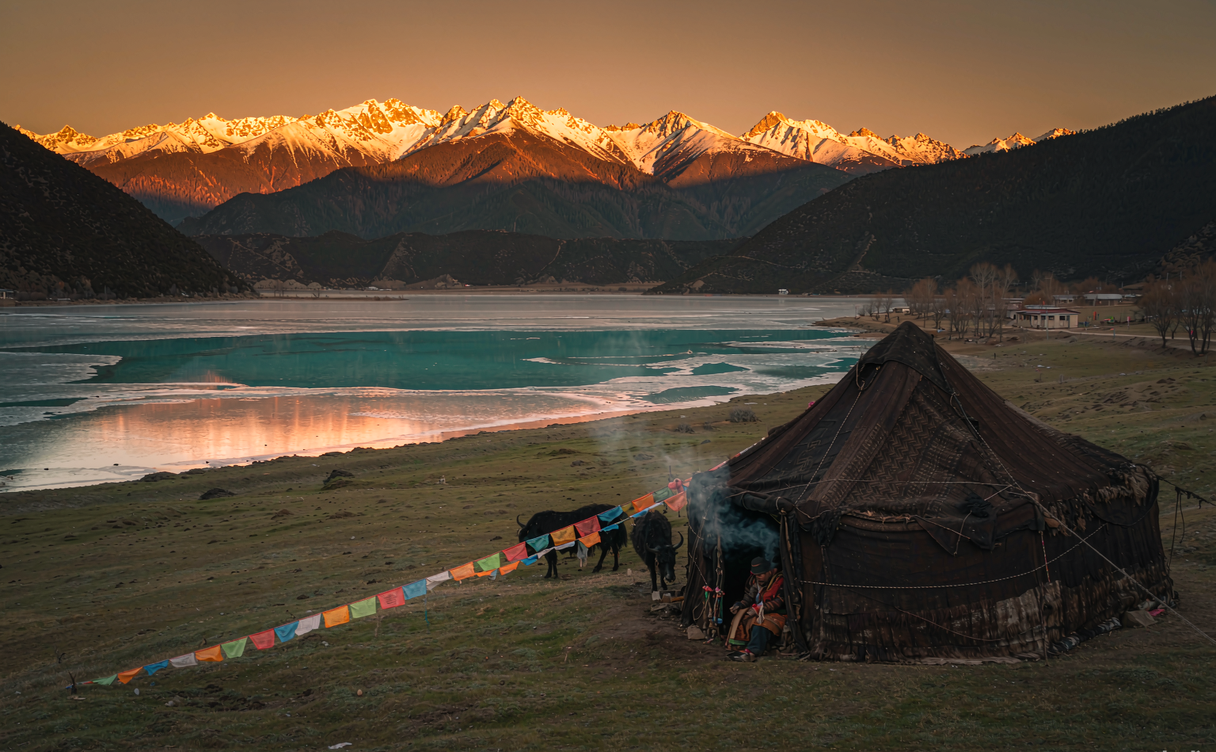
Fish, picnic, sleep in a tent. Fishing is permitted in season with a local licence; camping on the open pasture above the shoreline is common in summer and cheap. You will be asked for a small fee by herders whose yak pasture you occupy.
Photograph the horses. Ranwu’s horse breeding station keeps a stable of horses that graze the flats; a guide can arrange a short ride for a fee.
A Ranwu Lake Itinerary That Fits Five Days
Here is a Ranwu Lake itinerary that works for a first visit, without rushing the altitude.
Day 1. Arrive Nyingchi, stay indoors, drink water, sleep early. Nothing else.
Day 2. Nyingchi to Ranwu, about six hours with two stops. Check in, walk the road, first view at sunset, early dinner.
Day 3. Full day at the lake: western moraine at dawn, platform mid-morning, Midui Glacier in the afternoon, back for dinner.
Day 4. Ranwu east to Zayu, then the road south toward the Yarlung Zangbo canyon or a return west depending on your next leg.
Day 5. Long drive out — back to Nyingchi, or continue to Bomi and the eastern valleys.
Decide now whether your trip includes the peach-blossom season in the Nyingchi valleys, because April fills these roads and the small guesthouses at Ranwu fill with them too. If you are visiting in the low season, message a handful of places early and take whichever one has a working radiator and a heated bathroom.
Where to Stay and Where to Eat
Ranwu Town is small. Accommodation runs to family guesthouses and a couple of small hotels, and the standard varies year to year. What to ask for: a room facing the road end rather than the courtyard, thick curtains, and a bathroom with a real hot shower — many bathrooms here are shared and heated by wood boiler.
Prices in shoulder season sit around 180 to 300 RMB per night for a clean double; in the April and October peaks expect to pay toward 400 or to be turned away. Outside the summer months, some of the smaller places close entirely and the town half empties, which is quiet but means fewer options.
For food, the choice is simple: local fare in the guesthouses, Chinese highway stop food in the daytime, and the occasional Sichuan truck-stop kitchen serving chilli oil noodles. If you are travelling onward through the region, the Nyingchi peach blossom season guide lists a few towns where the food is noticeably better than average.
Stock up in Zayu. The supermarket there is the last reliable one for a long stretch.
Best Time to Visit Ranwu Lake
May, June, September and October are the months I would pick. Views are clear, the road is stable, and the pastures are either fresh green or turning gold.
April is special and difficult. The Nyingchi peach blossom is the draw, and the lake is still cold and sometimes half frozen at the edges, but the roads carry heavy tourist traffic and the guesthouses near Nyingchi price aggressively. Ranwu Lake Tibet, China is at its most different then: pale blue, low water, thin ice on the shallows.
July and August bring the monsoon. The lake is full and dramatic and the water colour is often at its best, but landslides close G318 for hours at a time and insurance on some chartered vehicles excludes wet-season driving. If you must come, build a spare day into your Ranwu Lake itinerary.
Winter, December to February, is genuinely cold — below minus ten at night in the town — but the road is open and you will have the lake almost to yourself.
Mistakes I Would Avoid
Do not plan Ranwu as a one-night stop between two flights. You will arrive late, see nothing, and leave before the light. Two nights minimum, three if you want a glacier day.
Do not skip acclimatisation. Three days in Lhasa or Nyingchi before G318 is not a luxury; it is what stops your first day here becoming a day in a hotel room with a headache.
Do not believe the weather forecast for the pass. Mountain forecasts here are useless beyond about twelve hours.
And one genuinely useful reference if you want to understand why the plateau moves people: China Daily’s reporting on tourism and conservation in Tibet, China covers the infrastructure changes along these roads better than any guidebook.
Make the call: add two nights at Ranwu, book the driver for the full loop, and leave one day of slack at the end for a road that does what it wants. If you are still weighing the rest of the plateau, read the Yamdrok Lake guide and the train guide for Tibet, China before you lock the dates.
Ranwu Lake near Nyingchi is barely a detour from the Nyingchi–Lhasa corridor, so there is no good reason to skip it. The lake is not a destination that rewards a checklist. It rewards a slow morning, a cold wind, and the moment the lake turns from grey to blue as the sun clears the ridge. Go for that, give yourself the extra night, and the eastern Tibet, China stretch will be the part of the trip you still think about a year later.