

The first time I saw Yamdrok Lake, I was leaning out of a minivan window at 4,900 metres, gasping less from the altitude than from the colour. Below me a ribbon of water bent around a peninsula in a shade of turquoise that has no business existing outside a chemist’s shop. I had read every superlative written about this place, and they were all wrong — the lake is better. If you are building a Tibet trip around Lhasa, Tibet, China, this is the single half-day excursion I would protect with my life. Here is everything I have learned after three visits, including the mistakes.
Where Yamdrok Lake Actually Is
Yamdrok Lake (Yamdrok Yumtso, or 羊卓雍错 in Chinese) sits in the Tibet Autonomous Region of China, about 110 kilometres southwest of Lhasa, Tibet, China. It is one of the three sacred lakes of Tibet, China, alongside Namtso and Manasarovar. Unlike those, Yamdrok is shaped like a sprawling, tangled river delta frozen mid-flow — a vast inland lake that coils around green hills for more than 70 kilometres of shoreline.
Most travellers reach it on a loop road that climbs over the Gambala Pass (Gangbala, 岗巴拉山口) at roughly 4,990 metres before tumbling down to the lakeshore. The drive from central Lhasa takes around two hours without stops, but nobody does it without stops. Plan for a full morning or afternoon, and treat the return as part of the experience.
The Viewpoint That Matters: Gambala Pass
If you remember one thing from this guide, make it this: the classic postcard shot of Yamdrok is taken from the Gambala Pass overlook, not from the water’s edge. The road switchbacks up the mountain, and at the top there is a paved viewing platform where the whole lake unfurls below you in a single, devastating panorama. This is where every tour bus stops, and for once the crowds are justified.
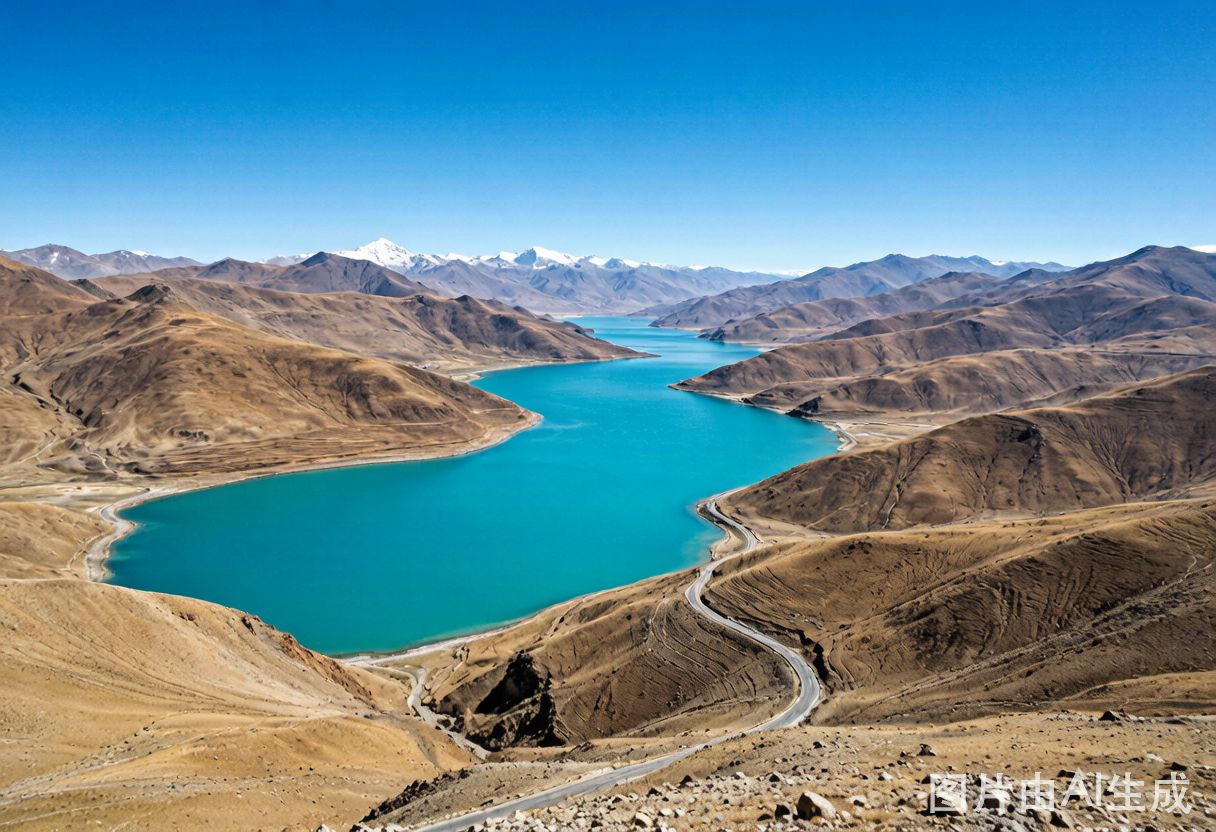
I arrived at the pass at 9 a.m. on a clear June morning and had the upper platform to myself for ten minutes before a tour group arrived. The light at that hour is flat and forgiving; by noon the glare off the water is merciless. Tip from experience: the smallung fenced platforms slightly below the main lot offer a cleaner foreground without the railings in your frame. Locals will wave prayer flags and ask for a photo fee at some spots — a few yuan is fair and supports the families who keep the area tidy.
A note on the lower lakeshore stops: many drivers will push you toward a “private beach” or yak-photo spot at the water line. These are commercial and underwhelming compared with the pass. Go if you want a yak selfie; skip if you want the view.
Getting There from Lhasa
Yamdrok is the easiest serious day trip out of Lhasa, Tibet, China, and that is exactly why it works as a first taste of the Tibetan plateau.
Self-drive or private car. This is what I recommend. A private car with a driver for the loop (Yamdrok + often the nearby Karola Glacier) runs roughly 600–900 RMB for the vehicle, split between passengers. Your hotel in Lhasa can arrange it, or you book through a Tibetan-run agency. The freedom to stop at unnamed switchbacks on the way up is the entire point.
Tour group. Every Lhasa hostel and travel desk sells a Yamdrok day tour for around 200–400 RMB per person. Cheap, social, and efficient — but you get the fixed 20-minute stop at the pass and little else. Fine for a tight budget or solo travellers who want company.
Public bus. There is no clean public bus that does the loop as a tourist run; the local buses heading toward Gyantse pass through but do not wait. Not worth the hassle for a first visit.
Whichever you choose, you will pass the Gambala Pass, descend to the shore, then usually continue toward the Karola Glacier or loop back to Lhasa. The full loop is about 250 kilometres.
The Altitude Is the Real Story
I want to be blunt here, because nobody warned me properly the first time. The Gambala Pass sits at nearly 5,000 metres. Lhasa itself is already 3,650 metres. If you have just flown into Lhasa from sea level, attempting Yamdrok the next morning is how people get wrecked.
My rule, earned the hard way: spend at least two full days in Lhasa, Tibet, China, acclimatising before any excursion above 4,500 metres. Walk slowly, sleep well, drink water like it is your job, and skip the alcohol for the first 48 hours. At the pass I have seen fit travellers bent over panting; the combination of exertion (the platform is a short but steep walk from the car park) and thin air is no joke.
If you feel a pounding headache, nausea, or dizziness at the viewpoint, do not push for more photos — get back in the vehicle and descend. The symptoms usually ease within 30 minutes of dropping a few hundred metres. Carry Diamox if your doctor approves it, and know that the small shops at the pass sell oxygen cans (a gimmick, but they soothe nerves).
Best Season to Visit
Yamdrok changes personality with the months, and I have now seen it in three seasons.
- Late April to June. My favourite window. The winter snow has cleared from the passes, the air is crystal dry, and the tourist numbers are still low before the July rush. The turquoise is at its most saturated against the brown hills.
- July to August. Peak summer, also the rainy season. You get lush green valleys and the lake a deeper blue-green, but afternoon clouds can sock in the pass and hide everything. Go early in the morning to beat both crowds and weather.
- September to October. Excellent. Crisp, stable skies and the sharpest light for photography. Nights get cold.
- November to March. Raw, windswept, and often blocked by snow at the pass. Beautiful if you are hardy and lucky, but tours frequently cancel.
For most foreign visitors, I suggest timing your Tibet leg for May, June, September, or October. If you are also planning a wider China sweep, our best-time-to-visit-china guide lays out the national picture month by month.
What to Bring and How to Dress
The plateau weather swings 20 degrees between sunrise and noon. At the pass the wind cuts straight through a hoodie. I pack:
- A windproof jacket, even in summer — the pass is brutal.
- Sunglasses and high-SPF sunscreen. The UV at 5,000 metres burns you through cloud.
- A refillable water bottle.
- Small cash (yuan) for toilet fees, prayer-flag blessings, and yak photos.
- A camera with a polarising filter if you care about the colour; it deepens the turquoise wonderfully.
There are basic toilets at the pass (bring your own paper) and a few snack stalls. Do not expect restaurants at the lake itself — eat a solid breakfast in Lhasa before you leave.
Permits and Practicalities
Foreign travellers to Tibet, China, need more than a Chinese visa. You must obtain a Tibet Travel Permit (外人旅行证), which can only be arranged through a registered Tibetan travel agency as part of a guided trip — independent travel is not permitted for foreigners in the Tibet Autonomous Region. The permit takes roughly 15–20 days to process, so fold it into your China planning early. Once you have it, Yamdrok as a Lhasa day trip is straightforward.
You will also need your passport and the permit with you on the drive; there are police checkpoints on the Lhasa–Yamdrok road where documents are inspected. Keep them handy in the glovebox.
Why It Belongs on Your Itinerary
Yamdrok is not a “filler” stop. For many travellers it is the moment Tibet, China, clicks — the high, silent, impossibly coloured world that the flights and permits were all in service of. I have watched jaded backpackers go quiet at the pass. Pair it with two or three days in Lhasa, Tibet, China, to see the potala-palace-lhasa-guide, and you have the spine of a genuinely moving trip.
If you want the full context before you fly, our lhasa-tibet-travel-guide covers permits, acclimatisation, and the city’s other must-sees in detail. And if the sacred-lake bug bites, our qinghai-lake-travel-guide describes Tibet’s other great high-altitude lake over in neighbouring Qinghai Province — a different mood, same thin air.
For a broader China route that could include Tibet alongside the Silk Road and Sichuan, the xian-travel-guide is a natural next stop, since most travellers fly into Xi’an before hopping a connecting flight to Lhasa.
One more piece of context worth reading before you commit: the authoritative overview of the lake’s geography and cultural status from Encyclopedia Britannica remains the best neutral background for first-time visitors — Britannica: Yamdrok Yumtso. I read it on the plane and it set the right expectations about scale and significance.
A Final Word From the Pass
Stand at Gambala long enough and the buses thin out. The wind takes the last of the chatter. Below you the lake holds its colour without explanation, and somewhere a bell or a prayer wheel marks the fact that this water has been sacred here for more than a thousand years. That, not the photo, is the thing to bring home.