

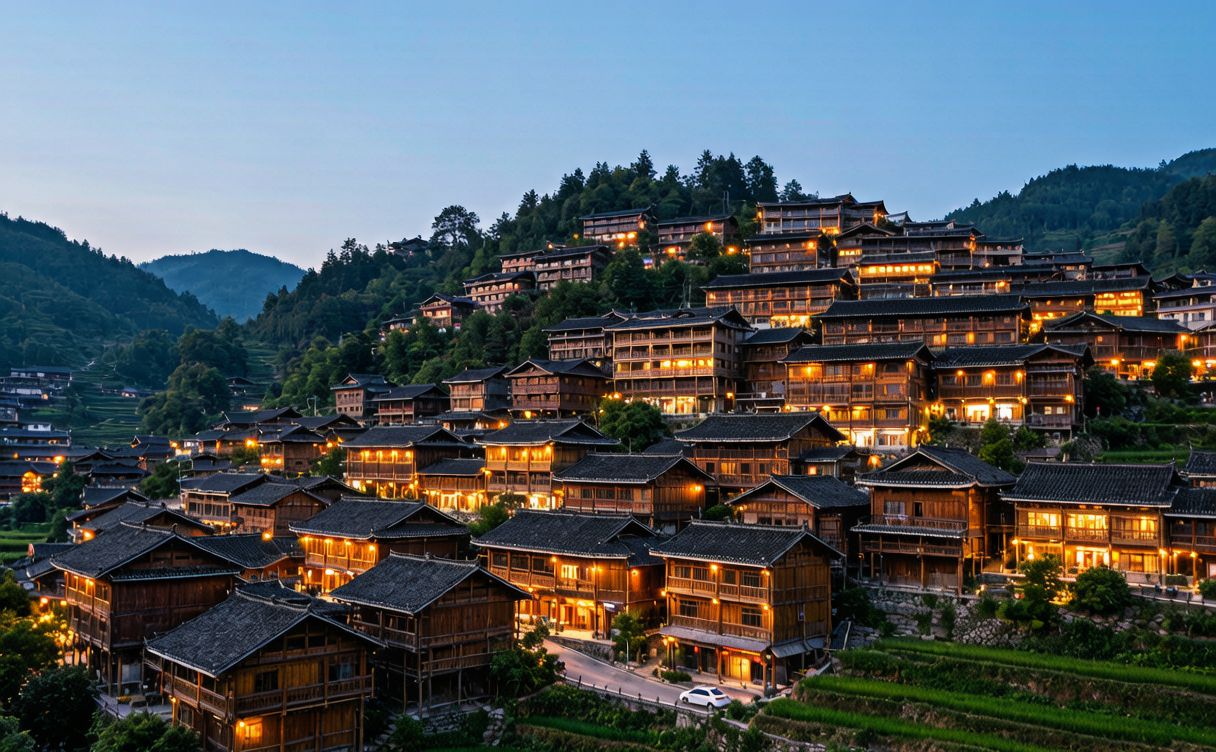
When I first climbed the viewing platform above the Baishui River and looked down at Xijiang Miao Village, I stopped talking for a full minute. More than 1,000 wooden stilt houses, stacked in tiers up both hillsides, glowed gold against the dark valley. This is Xijiang Miao Village (also called Xijiang Thousand Households, or simply Xijiang Miao), the largest Miao settlement on earth, and it is one of the most photographed places in all of Guizhou Province.
I had come expecting a postcard. What I got was something livelier: a working village where Miao families still live in theirstilt houses (diaojiaolou), where grandmothers in pleated skirts smoke long pipes on the steps, and where the nightly light show turns the whole mountain into a lantern. If you are building a Southwest China route, this stop earns its place.
Getting There from Kaili
Almost every foreign visitor reaches Xijiang Miao Village through Kaili, the capital of Qiandongnan Miao and Dong Autonomous Prefecture. I flew into Guiyang first, then took a high-speed train to Kaili South Station (about 40 minutes, ¥60). From Kaili, the village is roughly 35 km away, and this is where the practical planning begins. If you are looping in from Sichuan, our Chengdu Dufu Cottage guide makes a good bookend, since both stops reward travelers who slow down and read the culture rather than rush the photos.
Your easiest option is a direct shuttle bus from Kaili South Station to the Xijiang scenic-area parking lot. Buses leave regularly and cost around ¥25 one way; the ride takes about an hour on a winding mountain road. A Didi or private car will run ¥120–180 and is worth it if you are travelling with luggage or a group.
Buy your combined entry-and-shuttle ticket online or at the gate (around ¥110 including the four internal shuttle rides). Keep the ticket handy: you scan it to ride the free buses between the upper viewing platform, the riverfront, and the parking lot. I arrived mid-afternoon, dropped my bag at a guesthouse inside the village, and still had time to catch the sunset from the top platform the same day.
What to See
The heart of Miao Village Guizhou is the Baishui River, which splits the settlement into two banks linked by several stone bridges. The north bank is the tourist spine: restaurants, silver shops, and the main performance square. The south bank climbs toward the best viewpoints.
Walk the riverside first. The wooden stilt houses here are the real thing, not props. Each is built on timber posts driven into the slope, with the lower level left open for storage or livestock and the family living above. The density is what stuns you. House after house steps up the hill in a patchwork of weathered planks and tiled roofs, and every rooftop lines up with the one behind it like a giant staircase. If you enjoy this kind of traditional wood-and-water architecture, our Suzhou Lion Grove Garden guide shows the polished, scholar-built side of it, a neat contrast to Xijiang’s raw mountain village.
Climb to the observation deck on the south side. This is the classic postcard angle, and it is best in the blue hour just after sunset when the village lights switch on. I spent two evenings there; the second time I brought a small tripod and finally got the long-exposure shot I wanted.
Don’t miss the wind-and-rain bridges (风雨桥), covered footbridges with carved railings where locals sit in the evening. And if your legs allow, the short hike up to the viewing pavilion above the south bank gives you the widest panorama of all.
Wander the north-bank lanes behind the main street, too. Here the tourist gloss thins out: you’ll pass washing strung between posts, a tofu maker’s steam, and kids kicking a ball on a terrace. I liked this maze more than the square because it showed the village as a home rather than a stage. The small Guizhou Ethnic Museum on this side is worth 30 minutes if you want the backstory of the embroidery and batik you see for sale everywhere.
Miao Culture
Xijiang is home to the Xijiang Miao branch of the Miao people, and the culture here is worn, not hidden. The single best window into it is the Miao silver. Miao silversmiths hammer sterling silver into enormous feather-shaped headdresses, neck rings, and breastplates that can weigh several kilos. On festival days, women wear full sets that jangle as they walk. You can watch smiths at work in the lanes behind the main street and buy pieces by weight.
The other signature is the lusheng (芦笙), a reed pipe instrument played in circles. Every evening (and especially on holidays) a lusheng performance fills the central square: dozens of players in costume stamp and spin while the pipes wail a rhythm that pulls the crowd in. I caught one after dinner and ended up clapping along at the edge of the circle.
Two more experiences are worth your time. The Miao courtesy welcome, with rice wine and a blocking song at the gate, greets tour groups most mornings. And the Guizhou Ethnic Museum inside the village lays out the embroidery, batik, and farming tools of the local branches. Try the sour fish hotpot and the sticky glutinous rice wrapped in leaves. The sour, fermented flavor is the taste of Qiandongnan, and I still think about that first bowl.
Tips
A few things I wish I had known before I went:
- Stay inside the village. Guesthouses on the riverbank cost a little more but save you the shuttle ride back each night. The lantern-lit walk home across the bridge is part of the magic.
- Go up early. The viewing platform is packed at sunset. I went up at 6:30 a.m. once and had the whole railing to myself, with mist still in the valley.
- Carry cash. Most shops take Alipay, but the small silver stalls and roadside snack grannies often prefer notes. See our cash-in-China explainer if you are unsure.
- Mind the steps. The lanes are steep and slippery after rain. Wear grippy shoes, not flip-flops.
- Avoid the big holidays. During May Day and National Day the village swells past comfortable. A mid-week visit in shoulder season felt calm and real.
- Book the guesthouse by message. Many riverside hosts list on the apps but confirm by phone or WeChat. I arranged mine the day before and got a room ten steps from the bridge for ¥220.
- Sort your photos early. The famous switch-on happens around 7 p.m. in summer and 6 p.m. in winter. Be on the platform 30 minutes before to claim a spot before the tour groups arrive.
Best Time
The best months are April to June and September to early November. Spring brings green terraces and fewer crowds; autumn gives clear air and golden rice on the surrounding hills. I went in late May and had warm days, cool nights, and empty viewpoints by morning.
Summer (July–August) is lush but wet and busy with domestic tourists. Winter is quiet and cold, yet the off-season light and faint chance of snow on the rooftops make it a photographer’s secret. Whatever you pick, aim for at least one full night so you can see both the daytime lanes and the switched-on mountain after dark. If you can, time your trip to a local market day in nearby Langde or a Miao festival such as the New Year (usually in autumn by the lunar calendar), when the costumes and lusheng music reach their peak.
Good to know
Xijiang Miao Village sits in LeiShan County, about 1,000 meters above sea level, so nights are cooler than the lowlands even in summer. The scenic area is well signed in both Chinese and basic English, and the visitor center can arrange licensed English guides if you want deeper context on Miao silver and batik. For official opening hours, ticket prices, and festival dates, check the Guizhou Provincial Culture and Tourism Department before you travel, since schedules shift with the season.