

I still remember the first time I stepped into Lion Grove Garden and got completely turned around within five minutes. I had a map, a phone, and a clear idea of where the exit was — none of it helped. That is the whole point of the place. Of the four great gardens of Suzhou, Lion Grove (Shizilin to locals) is the one that plays with you, and the one I now send every first-time visitor to when they want to understand what a classical Suzhou rock garden actually feels like.
Built in 1342 during the Yuan dynasty by a Buddhist monk, the garden was named after its strange, lion-shaped Taihu rocks. Centuries later it still feels like a puzzle you walk through rather than a pretty park you look at. If you are planning a trip to Jiangsu, treat this as a non-negotiable stop, and pair it with the Suzhou travel guide I put together for the wider city.
Getting There
Lion Grove Garden sits in the northeastern corner of Suzhou’s old city, at 23 Yuanlin Road, just a few minutes on foot from the far more famous Humble Administrator’s Garden. I usually tell people to do both in one morning, because they sit almost next to each other and show two completely different ideas of what a garden should be.
If you arrive by high-speed train, Suzhou Railway Station is the one you want. From there it is a short taxi ride or a 20-minute walk south into the old town. The gardens are also an easy stop on the way to or from the canal streets of Pingjiang Road. Avoid driving yourself — the old city streets are narrow, parking is scarce, and you will waste the morning circling.
The garden opens early, around 7:30 in summer and 7:00 in winter, and I strongly suggest being at the gate when it opens. By 10 a.m. the tour groups arrive and the rock maze turns from a meditative wander into a traffic jam. There is an entry fee, usually in the 30 to 40 yuan range depending on season, and it is cashless — bring Alipay, WeChat Pay, or a card that works with local QR systems.
What to See
Before you dive into the rocks, walk the perimeter and look at how the garden is built. A classical Suzhou garden is never a random collection of pretty things. It is a carefully composed scene where every window, wall, and bridge is placed to frame a view, like a scroll painting you move through.
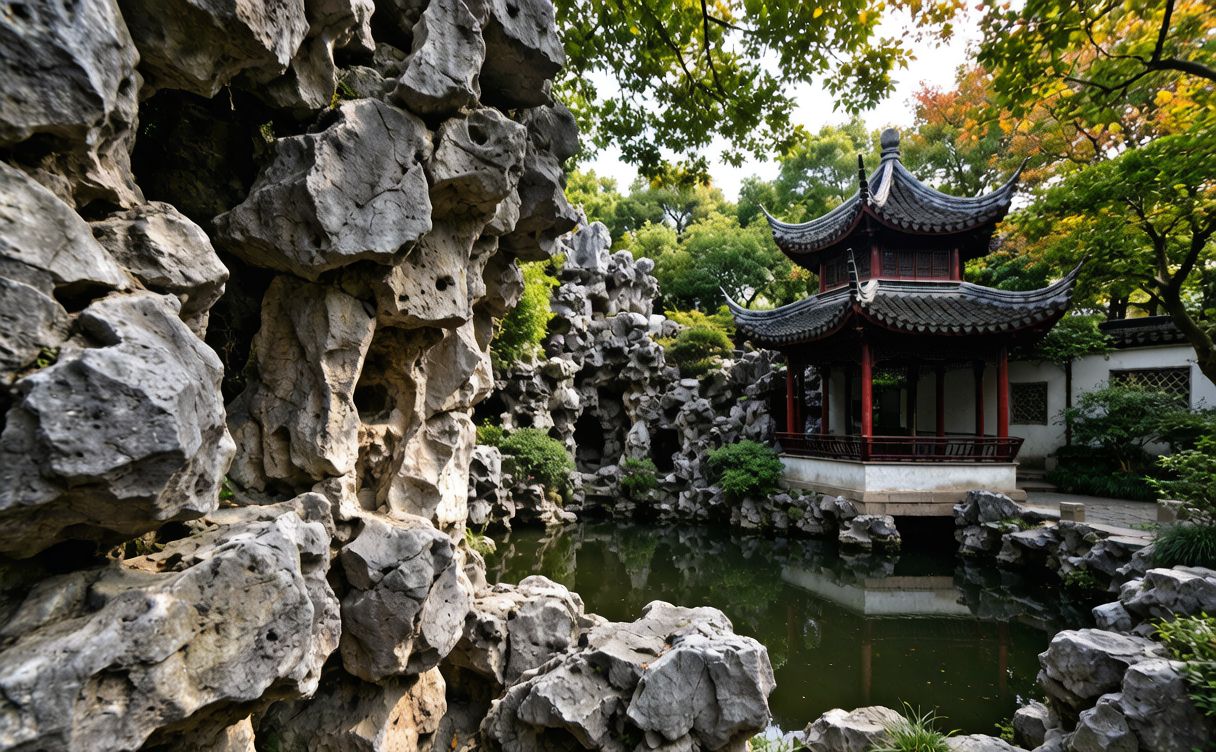
The main pond sits at the center, with a zigzag bridge crossing it. I love standing on that bridge early, before the crowds, when the water is still and the rockery reflects perfectly. Around the water you will find the Mind-Testing Study (Wenmei Xuan), the Standing-in-Snow Hall, and the Finger-Flicking Peak — the single tallest rock, said to be the most lion-like of them all.
The buildings here are quieter than the rocks but worth your time. The pavilions have carved wooden screens, the corridors have lattice windows you can peek through, and the inscriptions on the walls tell you which emperor or poet admired this exact spot. Qianlong, the Qing emperor who loved Suzhou, visited eight times and copied the layout for a garden inside Beijing’s Summer Palace. When a garden impressed him that much, you know you are in the right place.
The Rock Maze
This is the reason Lion Grove exists, and the reason I keep coming back. The rockery covers about half a hectare and uses roughly nine hundred tons of Taihu stones — the porous, water-worn limestone dredged from Lake Tai. Carved by nature over millennia and then stacked by master gardeners, the rocks form caves, tunnels, and narrow stairs that loop over and under each other.
I have walked it a dozen times and I still find a new turn. The paths climb to small peaks, drop into shadowy grottoes, and open onto unexpected viewpoints of the rooftops below. Kids absolutely lose their minds here — it is the closest thing China has to a natural jungle gym, and it is several hundred years old. Adults tend to get a slightly competitive gleam and try to find the fastest route from the north rocks to the south pavilion. (There is no fastest route. That is also the point.)
Take your time in the maze. Sit on one of the ledges, listen to the echoes, and watch how the light changes through the holes in the stone. The Taihu rocks are full of these natural windows, and the gardeners used them like lenses onto the rest of the garden. It is a small space made to feel vast, which is the oldest trick in Chinese garden design and the one Lion Grove does best.
Tips
A few practical things I wish someone had told me before my first visit.
Wear real shoes. The rock steps are uneven, sometimes slippery after rain, and there are no handrails in the older sections. Sandals are a bad idea.
Go with the flow — literally. The maze is not signed, and trying to follow a fixed plan just frustrates you. Pick a direction, follow your curiosity, and accept that you will loop back on yourself. That disorientation is the designed experience.
Bring water and a fully charged phone, but resist the urge to navigate by screen. The GPS does not work inside the rockery, and looking down at a map means missing the view up. If you get separated from your group, agree on a meeting spot at the pond before you go in.
Photography is allowed and the garden is gorgeous, but the best shots are early. By midday the light flattens and the crowds fill every frame. If you want that classic empty-garden photo, the first forty minutes after opening are gold.
If you enjoy this kind of garden, you should also see a cave system of a different sort at Guilin Reed Flute Cave or the Republican-era architecture in Nanjing Presidential Palace — both show very different sides of China’s built heritage.
Best Time
Suzhou has four real seasons, and Lion Grove looks different in each. I have been in late March when the garden’s old trees put out soft new green and the tourist numbers are still low — that is my favorite window. April and May are lovely but busier. Summer is hot and humid, and the rock maze holds the heat, so go at open or near closing. Autumn, especially late October and November, brings clear skies and good light for the rooftops and stone. Winter is cold but magical after a light snow, when the rocks turn white and the crowds vanish.
Avoid Chinese public holidays entirely if you can — the week around National Day in early October and the Spring Festival period turn every Suzhou garden into a shoulder-to-shoulder crush. For a calmer trip, aim for a weekday in the shoulder seasons.
Lion Grove pairs naturally with a wider Yangtze Delta route. Most visitors combine it with Hangzhou’s West Lake, an easy hour away by train, and you can plan that leg using the Hangzhou travel guide. If you want to see more water towns and old streets, the Best ancient towns in China list has several near Suzhou worth a full day each.
Good to Know
Lion Grove Garden is part of the UNESCO-listed Classical Gardens of Suzhou, inscribed as a World Heritage Site for its outstanding representation of Chinese landscape garden design. You can read the official description and the full list of component gardens on the UNESCO Classical Gardens of Suzhou page. Knowing that this small, dizzying maze of rocks is protected at that level changed how I look at it — every stone is part of a living tradition stretching back seven hundred years. Budget ninety minutes to two hours here if you want to do the maze twice and sit by the water. Add it to a Suzhou day that also covers the Humble Administrator’s Garden and Pingjiang Road, and you will have seen the best of the old city without rushing.