

People treat Zhuhai as the quiet gateway to Macau, China, and then underestimate the food. I have based clients here for the border access and watched them come back from dinner surprised that the seafood was better and cheaper than the casino strips next door. This Zhuhai food guide is the short version of what I tell them: the city is a Cantonese coastal table in its own right, with oysters, river crabs, and dim sum that locals queue for, and it borrows just enough from Macau, China to make breakfast interesting.
Zhuhai sits on the Pearl River mouth in southern Guangdong, facing Macau, China across a narrow border and looking out to the open sea. The cooking is classic Cantonese — steamed, brined, and light — but the coast adds oysters, crabs, and sea bass that the inland cities do not get as fresh. You can eat at a high level here without the Macau, China prices, which is the whole point of staying on this side. Put simply, Zhuhai cuisine is Cantonese cooking with a coastal accent: the day’s catch leads, the sauces stay light, and nothing is asked to hide the seafood.
Zhuhai Seafood: Oysters and the River’s Crab
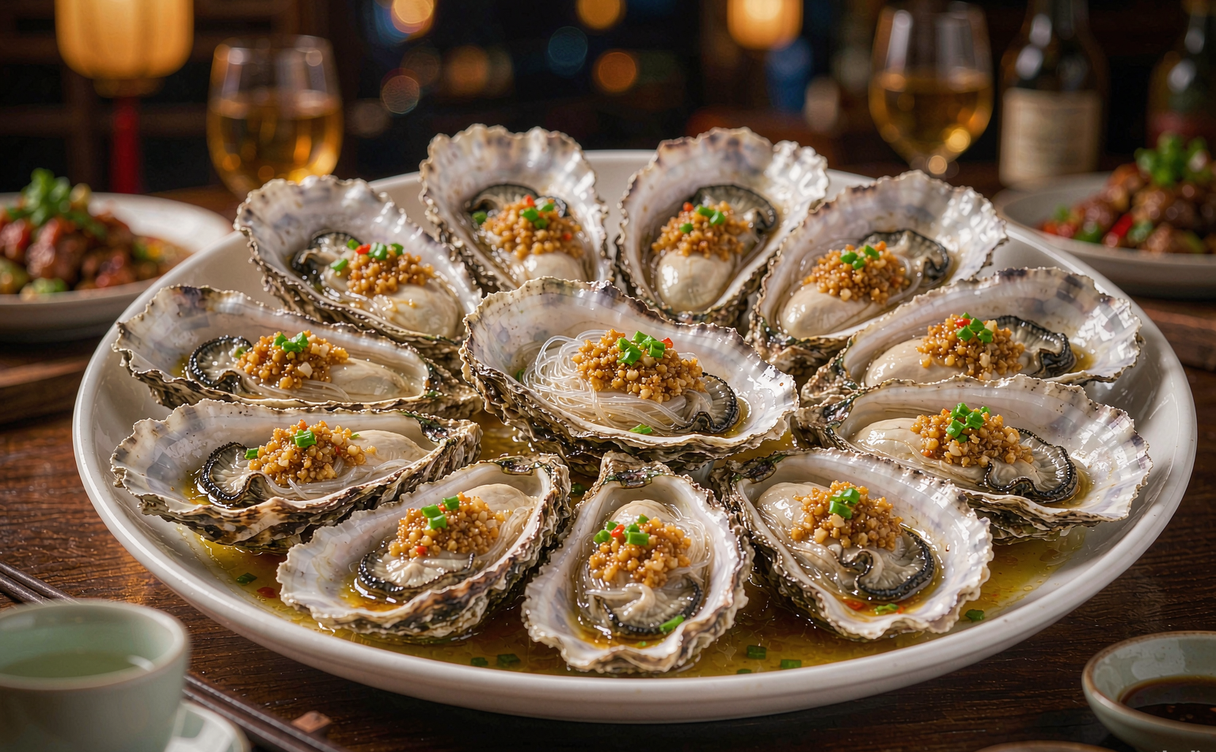
The star of Zhuhai seafood is the Hengqin oyster (Hengqin hao), farmed on Hengqin Island just west of the city center. They are plump, clean, and served every way: raw with a squeeze of lemon, steamed with garlic and vermicelli, or grilled over charcoal. A plate of steamed oysters is ¥38–68 RMB for a half-dozen, and the grilled version runs a little more. I send clients to Hengqin itself for the freshest, where the oyster houses line the water and the boats unload out front.
The second headline is the Doumen double-shell crab (chong ke xie), a local crab with a soft inner shell inside the hard one, eaten whole and prized for its sweetness. In season (late summer into autumn) a steamed crab plate is ¥88–160 RMB. Doumen also gives the city its Baijiao sea bass (hai lu), a firm, clean fish steamed with scallion and soy for ¥58–98 RMB, and the yellow-sand clams (huang sha xian) stir-fried with black bean for ¥38–55 RMB. For the wider provincial table, our Guangdong yum cha guide explains the dim sum half of this same Cantonese tradition.
Zhuhai Cantonese Food and the Dim Sum Habit
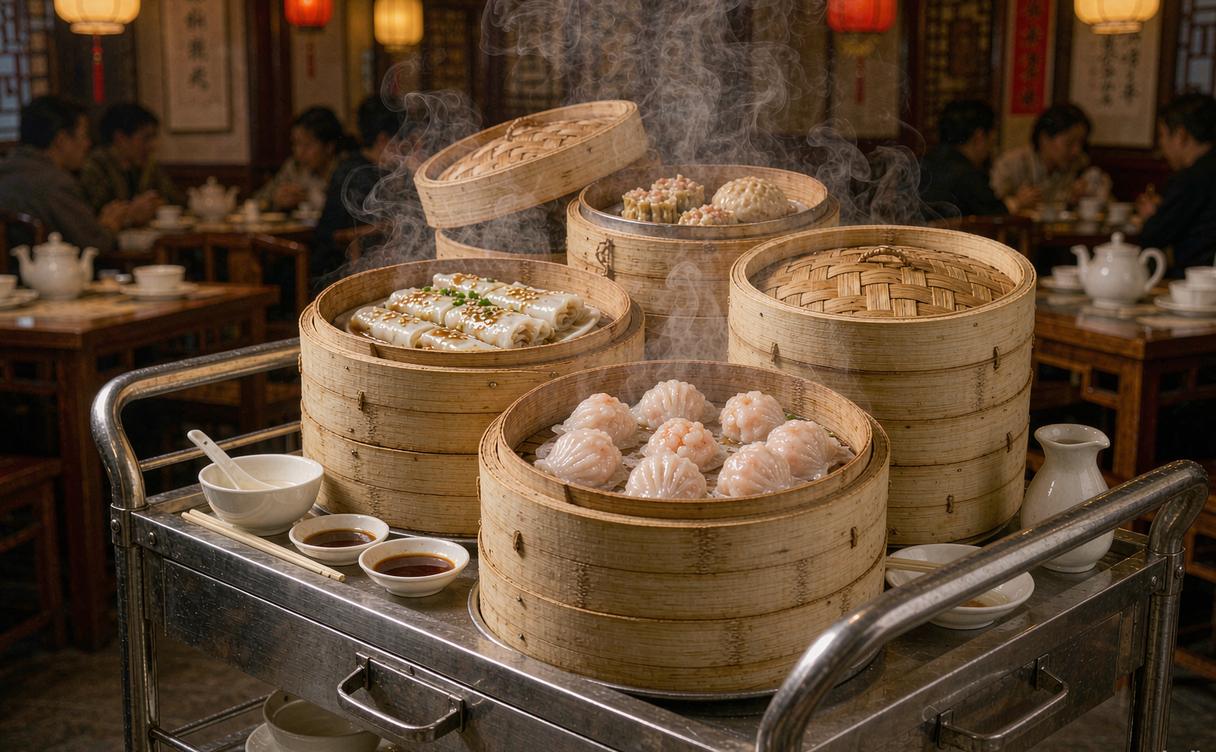
The daily rhythm is Zhuhai Cantonese food built around yum cha. Locals fill the teahouses by 8:30 a.m. for steamed shrimp dumplings (har gow), pork buns, rice noodle rolls (cheung fun), and egg tarts, and a relaxed session runs ¥40–80 RMB per person. The city’s chains — Yihé, Mingting, and the hotel houses — do this reliably; I point first-timers at the Mingting branch near the seafront for the view and the consistent carts. Order by ticking a paper card; the carts come to you, and the bill is printed when you leave.
Beyond dim sum, Zhuhai does the Cantonese classics cleanly: white-cut chicken (bai qie ji) with ginger dip, ¥48–68 RMB; clay-pot rice (bo zai fan) with sausage and liver, ¥28–45 RMB; and silken tofu pudding (dou fu hua) for dessert, ¥8–15 RMB. The Macau, China influence shows up in the egg tarts and the Portuguese-style baked buns you find at border-district cafes — a nice bridge if you cross over for a day and come back hungry. The Shenzhen travel guide covers the same coastal Cantonese style an hour up the bay if you are looping the delta.
What to Eat in Zhuhai Between Meals
The snack crawl is where Zhuhai surprises people. Wanzai, by the Macau, China border, has a seafood street where you pick the catch and eat it cooked at the attached restaurant — a fun, noisy dinner for ¥100–160 RMB per person. Doumen town sells ai bing, a mugwort-leaf cake with sweet or savory filling, ¥5–10 RMB, and Hengshan kudzu (fen ge) shredded into cool soups in summer. The old Xiangzhou waterfront has congee (zhou) shops open late, a ¥10–20 RMB bowl of fish or pork congee that fixes any long border day.
If you want the market backstory, our China food tour guide links Zhuhai into a Pearl River delta eating route that runs up to Guangzhou and over to Hong Kong, China’s kitchens. Our Zhuhai travel guide maps the Wanzai street and the Hengqin oyster houses so you are not taxi-guessing at dinner.
Best Restaurants in Zhuhai
Naming the best restaurants in Zhuhai splits into seafood houses and teahouses. For oysters and crab, the Hengqin island restaurants are the real deal — pick the busy one with tanks out front, agree the price per jin (500 g) before cooking, and expect ¥120–200 RMB per person for a full seafood spread. In the city, the seafood streets at Wanzai and the fishing-port area near Xiangzhou do tank-to-table at similar prices with more buzz.
For dim sum, the hotel teahouses (Chimelong, Yinhua) and the Mingting and Yihé chains are consistent and foreign-card friendly; ¥50–90 RMB per person. For a splurge with a sea view, the restaurants at the Gongbei waterfront plate Cantonese seafood with a Macau, China skyline across the water, ¥150–260 RMB per person. As of 2026, payment apps rule everywhere except the smallest congee stalls, so carry some cash for those.
Getting to Zhuhai and When to Go
Zhuhai is well connected. The high-speed train reaches Zhuhai station from Guangzhou in about 1 hour and from Shenzhen in about 1.5 hours via the intercity lines, and the airport (ZUH) has domestic flights from major cities. The Gongbei port is the walking crossing into Macau, China. Our China high-speed train guide for foreigners covers booking those delta legs with a foreign card, which I recommend because the stations get busy on weekends.
The best time to visit China for Zhuhai eating is autumn (October–November), when the oysters and Doumen crabs peak and the humidity drops enough for outdoor oyster grills. Spring is pleasant; summer is hot and the raw oyster risk rises, so I steer clients to cooked seafood then. Our best time to visit China page marks the holiday weeks when the border crowds spill into the restaurants. For background on the city itself, the Wikipedia entry on Zhuhai gives a plain overview of how the seafood town grew beside Macau, China.
A One-Day Zhuhai Eating Plan
8:00 a.m. — dim sum at a seafront teahouse. 11:30 a.m. — Hengqin oysters and sea bass at an island house. 3:00 p.m. — ai bing and congee crawl in Xiangzhou. 6:30 p.m. — Wanzai seafood street pick-your-catch dinner, walk the Gongbei waterfront with the Macau, China lights across the channel.
Frequently Asked Questions
Is Zhuhai cheaper than Macau, China for food? Yes, clearly — seafood and dim sum run 30–50% less for similar quality.
Raw oysters safe? In cool months, yes. In summer heat I suggest steamed or grilled.
English menus? At hotel teahouses and bigger seafood houses, yes; small stalls, no — point and pay cash.
Worth crossing to Macau, China just to eat? A day trip is easy; but eat your big seafood meal on the Zhuhai side and save Macau, China for the egg tarts.
Ride the delta rail into Zhuhai with our China high-speed train guide for foreigners and we will flag the quietest border hours.
Stack Zhuhai into a Pearl River delta eating route with our China food tour guide, then read the Guangdong yum cha guide for the dim sum rules.
Loop the bay north to the same coastal Cantonese table using our Shenzhen travel guide and the Zhuhai travel guide for the seafood streets.