

This China regional noodles guide exists because of a conversation we have with clients almost every month: someone books a fortnight of temples and karst scenery, then discovers halfway through that the best ¥12 they spent all trip was a bowl of noodles in a shop with plastic stools and a laminated menu. A bowl costs ¥6 to ¥30 in almost every province, it is served from 06:30, and it changes completely every 300 kilometres. We’ve built whole routes around them, and travellers who chase bowls end up in far more interesting neighbourhoods than those who chase restaurants.
The One Rule That Explains Everything
North of the Huai River, wheat grows and noodles are wheat: pulled, cut, shaved, rolled, pressed. South of it, rice dominates, so “noodles” often means rice noodles — mifen, hefen, misian — soft and slippery rather than chewy. Along the Yangtze you get both, plus egg and alkaline noodles.
That line explains the texture confusion many first-time visitors report: if you expected chew and got softness, you crossed the wheat–rice divide. For the wider culinary map these bowls sit inside, our guide to China’s eight great cuisines sets out the regional logic noodles follow.
How to Order Noodles in China
Learning how to order noodles in China takes about four minutes and saves you the entire trip.
The mechanics. You pay first at a counter or by QR code, take a paper ticket or number, then collect at the kitchen window. Sit anywhere. No bill afterwards, no tipping.
Size. 小碗 (xiǎo wǎn, small) or 大碗 (dà wǎn, large). The price gap is usually ¥2–4. A large bowl in the northwest is genuinely large.
Thickness. This matters most in Lanzhou shops, where you name your cut: 毛细 (máoxì, hair-thin), 细 (xì, thin), 三细 and 二细 (medium), 韭叶 (jiǔyè, flat “leek leaf”), 宽 (kuān, wide), 大宽 (dàkuān, belt-wide). Our advice for a first bowl is erxi or jiuye — thin enough to soak up broth, thick enough to have bite.
Heat and extras. 微辣 (wēi là) is mild, 不要辣 (bù yào là) is no chilli, 多辣 (duō là) invites trouble. 不要香菜 (bù yào xiāngcài) means no coriander, the single most useful phrase in this article. 加肉 (jiā ròu) adds meat for ¥5–15.
Wet or dry. 汤面 (tāngmiàn) is in broth; 干拌 (gānbàn) is tossed dry with sauce.
Self-service. Vinegar, chilli oil, raw garlic, pickles and sometimes free broth sit on a side counter. Take them — in Shanxi the vinegar is part of the dish, not a condiment.
The Northwest: Wheat, Lamb and Hand-Pulling
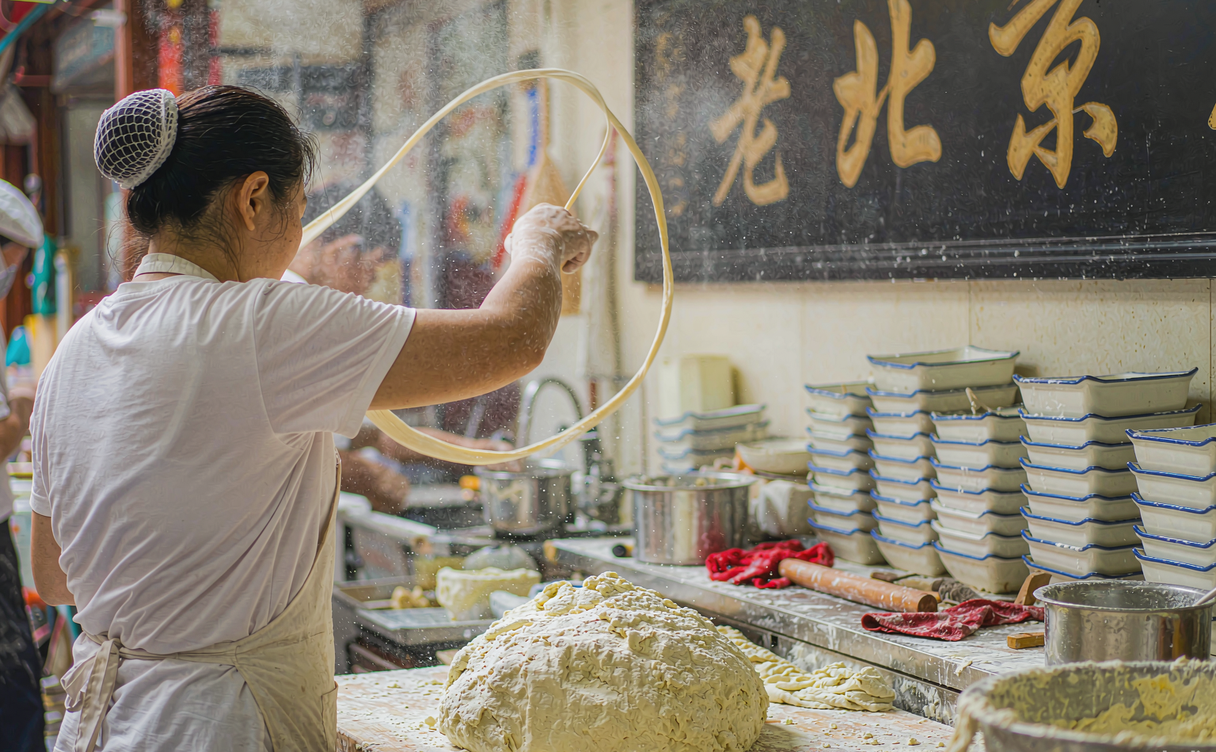
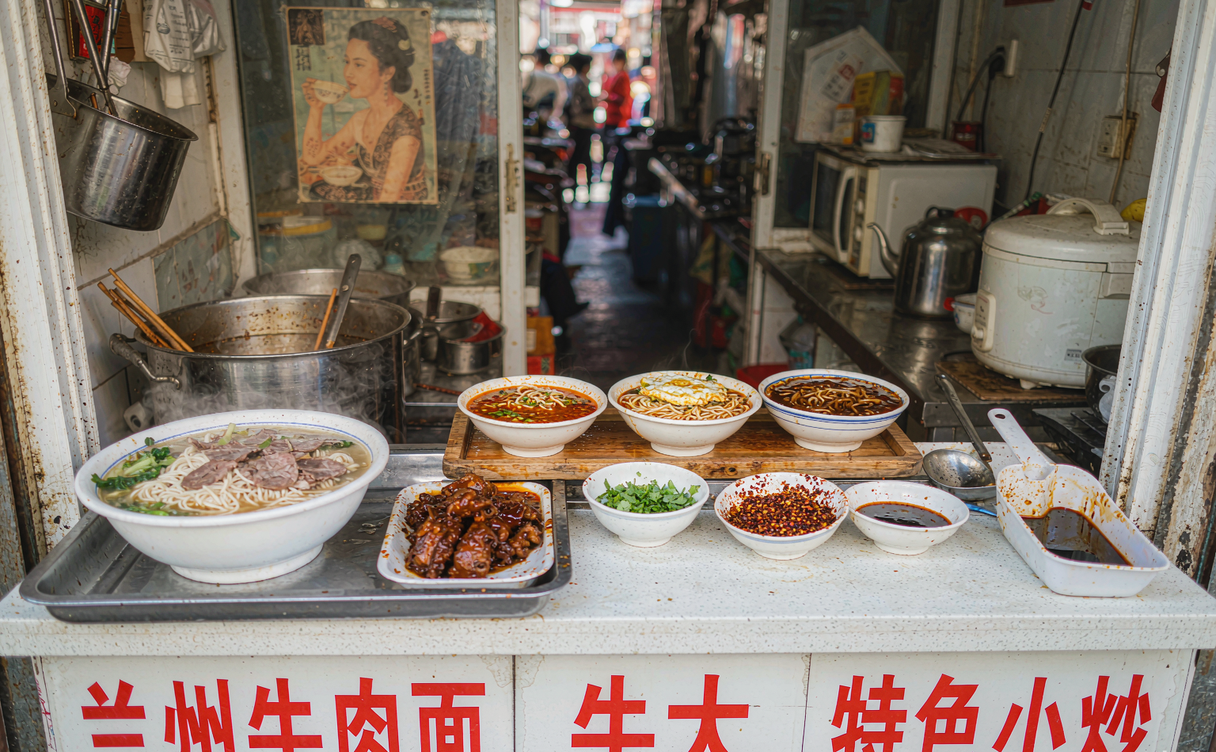
1. Lanzhou beef noodles (Gansu) — ¥12–25. Clear beef broth, hand-pulled to your chosen width, thin beef slices, white radish, chilli oil, garlic greens. Eaten at breakfast, not dinner; the good shops sell out by 11:00. The national benchmark bowl.
2. Biangbiang and youpo che mian (Xi’an, Shaanxi) — ¥15–28. Belt-wide hand-slapped noodles under a spoonful of chilli flakes flash-scalded with hot oil. Toss hard before eating. Order it “youpo” for the pure version.
3. Qishan saozi noodles (Baoji, Shaanxi) — ¥12–20. Thin noodles in a sour-hot pork broth with tofu, eggs and wood-ear. The sourness is vinegar-driven and it is the ancestor of a lot of Shaanxi cooking.
4. Laghman hand-pulled noodles (Xinjiang, China) — ¥28–45. Thick chewy strands topped with a stir-fry of lamb, peppers, tomato and onion. Ask for the sauce on the side and mix it yourself. Portions are enormous and Uyghur restaurants across the country serve it.
North China: Cutting, Shaving and Fermented Paste
5. Knife-cut noodles, daoxiao mian (Shanxi) — ¥12–22. A block of stiff dough shaved straight into boiling water with a curved blade, producing thick-centred, thin-edged ribbons that hold sauce better than anything else in China. Best with tomato-egg or braised pork, and always with the local aged vinegar. Shanxi has dozens of other wheat forms — cat’s ear pasta, oat noodle rolls, pinched dough — and our Shanxi noodles and vinegar guide works through them properly.
6. Zhajiangmian (Beijing) — ¥18–32. Thick wheat noodles with fried pork in fermented yellow bean paste, surrounded by shredded cucumber, radish, celery and soybeans. Salty, dry, mixed at the table.
7. Hui mian (Henan) — ¥15–28. Wide hand-stretched noodles stewed in mutton broth with coriander, sold in enormous bowls across Zhengzhou and Luoyang. Cold-night food.
8. Yanbian cold noodles, lengmian (Jilin) — ¥15–30. Buckwheat noodles in chilled beef broth with pear slices, kimchi, cucumber and half a boiled egg, served with ice in the bowl. The best thing to eat in a northeastern summer.
The Yangtze Belt: Sesame, Broth and Delicacy
9. Hot dry noodles, reganmian (Wuhan, Hubei) — ¥5–12. Alkaline noodles, blanched and oiled the night before, tossed with sesame paste, pickled radish and chilli. Eaten standing up, often walking. Cheapest great bowl in China. Our Wuhan hot dry noodles guide names the stalls locals actually queue at.
10. Aozao mian (Kunshan, near Suzhou) — ¥25–50. The refined end of the spectrum: a clear or “red soup” broth, thin noodles, topped with braised duck leg or a fried fish. Order the red soup version.
11. Guogai mian, pot-cover noodles (Zhenjiang, Jiangsu) — ¥10–20. Cooked with a small wooden lid floating in the pot, in soy-based broth with liver, tofu skin or pork. Local vinegar on the side, from the city vinegar made famous.
12. Scallion oil noodles, cong you ban mian (Shanghai) — ¥12–25. Noodles tossed in oil infused with slowly browned scallions, soy and a little sugar. Four ingredients, and one of the few reliably meat-free bowls in the country.
13. Pian’er chuan (Hangzhou, Zhejiang) — ¥20–35. Noodles in broth with pork slices, bamboo shoots and preserved snow vegetable. Restrained, savoury, very Zhejiang.
Southwest: The Spicy Heartland
If you are hunting spicy noodle dishes across China’s regions, this is the section to memorise.
14. Chongqing xiaomian — ¥8–16. Alkaline noodles in a bowl pre-loaded with chilli oil, Sichuan pepper, sesame paste, preserved vegetable, lard and stock. Order “er liang” — the standard size — and specify heat. Pea topping costs ¥3.
15. Dan dan noodles (Chengdu, Sichuan) — ¥10–20. Small portion, minimal broth, minced pork, ya cai preserved mustard, chilli, numbing pepper. The real version is a snack, not a main course.
16. Ranmian (Yibin, Sichuan) — ¥8–14. Dry noodles with crushed peanuts, sesame, chilli and pork, so oily they “burn” — hence the name. Worth a detour if you pass through southern Sichuan.
17. Crossing-the-bridge rice noodles (Yunnan) — ¥25–60. A bowl of oil-sealed chicken broth so hot it cooks the raw ingredients you tip in: quail egg, ham, chicken slices, chrysanthemum petals, then the rice noodles. Order the mid-price set; the ¥60 versions add quantity, not quality.
The South: Rice Noodles and Fermentation
18. Luosifen (Liuzhou, Guangxi) — ¥12–25. River-snail broth, fermented bamboo shoots, peanuts, wood-ear, dried tofu, chilli. The smell is confrontational, the taste is not. Divisive and addictive — our luosifen snail noodles guide explains why it went from local snack to national obsession.
19. Guilin rice noodles (Guangxi) — ¥8–15. Round rice noodles with a spoonful of dark braising liquor, crisp fried soybeans, pickled beans and sliced beef. Broth is added from a communal urn — that is normal, not a shortcut.
20. Wonton noodles, zhusheng mian (Guangzhou, Guangdong) — ¥15–30. Thin bamboo-pressed egg noodles with a springy snap, shrimp wontons, a clear dried-flounder-and-pork broth, chives. Eat immediately or the noodles soften.
Also worth chasing in town: Changsha’s rice noodles with fried toppings (¥10–18) and Xiamen’s satay-style shacha noodles (¥12–20).
Hand-Pulled Versus Knife-Cut
The hand-pulled versus knife-cut noodles question comes up constantly. Hand-pulled (拉面, lamian) dough is soft and stretched by repeated folding and slapping, giving even, springy strands that take broth well. Knife-cut (刀削面, daoxiao mian) dough is stiff and shaved off a held block, giving irregular ribbons — thick in the middle, feathered at the edge — that grip heavy sauces.
Rule of thumb: soup bowl, order hand-pulled; sauce bowl, order knife-cut. Both are made to order in serious shops.
What You Actually Pay
Noodle prices in Chinese restaurants are stable and predictable:
| Setting | Price per bowl | Notes |
|—|—|—|
| Street stall / market counter | ¥6–12 (US$0.85–1.70) | Cash or QR, no seats sometimes |
| Neighbourhood noodle shop | ¥10–22 (US$1.40–3) | The sweet spot for quality |
| Named local institution | ¥20–35 (US$2.80–4.90) | Queues, often cash-and-ticket |
| Chain in a shopping mall | ¥28–48 (US$3.90–6.70) | Consistent, air-conditioned, blander |
Add ¥3–8 for a braised egg, ¥5–15 for extra meat. Two people eat well for ¥40.
Practical Tips
- Go early. Breakfast bowls — Lanzhou beef noodles, reganmian, Guilin mifen — are best before 09:30. By 14:00 the good shops have closed.
- Follow the queue, not the sign. Twelve locals outside at 08:00 beats a polished storefront with photographs of everything.
- Vegetarians, ask carefully. Most broths are pork or beef based and lard is common. Safer choices: scallion oil noodles, liangpi, tomato-egg knife-cut. Say 我吃素 (wǒ chī sù).
- Slurping is fine, and expected. Use the spoon for broth and to steady the strands.
- Background reading: the Wikipedia overview of Chinese noodles has a useful taxonomy of shapes and doughs if you want the technical names before you travel.
FAQ
Which single noodle dish should I try if I only have one?
Lanzhou beef noodles — available nationwide, cheap, and the northern wheat tradition at its most skilful. Wuhan’s hot dry noodles are the runner-up on value.
Are noodle shops safe to eat at?
Yes, in the busy ones: high turnover means fresh stock, and boiling water handles the rest. Skip anywhere with pre-cooked noodles sitting out and no customers.
How spicy is “wei la” really?
Mild by Sichuan or Hunan standards, which can still mean noticeable heat elsewhere. If you are cautious, order chilli oil on the side — 辣椒油分开放.
Can I find these dishes outside their home cities?
Many, yes — Lanzhou, Xinjiang-style, Chongqing and luosifen shops exist in most large cities. But Kunshan’s aozao mian and Zhenjiang’s guogai mian really do need to be eaten locally. Nowhere takes reservations; the famous places just mean a 20–30 minute queue.
Written by Karl, China Travel Places — updated August 2026.