

The dish that defines a Wuhan morning is not a soup and not a stir-fry, it is a dry, sesame-slicked bowl of Wuhan hot dry noodles, known locally as reganmian. Unlike the broth-heavy noodle bowls of the north, reganmian comes with no liquid at the bottom: springy alkaline wheat noodles are tossed in a dark, nutty sesame paste, sharpened with black pepper, scallion, and pickled vegetable, then finished with a thread of chili oil. We’ve had travelers tell us they did not “get” Wuhan until they stood at a Wuchang street corner at 7 a.m. with a bowl in one hand and a spoon in the other, and we understand exactly what they mean.
What makes Wuhan hot dry noodles different
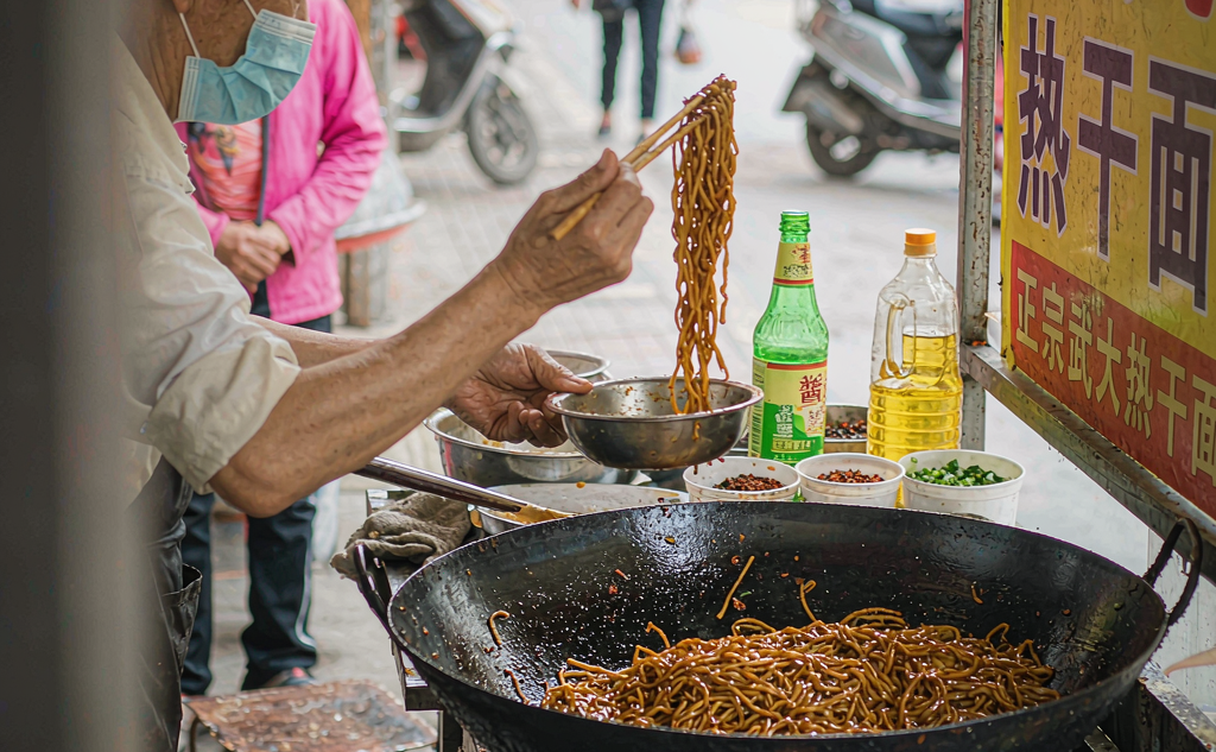
Reganmian is one of China’s five great noodle styles, but it is the only one served dry. The noodles are a specific alkali noodle (碱面) with a yellow tint and a springy, almost rubbery bite. The secret is in the prep: cooks boil the noodles, drain them, toss them in a little sesame or rapeseed oil to stop sticking, then give them a quick re-dunk in boiling water right before serving. That two-step cook keeps the strand firm enough to carry the heavy topping without going soggy.
The topping is built in the bowl, not the wok. At the bottom goes soy sauce, a generous scoop of toasted sesame paste (芝麻酱), a pinch of black pepper, minced scallion, and pickled mustard greens (雪里蕻) or diced pickled turnip. Chili oil is optional but expected. There is no broth to dilute anything, so the first mix matters, you stir hard until every strand is coated, then eat immediately. The Wikipedia entry on Wuhan notes the city’s role as a transport hub at the meeting of the Yangtze and Han rivers, and that rail-and-river culture is exactly why a fast, portable, filling breakfast like this took hold.
A Wuhan reganmian guide to the toppings
Ordering is simpler than it looks because the base is fixed; what changes is what you add. The standard bowl already includes sesame paste, scallion, and picked vegetable. From there you choose extras:
- Doubanjiang, a salty fermented bean paste for depth.
- Suan cai, pickled cabbage for sour crunch.
- La jiao you, chili oil, mild or hot.
- Hua sheng su, crushed peanuts, common in the Hankou style.
Spice is milder than Sichuan by a long way. Wuhan reganmian guide advice from locals is consistent: the heat is a background note, not the point. If you want fire, ask for “jia la,” but the dish is really about the sesame. We tell first-timers to skip extra chili on bowl one and taste the paste as it is meant to be.
Best hot dry noodles in Wuhan: where we send people
Cai Lin Ji (蔡林记) is the name every local mentions, and for good reason, it is the oldest brand, started in 1928, with the original shop on Zhongshan Avenue in Hankou. A bowl there runs 6 to 12 RMB depending on toppings, and the sesame paste is consistent and rich. It is a chain now, with branches inside train stations and malls, which actually helps travelers: you can land at Wuhan station and have a legit bowl within minutes.
For a more local feel, we send people to Hubu Lane (户部巷) on the Wuchang side, the famous breakfast street near the Yangtze. The lanes are packed from 6:30 a.m. with tiny reganmian counters charging 5 to 10 RMB. Watch which stall has the longest line of uniformed students and office workers, that is your bowl. Pang Ji (庞记) near Zhongshan Park and Lao Tian Ji (老田记) in Hankou are two more we trust; both do the classic version without tourist markup.
Timing is everything. Reganmian is a breakfast food. Stalls open around 6 a.m. and most close by 10 a.m., a few by lunch. If you want it at 3 p.m., you will struggle, and the late bowls are never as good. Plan your Wuhan mornings around it the way locals do.
Things to eat in Wuhan around the noodles
Reganmian is the anchor of a much larger breakfast culture that Wuhaners call “guo zao”, literally “passing the morning.” Around any good noodle stall you will find mian wo (a fried taro-shrimp disc), re geng (a thick rice and beef broth), tang bao (soup dumplings, different from Shanghai’s), and dou pi (egg-and-rice wrapped sticky rice with pork). The full Wuhan food guide lays out a walking breakfast route that strings these together, and the Wuhan travel guide maps the districts where the best breakfast streets sit.
How to eat it the local way
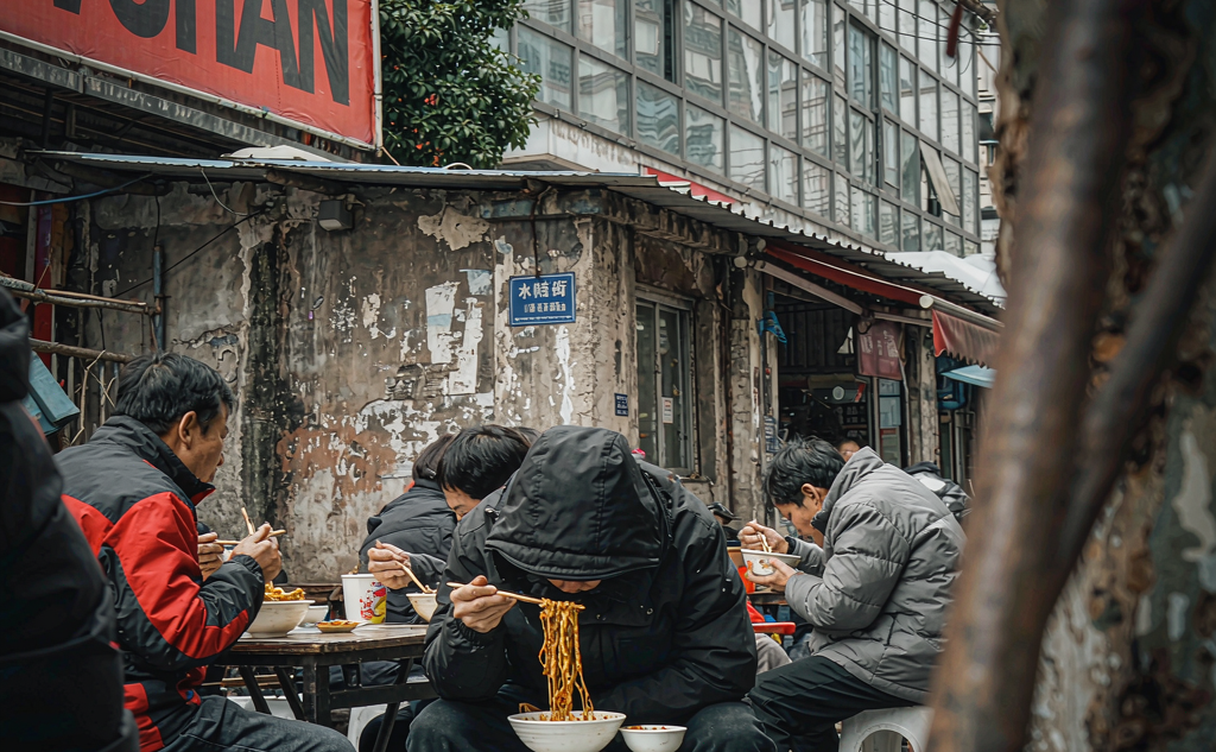
There is a technique, and locals notice when you skip it. Take the bowl, use the spoon to fold the noodles from the bottom up at least ten times so the paste coats everything, then eat while it is hot, the paste tightens as it cools and the texture turns heavy. No blowing on it, no waiting for a companion. Wuhan breakfast is eaten standing, often on the move, and the whole thing is gone in five minutes.
Pay at the counter first (most stalls take WeChat and Alipay, and cash still works), collect a numbered bowl, and step aside so the next person can order. Tissues are not given; carry your own because the sesame paste sticks to fingers. One practical call we make for nervous eaters: the street food in China safety guide covers how to pick busy, high-turnover stalls like these, which is the single best defense against a bad stomach. A stall with a constant local crowd, boiling water on the go, and noodles made to order is about as safe as Chinese street food gets.
A Wuhan food guide to pairing the morning
Reganmian rarely travels alone. The classic combo is a bowl of noodles plus a cup of doujiang (sweet soy milk) or a mian wo on the side, total cost around 10 to 14 RMB for a huge breakfast. If you want the dumpling route, add two tang bao for another 8 RMB. We’ve found that the sesame-and-savory pairing settles better than chili-forward breakfasts when you have a full day of walking the Hankou concession streets or the Yellow Crane Tower ahead.
Practical tips from the ground
A few things come up every time we walk someone through their first bowl. The noodles look pale and dry when they arrive, that is correct, do not send them back. Mix before you judge. The bowl is smaller than a meal portion elsewhere, so order a second item if you are hungry; nobody eats only noodles for breakfast here. Prices on the wall are in Chinese and usually show 5, 6, 7 for the base bowl, anything quoted above 15 RMB to a foreign face is a tourist premium, so step to the next counter.
Season affects the experience more than the taste. Spring and autumn are the comfortable months to stand outside and eat; summer in Wuhan is famously hot and humid, and the “stove city” nickname is earned, so morning noodles become a sweaty affair best taken in shade. Winter is crisp and the sesame paste feels warming. Hubei cooking, of which this is the signature breakfast, sits in the broader map of China’s regional styles, and a multi-city food route can line up Wuhan’s morning with noodle stops in Chongqing and Beijing.
Bringing it together
Wuhan hot dry noodles are the most honest window into the city’s pace: fast, working-class, unpretentious, and built for people who are already moving at 7 a.m. Learn to mix the bowl and you have learned the rhythm of the town. Our Wuhan travel guide puts the breakfast streets on your map, and if this is your first visit to China overall, the China travel guide for first-timers walks through payments and the daily logistics that make a guo zao run easy.
The one habit we hope you keep: eat breakfast standing, eat it early, and eat it where the line is longest. That single rule has not failed a traveler yet.
If you want the wider eating day, the Wuhan food guide strings reganmian into a full guo zao route.
For first-time visitors to the country, the China travel guide for first-timers covers the payments and SIM basics that make any street breakfast smooth.
One last note: the best reganmian is the one eaten within two minutes of mixing, so do not photograph it for long, the sesame waits for no one, and the crowd behind you is already hungry.