

Ask a Beijing local what they eat when they want to feel at home, and a large share will say Beijing zhajiangmian, noodles with soybean paste. This is the capital’s quiet comfort bowl: chewy wheat noodles under a dark, savory-sweet sauce of fried soybean paste and pork, buried under a pile of crunchy raw and blanched vegetables you mix in yourself. We’ve watched travelers who came to Beijing for the Great Wall and the duck leave with a soft spot for this humble bowl, and we always point them to it as the most local thing on the menu that does not come with a ceremony.
What Beijing zhajiangmian actually is
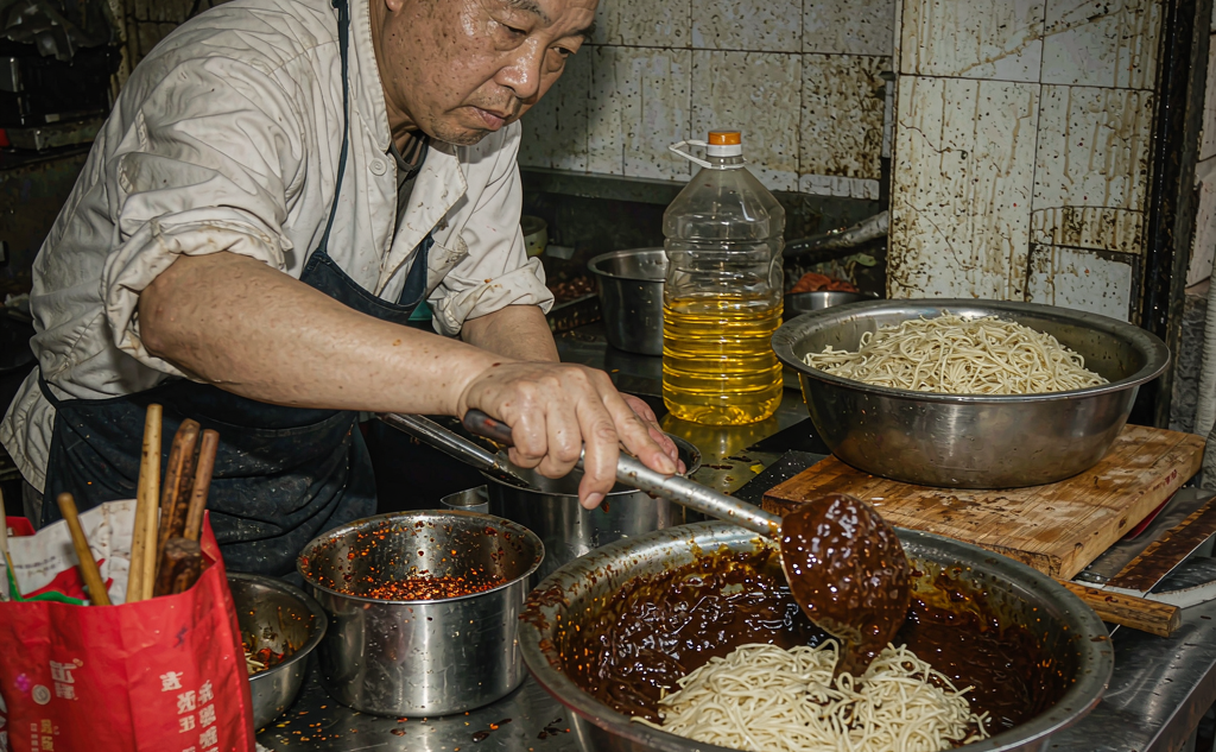
Zhajiangmian means, quite plainly, “fried sauce noodles.” The soul of the bowl is the zhajiang, a sauce built from tianmianjiang (sweet wheat-bean paste) and doubanjiang (fermented broad-bean paste), cooked low with ground pork, scallion, and ginger until it turns glossy and brown. That sauce is the only cooked part. Everything else is raw or quickly blanched vegetable “code” you stir in at the table.
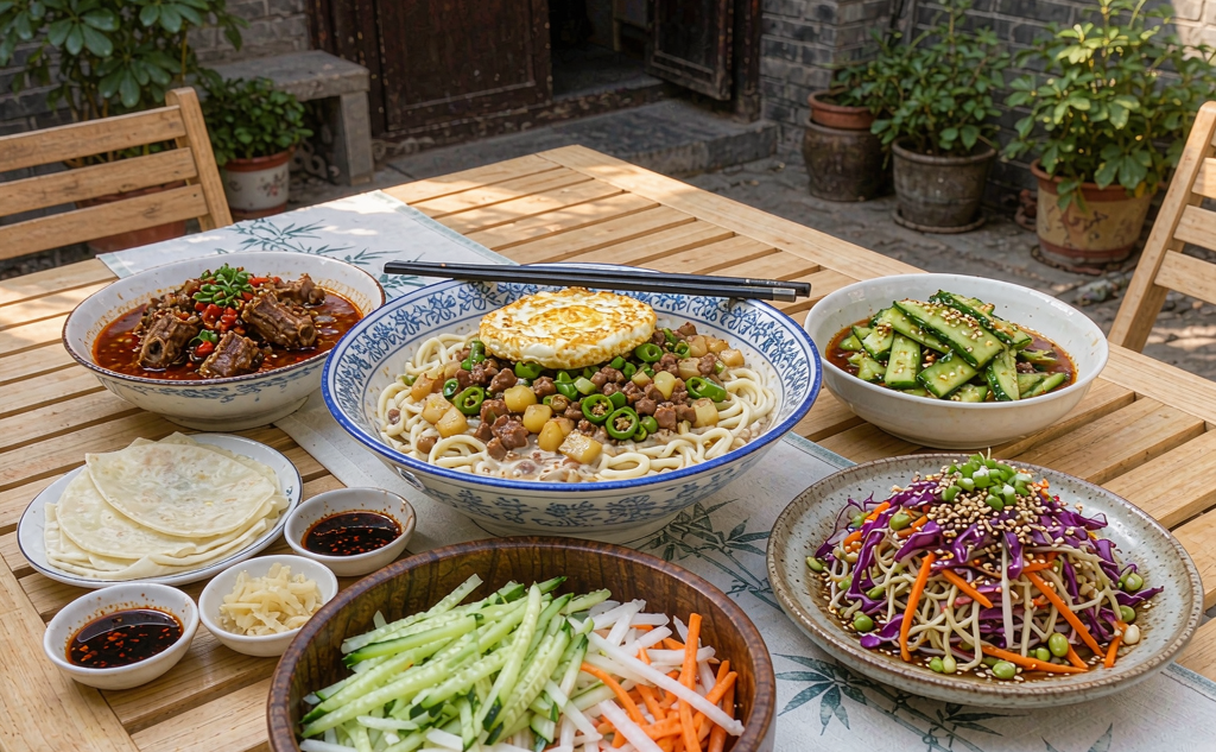
The classic vegetable set, called peimian cai, is what makes the bowl Beijing and not just “noodles with sauce.” You get cucumber cut into thin strips, blanched soybean sprouts, cooked soybeans, shredded radish, and sometimes heart-of-cabbage or boiled celery. The Wikipedia entry on Beijing describes the city’s long northern-plain food traditions, and zhajiangmian is the clearest expression of that: cheap grain, a little pork, and whatever vegetables were in season, all built into one bowl.
Beijing noodles with soybean paste: the parts that matter
The noodle itself is usually a fresh wheat noodle, thicker than spaghetti and with a good bite, the kind pulled or extruded that morning, not dried. Some shops use a round noodle, others a flat one; both are correct. What you are really ordering is the sauce-and-vegetable system on top, and the quality shows in three places: the depth of the fried sauce (it should taste of caramelized bean paste, not salt), the freshness of the cucumber, and the temperature of the noodles (served room-warm or lightly cooled, never icy).
Vegetarian travelers do well here. Ask for “su zha jiang” and the cook fries the sauce with extra mushroom or just the bean paste alone, dropping the pork. The bowl still works because the vegetable crunch carries it. We tell plant-based visitors this is one of the easier Beijing dishes to adapt without losing character.
Best zhajiangmian in Beijing: where we send people
The famous name is Fangzhuanchang No. 69 (方砖厂69号炸酱面), a tiny hutong shop near Di’anmen that blew up online and now has a queue most afternoons. A bowl is 28 to 38 RMB with the full vegetable spread, and the sauce has the right burned-sweet edge. It is tourist-known but still run like a local joint, which is the rare combination we look for.
For a calmer, more old-school meal, Haiwanju (海碗居) has several branches and serves the bowl in a big “sea bowl” with performances of noodle-stretching at some locations; prices run 26 to 45 RMB. In the hutongs around Nanluoguxiang you will find family shops charging 20 to 30 RMB where the owner fries the sauce in a wok you can see from your seat. We’ve sent travelers to a nameless spot off Yandai Xiejie that had no menu in English and the best sauce of the trip, that is the version of Beijing you remember.
Unlike the breakfast noodles of the south, zhajiangmian is an all-day food: lunch from 11 a.m., dinner until 9 p.m. Most shops do not close between, so timing is forgiving. A bowl fills you for 18 to 40 RMB, making it the best value hot meal in a city where duck runs ten times that.
Things to eat in Beijing around the bowl
Zhajiangmian sits in a wider Beijing eating day built on wheat, not rice. Around it you will find baozi (steamed pork buns), jianbing (the breakfast crepe), lu zhu (offal stew), and the city’s famous kaoya roast duck. The Beijing duck guide explains how to order that centerpiece without overpaying, and the Beijing first-time travel guide lays out a day that pairs a hutong noodle lunch with the Forbidden City morning. For the wider eating picture, a solid Beijing travel guide always lists zhajiangmian among the true local dishes worth seeking out.
How to eat it the Beijing way
The bowl arrives with the sauce in a mound and the vegetables fanned around it, noodles underneath. Do not eat yet. Use your chopsticks to fold the sauce down into the noodles, then work the vegetables in, turning the whole thing perhaps fifteen times until the color is even and no white noodle shows. Beijingers mix hard and fast; a half-mixed bowl tastes of plain noodles and lonely sauce. Eat with the extra raw cucumber on the side if you like crunch, and sip the free broth many shops bring.
Pay at the counter, WeChat, Alipay, and cash all work, and do not wait for table service beyond the bowl drop. Portions are large; if you are not that hungry, ask “xiao fen” for a small bowl, usually 18 to 22 RMB. One thing we flag for visitors: a street-food safety mindset is less critical here because these are sit-down shops with cooked sauce, but the general rule of eating where locals queue still applies and saves you from a bland tourist bowl.
A Beijing food guide to timing and seasons
Zhajiangmian is a cool-weather bowl by instinct, though you can get it year-round. Autumn, when the cabbage and radish are fresh and the air is dry, is the peak; a steaming bowl after a morning at the Summer Palace is the local move. Summer versions lean on extra cucumber and are served a touch cooler. Spring sees the first tender soybean sprouts. There is no bad season, but the sauce tastes richest from October to March when the paste has aged and the vegetables are hearty.
Practical tips from the ground
A few habits make the first bowl better. Always mix fully before tasting, the single biggest rookie error is eating the sauce as a topping and leaving plain noodles below. The vegetable set is not decoration; it balances the salt, so use all of it. If the sauce tastes too strong, ask for “shao yi dian” (a little less) next time, or stir in the free broth to loosen it.
Navigation is the other catch. The best shops hide in hutongs with no signs in English, and a map pin sometimes drops you a block away. We tell travelers to download the shop name in Chinese before setting out and show it to a taxi driver or ask at the hutong mouth. The Beijing Nanluoguxiang guide covers exactly this kind of hutong wandering and the food stops along the way, which is the easiest on-ramp to finding your own unnamed bowl.
Bringing it together
Beijing zhajiangmian is the dish that shows you the capital is a northern wheat city before it is a tourist stage. Learn to mix the bowl and you have learned the local rhythm of a cheap, filling, no-fuss meal that everyone from cab drivers to professors eats the same way. The Beijing first-time travel guide maps the neighborhoods where the best bowls hide, and if this is your first trip to China overall, the China travel guide for first-timers covers payments, transit cards, and the small logistics that make a hutong lunch easy.
The habit we hope you keep: skip the hotel’s version and find the wok where the sauce is fried to order. That single choice turns a tourist meal into a Beijing one.
If you want the city’s other famous meal, the Beijing duck guide shows how to order roast duck without the markup.
For first-time visitors to the country, the China travel guide for first-timers covers the payments and transit basics that make any Beijing meal smooth.
One last note: the best zhajiangmian is the one mixed at your own table, so do not let anyone “help” you too early, the mixing is the meal, and it is yours to finish.