

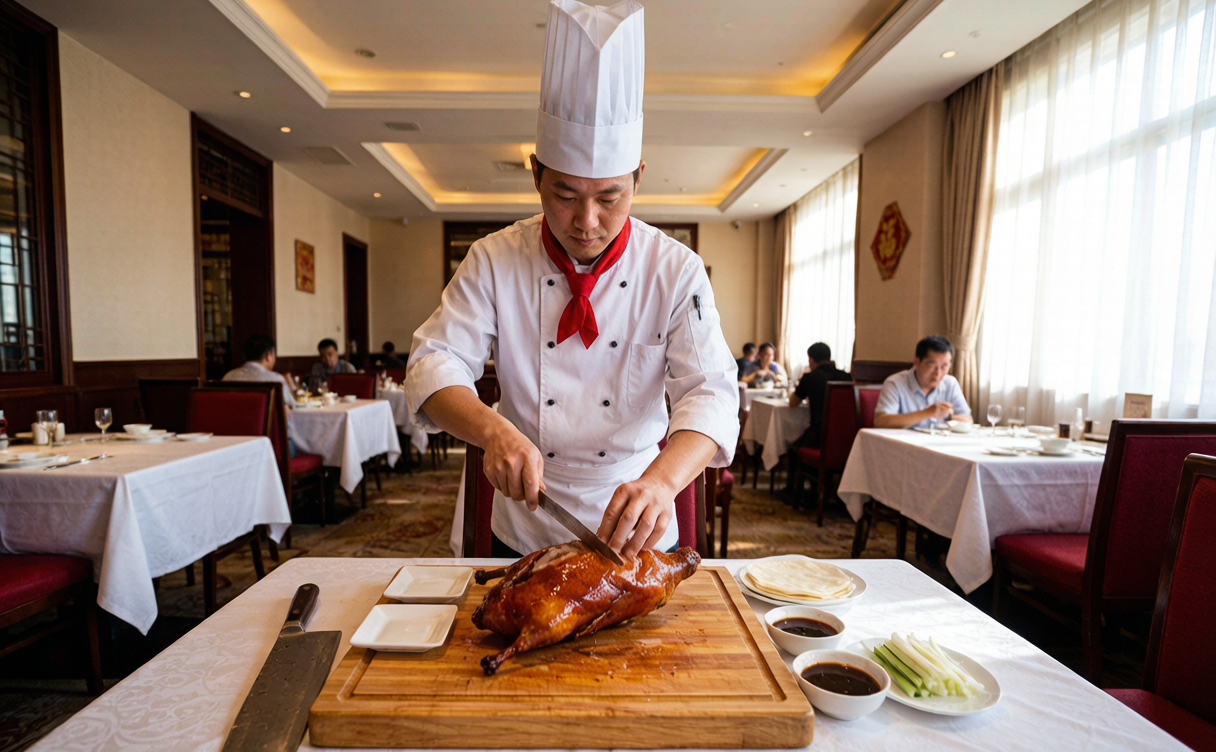
Most first-timers in Beijing order Peking duck the way they’d order a rotisserie chicken — carved at the pass, dropped on the table, eaten with a fork. That misses the point entirely. Proper Peking duck is a ceremony: a duck aged and air-dried, roasted in a hung (or closed) oven until the skin separates into a glassy, mahogany shell, then carved tableside in a few minutes so the skin stays hot and crisp. You eat it by hand, rolled into a thin pancake with scallion, cucumber and sweet bean sauce. Beijing, China’s capital, has been perfecting this since the Ming court, and the gap between a great duck and a tourist-trap duck is wide. This Peking duck guide tells you which houses to trust, how to roll it, what to pay, and how to order the second-course duck soup so nothing is wasted. For the wider picture, our guide to China’s eight great cuisines places Beijing (and northern) cooking in context.
Why Peking Duck Is a Technique, Not Just a Bird
The magic is in the skin. Producers inflate the duck between skin and fat, scald it, hang it to dry, then roast over fruitwood (usually jujube or pear) so the fat renders and the skin lifts into a crisp sheet you can hear crack. Two oven traditions exist:
- Hung oven (gua lu, 挂炉) — the duck hangs in an open hearth, turned by the chef; the classic Quanjude style, smoky and lacquered.
- Closed oven (men lu, 焖炉) — Bianyifang’s method, slower and less smoky, with softer skin.
Either way, a real house ships a whole duck to your table on a trolley and carves it in front of you — typically two plates: one of pure skin (dipped in sugar), one of skin-and-meat. If your duck arrives pre-carved in the kitchen, you’re at the wrong place.
The Houses Worth the Queue
A Peking duck guide has to name names, because Beijing is thick with mediocre roast duck:
- Quanjude (全聚德) — the 1864 institution; touristy and pricey, but the Front Gate (Qianmen) flagship still does the hung-oven show. Go for the spectacle, not the value.
- Bianyifang (便宜坊) — the 1416 closed-oven survivor; quieter, historically serious, softer skin.
- Liqun (力群) — a hutong courtyard with a real hung oven and a cult following among knowing visitors; small and books out.
- Da Dong (大董) — modern, leaner “super lean” duck and slick branches; pricier but consistent and foreigner-friendly.
- Siji Minfu (四季民福) — the local favorite, multiple branches, strong duck and reasonable bills; the Forbidden City-adjacent branch books weeks ahead.
Expect RMB 200–300 for a whole duck (US$29–43) at a serious house, plus sides; tourist traps charge similar but cut corners on the dry-age and carving.
Best Time to Visit Beijing
The best time to visit Beijing for a duck dinner tracks the city’s climate more than the food (duck is year-round):
- September to October is ideal — crisp, dry, 18–25°C, and the hutongs are pleasant for a post-dinner walk.
- April to May is spring and comfortable, with occasional dust-wind days.
- June to August is hot and humid (30°C+); duck houses crank the AC but the city saps you.
- December to February is cold and sometimes smoggy, though the duck tastes great after a frozen hutong stroll.
Book famous houses 1–3 days ahead, longer for Siji Minfu’s prime branch. Slot the capital into a wider route using our month-by-month China timing guide.
How to Get to Beijing
Beijing is the national hub — two airports and a vast high-speed net. The food-trip math:
| Route | Option | Time | Approx. Cost |
|—|—|—|—|
| Shanghai → Beijing South | High-speed train | ~4.5 hr | RMB 550–1,000 (US$79–144) |
| Xi’an → Beijing West | High-speed train | ~4.5–5.5 hr | RMB 515–1,100 (US$74–158) |
| Hong Kong → Beijing West | High-speed train | ~8–9 hr | RMB 1,000–1,900 (US$144–273) |
| Major city → Beijing Capital (PEK) | Flight | 2–4 hr | RMB 500–1,500 (US$72–215) |
| Airport → city center | Airport Express / taxi | 30–60 min | RMB 25–150 |
Trains use the same passport-and-app system as anywhere in China for ticketing. Stay near the duck: Qianmen, Wangfujing and the hutongs put you within a short taxi of the marquee houses.
Where to Stay
Base yourself where the duck and the sights cluster. Qianmen (by the Front Gate) puts Quanjude’s flagship and the hutongs at your door, with hotels at RMB 400–1,200. Wangfujing is central and tourist-polished (RMB 500–1,500). The hutongs (Dongcheng) offer courtyard guesthouses (RMB 300–800) and the most atmospheric post-duck walk. For a fuller lodging breakdown by district and budget, see our where to stay in Beijing guide.
How to Eat It (The Roll)
This is the part a Peking duck guide must drill, because the table setup assumes you know:
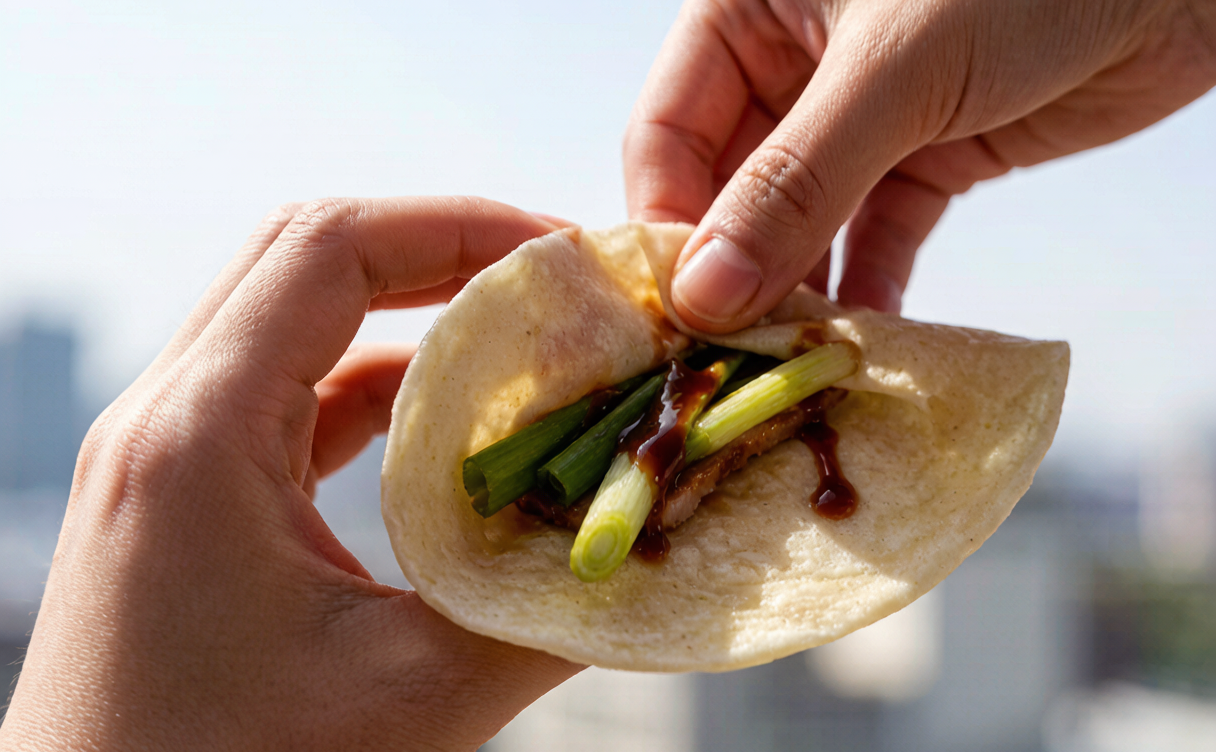
1. Lay a thin pancake (bing) in your palm; brush on a little sweet bean sauce (tianmianjiang).
2. Add 2–3 slices of duck skin-and-meat, a stick of scallion, and a cucumber baton.
3. Fold the bottom up, then roll the sides in — like a small burrito. Eat it in two or three bites while the skin is hot.
4. The pure-skin plate is dipped in white sugar (not sauced) — the old imperial habit, and the crispest bite of the meal.
5. Don’t overstuff the pancake; a fat roll splits and drips.
The chef carves the duck in roughly 100 slices; the “duck frame” left after is yours to use in the second course.
Sample Itinerary (A Duck Evening)
5:00pm — arrive at your booked house 15 minutes early; confirm the whole duck and the second course.
5:30–6:30pm — watch the carving, eat the skin-with-sugar first, then roll your way through the meat plate.
6:45pm — order the duck-frame soup or stir-fried duck with leeks (韭菜炒鸭丝) so nothing is wasted.
7:30pm — walk the lit hutongs or Qianmen pedestrian street. This is one of the best things to do in Beijing for a first evening, and it pairs naturally with a Forbidden City day.
Practical Tips (Peking Duck Guide Tips)
- Book ahead. Serious houses need 1–3 days; walk-ins risk a 60-minute wait or sold-out ducks.
- Order a whole duck — most houses won’t sell half, and the second course needs the frame.
- Eat the skin first. It is best in the first five minutes; don’t let it sit while you photograph.
- Ask for the frame. Request the duck-frame soup or stir-fry when you order, or it gets discarded.
- Skip all-you-can-eat “duck” buffets — they shortcut the dry-age and oven steps.
- Sauce lightly. Sweet bean sauce is strong; a brush, not a slather, lets the skin shine.
FAQ
How much does a real Peking duck cost?
RMB 200–300 (US$29–43) for a whole duck at a serious house, plus sides and tea; tourist traps charge similar but cut the dry-age and carving.
Do I need to book Quanjude or Siji Minfu?
For the marquee branches, yes — 1–3 days ahead, longer for Siji Minfu’s Forbidden City location. Lesser branches and Liqun take shorter notice but still call.
What’s the difference between hung and closed oven?
Hung oven (Quanjude style) is fruitwood-smoky with lacquered skin; closed oven (Bianyifang) is gentler and softer-skinned. Both are legitimate; try one of each if you’re a fan.
Is the skin supposed to be eaten with sugar?
Yes — the pure-skin plate is classically dipped in white sugar; it’s the crispest, richest bite and an old court habit.
Can I get a half duck or takeaway?
Most houses sell whole ducks only, carved fresh; takeaway loses the crisp. Some will pack a whole carved duck, but eat it within the hour.
What’s the second course?
The leftover frame becomes duck soup or a stir-fry (often with leeks); ask when ordering so the kitchen holds it. For the dish’s history and method, the Wikipedia entry on Peking duck is a useful reference.
Written by Karl Huang, updated August 2026.