

Of all the ancient sites we have helped travelers plan in China, the Confucius Temple in Qufu (孔庙) is the one that most reliably silences first-time visitors. It is not the oldest temple in the country, but it is the most consequential: a sprawling complex built on the site of Confucius’s own home, expanded by emperors for more than two thousand years, and still an active place of ceremony. If you are searching for a practical Confucius Temple Qufu guide that explains not just what to see but why it matters, this is the one we wrote after several visits with clients ranging from school groups to retired scholars.
Why Qufu and why this temple
Qufu (曲阜) is a county-level city in southwest Shandong Province and the birthplace of Confucius (551–479 BCE). According to tradition, the temple was first erected in 478 BCE, one year after the sage’s death, when the reigning duke turned his former residence into a place of memorial. What began as a few halls grew across dynasties into a walled city-within-a-city of nine courtyards, more than 100 buildings, and over 2,000 stone steles. The temple, together with the adjacent Kong Family Mansion (孔府) and the Cemetery of Confucius (孔林), forms the UNESCO-listed “Temple and Cemetery of Confucius and the Kong Family Mansion,” inscribed in 1994. For the full context on how this site fits the national heritage map, see our China UNESCO World Heritage guide.
Confucius Temple Qufu tickets and how booking works
Most visitors buy the combined “Three Confucian Sites” through-ticket (三孔联票), which covers the temple, the mansion, and the cemetery. As of recent seasons the joint ticket is priced around 140 RMB in peak months and about 120 RMB in the low season; a standalone Confucius Temple Qufu ticket, when sold separately, is roughly 80 RMB but the combo is better value if you plan to see all three. Tickets are sold at the entrance plaza and through major Chinese travel apps; we recommend buying a day ahead during holidays. We once arranged a dawn entry for a photographer client by coordinating with a licensed local guide, and the empty courtyards at opening hour were a world apart from the midday crowds. Opening hours are typically 07:40 to 17:00 in summer and 08:00 to 16:30 in winter, with last entry about an hour before closing.
How to get to Qufu
Qufu is remarkably easy to reach thanks to the Beijing–Shanghai high-speed line. Qufu East Railway Station (曲阜东站) sits on that corridor; from Beijing South it is about two to two and a half hours, and from Shanghai Hongqiao roughly two and a half to three hours. From the provincial capital, the trip is even shorter: our Jinan travel guide readers can reach Qufu from Jinan in about 35–50 minutes by high-speed train, with second-class fares around 50–70 RMB. A taxi from Qufu East Station to the temple entrance takes roughly 20 minutes and costs 30–45 RMB. If you are combining the sage’s hometown with the sacred mountain, our Mount Tai Shandong guide and Tai’an travel guide explain the short hop north. There is also a small Qufu Airport with limited domestic flights, but the train is the better choice for almost everyone.
What to see inside the temple
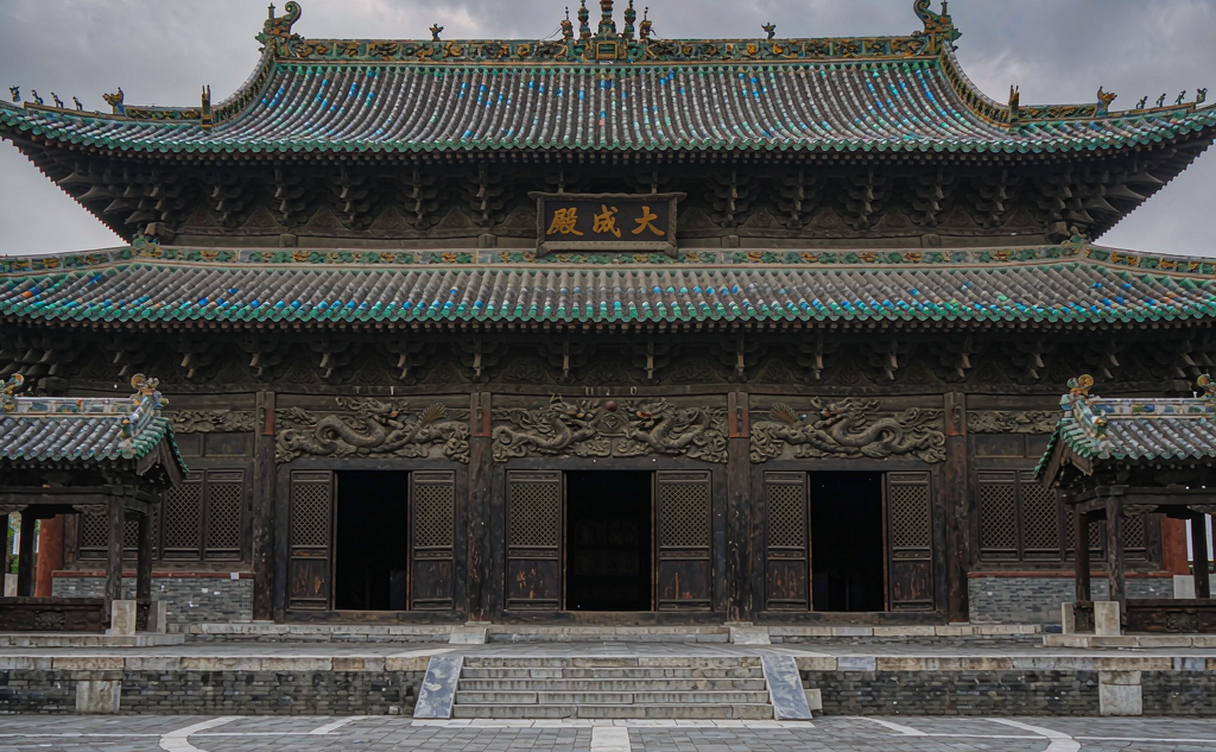
The visit is a procession inward through successive gates and courtyards. You enter via the Lingxing Gate (棂星门) and pass the Thirteen Imperial Steles Pavilions (十三碑亭), where stone tortoise-borne tablets record imperial visits. The heart of the complex is Dacheng Hall (大成殿), the “Hall of Great Achievement,” where the main rites are held. Its front row of ten coiled-dragon stone columns is the detail most visitors remember; legend holds that the emperor’s inspectors were shown carved-wood covers so the dragons would not outshine the Forbidden City. Just in front lies the Apricot Altar (杏坛), said to mark where Confucius taught under an apricot tree. We always tell clients to slow down at the Hall of Confucius’s Wife (寝殿) and the rear garden, which many rush past but which show the temple’s domestic, almost family-shrine side.
The Kong Family Mansion and Kong Lin
A Confucius Temple Qufu guide would be incomplete without its two companions. The Kong Family Mansion (孔府), immediately west of the temple, was the residence of the Confucius descendants, who held the hereditary title of Duke Yansheng for centuries; its rooms display official robes, genealogical records, and a famously deep courtyard layout. The Cemetery of Confucius (孔林), about 1.5 kilometers north, is the family burial ground where Confucius, his son, and grandson, plus tens of thousands of descendants, are interred among ancient cypresses. A battery cart shuttles between the mansion and the cemetery for about 10–15 RMB, though we prefer walking the tree-lined approach for the atmosphere. We once joined a client in tracing his genealogical curiosity here; the on-site genealogy hall can sometimes help visitors with the Kong surname trace their line.
Best time to visit Qufu
The best time to visit Qufu is spring (April to May) and autumn (September to October), when the weather is mild and the cypresses glow. Avoid the National Day holiday (October 1–7) and the week of the Confucius Birthday ceremony (usually late September) if you dislike crowds, though those dates bring special ritual performances. Summer is hot and humid, with afternoon thunderstorms, while deep winter is cold but wonderfully quiet. For a broader seasonal framework across the country, our China travel guide for first-timers helps you time multiple stops.
Things to do in Qufu beyond the temple
Beyond the three sites, Qufu’s Ming-era city wall and moat offer a gentle evening stroll, and the Confucius Six Arts City (六艺城) gives families a playful introduction to the sage’s teachings through archery, music, and chariot displays, with entry around 60 RMB. The nearby town of Nishan (尼山), birthplace of Confucius, has a large new cultural complex and the Nishan Academy; it is about 30 kilometers south and makes a calm half-day. We once arranged a calligraphy class for a client’s teenager inside a restored courtyard school, and the patient brush-work session did more to explain Confucian discipline than any lecture.
A practical Qufu itinerary
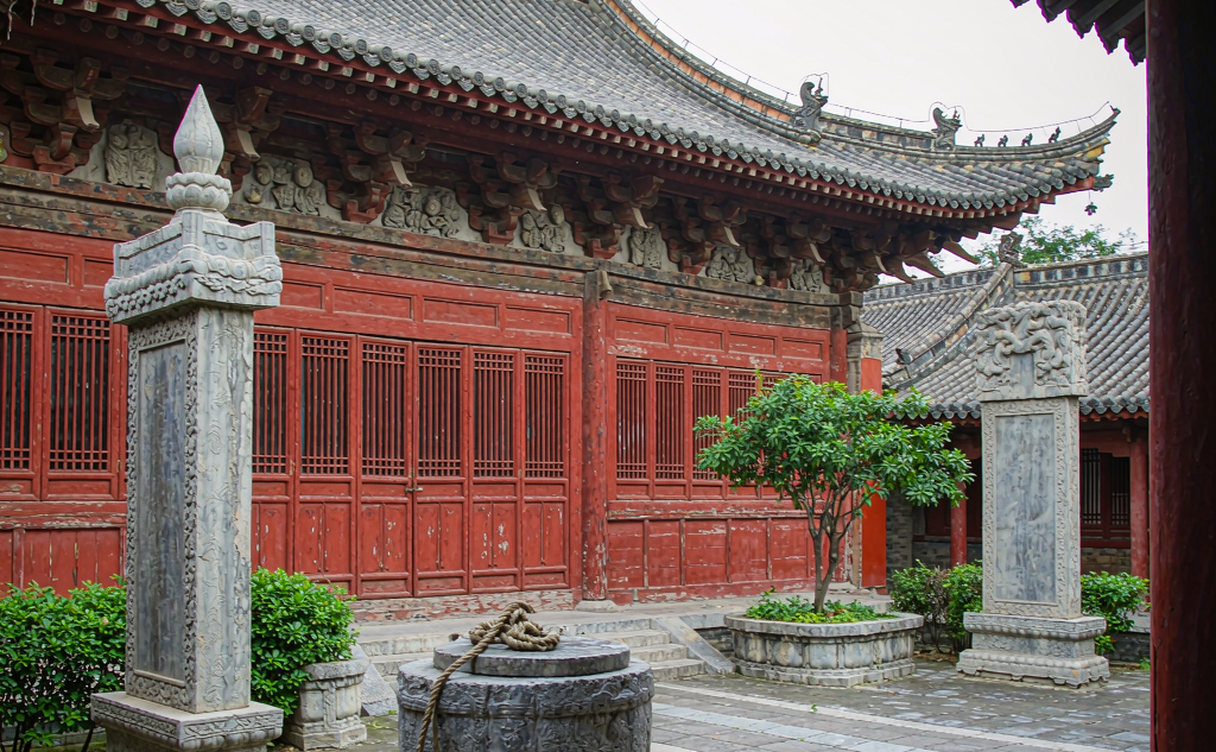
We suggest a full day, or two relaxed half-days. Morning: Confucius Temple at opening, then the Kong Family Mansion. Lunch on local Shandong dishes such as 孔府豆腐 (Kong-family tofu) or 煎饼 (jianbing rolls) for 40–80 RMB per person. Afternoon: Kong Lin by cart or on foot, then the city wall at dusk. If you have a second day, add Nishan. This Quful itinerary pairs naturally with an overnight in Qufu travel guide logistics, which covers hotels and transport passes in more detail.
Food and lodging notes
Qufu is compact and walkable; mid-range hotels near the south gate run 250–450 RMB per night, and the street food around the temple sells roasted seeds, sugar haws, and Jianbing for a few RMB each. The local style is northern Shandong: wheat-based, savory, not spicy. We once had a memorable 孔府宴 (Kong-family banquet) at a heritage restaurant for about 180 RMB per person, a splurge that reproduced dishes from the ducal kitchen.
Why the temple still matters
The Confucius Temple is not a ruin to be admired from a rope line; it is a living institution where annual rites still occur and where Chinese students often come to pray before exams. Standing in Dacheng Hall as light falls through the old timbers, you understand why emperors kept enlarging it. For authoritative background, the UNESCO World Heritage listing for the Temple and Cemetery of Confucius gives the official description and conservation history, useful reading before you go.
Practical tips
Hire a licensed guide at the entrance (about 100–150 RMB for a group tour) or rent an audio device; the steles mean little without interpretation. Dress modestly, as this remains a ceremonial site. Wear comfortable shoes; the temple alone is a 30–45 minute walk end to end. Arrive at opening to beat tour buses, which typically arrive after 09:30. We once arranged skip-the-line access for a mobility-limited client by calling ahead to the visitor center, and the staff were helpful once they understood the need.
Final thoughts
A visit to the Confucius Temple in Qufu is less a sightseeing stop than a walk through two millennia of Chinese intellectual life. Plan a half day at minimum, bring curiosity about ritual and family, and let the quiet courtyards do their work. We hope this Confucius Temple Qufu guide gives you the confidence to include Qufu on a Shandong route and the detail to enjoy it deeply when you arrive.