

When people ask us for an off-the-radar stop in Heilongjiang, we often point them past the obvious winter capitals toward the southeast corner of the province. Jixi (鸡西) rarely appears on foreign itineraries, yet it rewards curious travelers with a strange and appealing mixture: working-class coal heritage, a vast border lake shared with Russia, and some of the best Korean-style food in northeast China. This Jixi travel guide is built from the notes we gathered on two separate trips, including one slow summer we spent tracing the Ussuri River frontier.
Understanding the city
Jixi is a prefecture-level city in southeastern Heilongjiang, bordering Russia’s Primorsky Krai to the east. It was built on coal. For most of the twentieth century the city’s identity, economy, and even its layout revolved around the pits and the railways that carried the black rock south. That industrial past is not hidden behind a museum wall; you feel it in the older neighborhoods and in the pride of local retirees who spent their working lives underground. If you want “things to do in Jixi” that go deeper than a photo stop, start with that story, because the city’s best attractions are really footnotes to it.
How to get to Jixi
The city is served by Jixi Xingkai Lake Airport (鸡西兴凯湖机场), with flights from Harbin, Beijing, and occasionally Qingdao. A Harbin–Jixi flight runs about one hour and costs 500–1,000 RMB by season. On the ground, the conventional train from Harbin to Jixi takes roughly seven to eight hours, with a hard sleeper around 180–230 RMB; faster “bullet” daytime services trim that to about five hours on certain routes. There is no high-speed line all the way to Jixi yet, so for background on how the rail network connects the northeast, see our China high-speed train guide for foreigners. We once arranged a client to fly Harbin to Jixi and then rent a car at the airport for the lake loop; the rental, including the border-region permit paperwork handled by the agency, ran about 350 RMB per day plus fuel.
Best time to visit Jixi
The best time to visit Jixi is July and August, when Xingkai Lake is at its liveliest and the regional humidity is tolerable compared with the inland heat. Daytime highs sit around 26–30°C, and the lake breeze keeps evenings comfortable. September brings golden rice fields and thinner crowds, while October can be crisp and photogenic. Winter is harsh and many lakeside facilities close, though the snowbound frontier has its own quiet appeal for photographers. We generally advise against the muddy spring thaw in April and May.
Xingkai Lake: the region’s centerpiece
Xingkai Lake (兴凯湖), called Khanka Lake in Russia, is the largest freshwater lake in northeast Asia and is split by the border, with roughly a quarter on the Chinese side and the rest in Russia. The Chinese shoreline near the city of Mishan offers sandy beaches, reed wetlands, and excellent migratory-bird watching. Entry to the managed scenic belt is modest, often 30–50 RMB, and the open public beaches cost nothing. We spent a morning there in late July counting egrets and was thrilled by how few other tourists shared the sand. A small on-site museum explains the lake’s geology and the 1860 treaty that divided it; that history is worth understanding before you stand at the waterline and realize Russia begins a few kilometers east.
Hutou Fortress and the border story
The single most moving site near Jixi is the Hutou Fortress (虎头要塞), a vast Japanese-built defensive complex from the 1930s and 1940s carved into hills above the Ussuri River. It is remembered as the last place where Japanese forces resisted in World War II, surrendering months after the official August 1945 end. Today you can walk the concrete tunnels, view the recovered artillery, and read the bilingual exhibits. Tickets are around 50 RMB. We arranged a guided visit for a history-minded couple, and the local guide’s grandfather had been conscripted to build the tunnels; that personal thread made the concrete corridors feel anything but abstract. Nearby, Zhenbao Island (珍宝岛, “Treasure Island”) in the Ussuri River is a symbolic border site tied to the 1969 Sino-Soviet clashes, reachable by a causeway in winter and viewed from overlooks in warmer months.
Coal heritage in the city
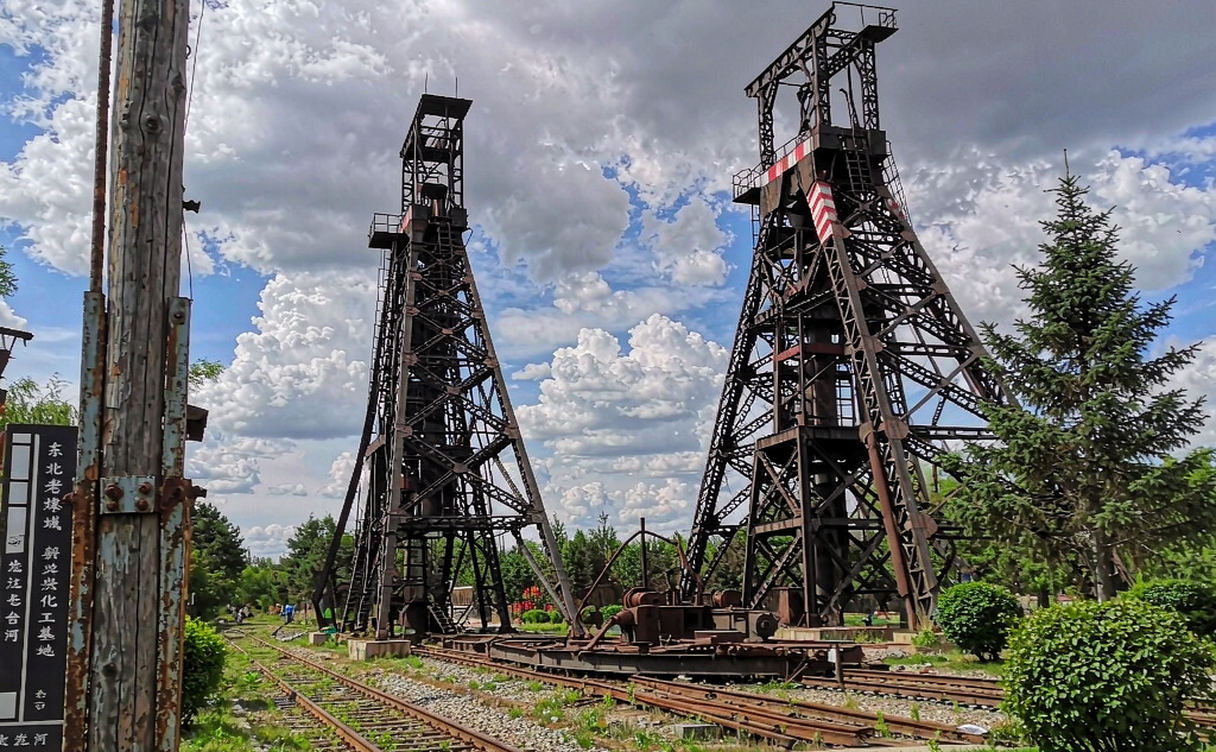
Back in Jixi proper, the Jixi Coal Mining Museum (鸡西煤矿博物馆) sits on the site of one of the earliest modern pits and uses preserved headframes, rail carts, and photo archives to tell the industry’s story. Admission is usually free or a token 10–20 RMB. For a more contemplative angle, the nearby coal-mining heritage park lets you ride a short narrow-gauge train through a retired surface mine. We once joined a retired miner on that ride; his matter-of-fact account of shift life in the 1970s was more honest than any plaque. This is the “coal heritage” half of the city’s character, and it pairs naturally with the lake and the fortress into a two- or three-day loop.
Things to do in Jixi beyond the headline sites
Qilin Mountain (麒麟山) scenic area, about an hour from the city center, offers cable cars, a small lake, and easy forest walks suited to families; entry is roughly 40 RMB. Baoding Mountain and the Hongxing Marshes give additional birdwatching for patient visitors. In town, the morning markets are a free and rich experience: smoked fish, wild herbs, and stacks of the spicy kimchi (辣菜) that define local snacking. If you enjoy slow travel, simply renting a bike and riding the flat river roads east of the city is a lovely half-day.
Food: Jixi’s Korean soul
You cannot write a Jixi travel guide without mentioning the food. The city has one of the largest ethnically Korean (Chaoxianzu) communities in Heilongjiang, and the result is genuinely excellent Korean cuisine at local prices. The signature dish is Jixi cold noodles (鸡西冷面), a chewy buckwheat noodle served in an icy sweet-sour broth with a slice of radish and a dab of mustard. A full bowl costs 12–20 RMB. Pair it with 辣菜 plates of spicy cabbage, squid, or potato, and you have a meal for two under 80 RMB. We once ate at a tiny family shop near the old rail station where the owner refused to let us pay more than 45 RMB for three bowls and a table of sides; that generosity is typical of the region.
A practical Jixi itinerary
We recommend two to three days. Day one: arrive, visit the Coal Mining Museum and heritage park, and eat cold noodles in the evening. Day two: drive to Xingkai Lake for beach and birdwatching, with a lakeside fish lunch (expect 60–100 RMB per person). Day three: Hutou Fortress and the Ussuri overlook, returning via Mishan. This Jixi itinerary keeps daily driving under two and a half hours and leaves room for unplanned market stops. In July and August, book lakeside guesthouses a week ahead; the rest of the year walk-ins are easy.
Pairing Jixi with the wider northeast
Jixi fits neatly into a southeastern Heilongjiang route. If you are already exploring the province, our Mudanjiang travel guide covers Jingpo Lake and the Korean-flavored south, while our Harbin Ice Festival travel guide anchors a winter visit to the capital. For the northern extreme, our Mohe travel guide describes the Arctic Village at the country’s top end. And for broader inspiration we keep a running list of best things to do in China that balances industry, nature, and culture.
For independent background, the Wikipedia overview of Heilongjiang explains the province’s border geography, which helps make sense of why Jixi feels pulled between Moscow and Harbin.
Practical tips
Carry your passport near the lake and fortress, because you are in a border management zone where spot checks happen. Download offline maps, as signal thins east of Mishan. Bring mosquito repellent in July and August; the wetlands are fierce. Cash helps at small food stalls, though mobile pay works in the city. We once arranged a sunrise boat on Xingkai Lake for a client; the captain asked 120 RMB and delivered an hour of glass-calm water and a heron rookery most visitors never see.
Final thoughts
Jixi will not court you with postcard glamour. It is a working city that happens to sit beside one of Asia’s great lakes and along a frontier that shaped the twentieth century. Give it two days and an open appetite, and it repays you with history, birdsong, and the best cold noodles north of the Yalu. We hope this Jixi travel guide encourages you to look past the usual northeast circuit and discover the southeast corner for yourself.