

If you draw a line to the eastern edge of China’s Northeast, it runs straight through Jiamusi. A Jiamusi travel guide should start there, because this city in eastern Heilongjiang Province is less a destination in itself and more a launch point into the country’s coldest, most remote, and most quietly beautiful frontier. We have used Jiamusi as the jumping-off town for readers chasing the easternmost sunrise in China, and it has never disappointed.
Jiamusi (佳木斯) sits on the south bank of the Songhua River, near where it joins the Heilong (Amur) River, about 380 kilometers east of Harbin. It is a city of around 2 million people built on industry, grain, and river trade. But the magic is what lies beyond: the Sanjiang Plain, the confluence of three great rivers, and the towns of Fuyuan and Tongjiang that sit at the very edge of the national border. In winter, Jiamusi is the kind of place where the river freezes solid enough to drive on, and the cold becomes the main attraction.
How to Get to Jiamusi
The most reliable way to learn how to get to Jiamusi is by train from Harbin. Jiamusi Station (佳木斯站) is on the line that now includes high-speed services; from Harbin the ride takes roughly 2 to 3 hours on a fast train (around 110 to 160 RMB second class) and longer on conventional services. There is also Jiamusi Dongjiao Airport (JMU) with domestic flights, mainly connecting through Harbin, but for most foreign travelers the train is simpler and lets you watch the plain turn to ice as you go east. From Jiamusi you continue by road to Fuyuan and Tongjiang, since those frontier towns are not on the main rail trunk.
We once arranged a reader’s route where they took an early G-train from Harbin, reached Jiamusi by late morning, hired a car, and were standing at the Songhua–Heilong confluence near Tongjiang by late afternoon. The whole eastern leg cost less than 600 RMB including the driver. For booking help, our China high-speed train guide for foreigners covers both fast and conventional trains. If you are basing in the provincial capital first, the Harbin Ice Festival travel guide is the natural prelude to a Jiamusi winter, and our Mudanjiang travel guide covers another key eastern Heilongjiang hub worth combining.
Best Time to Visit Jiamusi
The best time to visit Jiamusi splits cleanly into two kinds of trip. Winter, from December to February, is for ice and the extreme-cold experience: temperatures commonly fall to minus 20 to minus 30°C, the rivers freeze into roads, and the snowscapes are extraordinary. This is also when the nearby Mohe travel guide region to the north hits its coldest, so you can chain the two for a true arctic China itinerary. Summer, from June to August, is short and mild (highs around 24–27°C), good for the riverside and for reaching Fuyuan without frostbite concerns.
We steer most first-timers toward mid-January for the deepest ice and the clearest winter light, provided they pack properly. Avoid the Spring Festival week if you can, because transport to the frontier towns books out and drivers charge holiday rates. For travelers new to the region, our China travel guide for first-timers has a cold-weather packing section that applies directly here.
Things to Do in Jiamusi
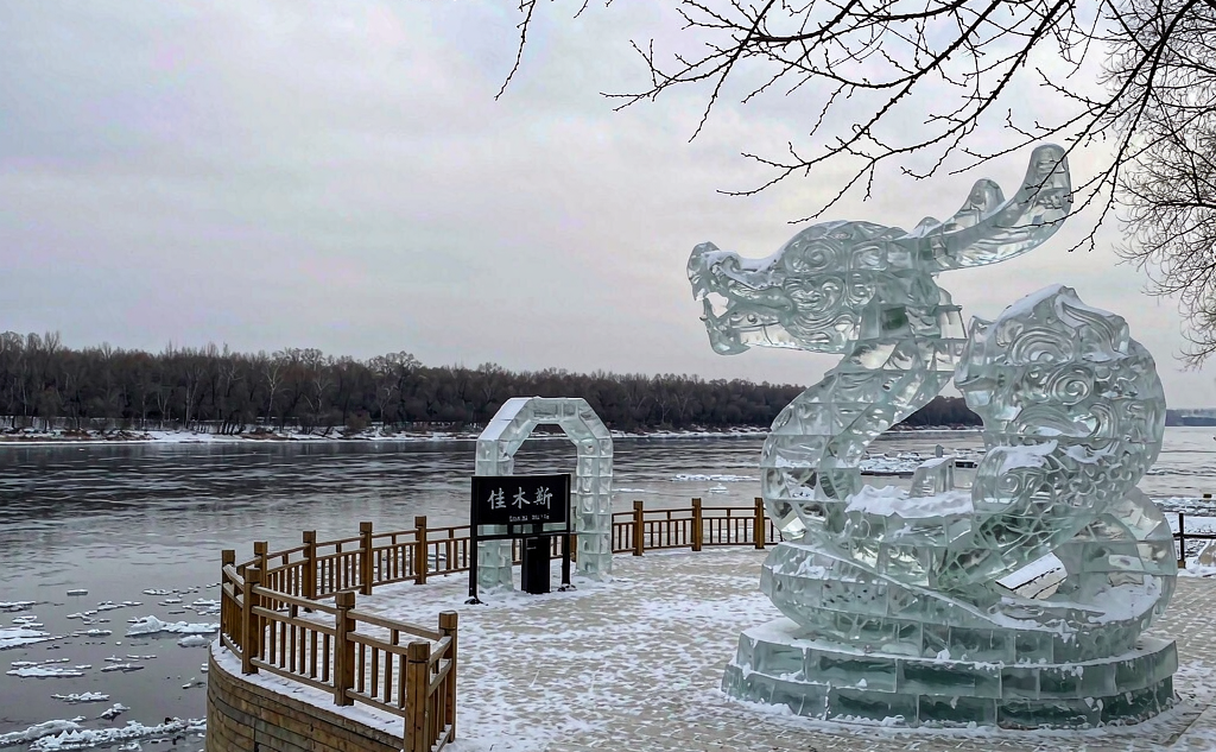
In the city itself, the riverside park along the Songhua is the everyday heart: locals skate, fish through ice holes, and walk the embankment even in deep cold. The Jiamusi Museum gives a solid overview of the region’s Han, Manchu, and Hezhe minority cultures; the Hezhe (Nanai) people are one of China’s smallest ethnic groups and have a distinct fishing and shamanic heritage worth learning about before you head east. Things to do in Jiamusi also include the winter ice-snow park the city builds near the river, with lit ice sculptures in the evenings.
The real draw is the frontier. Tongjiang (同江), about 2 hours east, sits near the confluence of the Songhua and Heilong rivers, with a striking junction where the yellow Songhua water meets the darker Heilong—you can stand on the bank and see two rivers become one. Fuyuan (抚远), another 2 to 3 hours on, is the easternmost county in China, famous for the “first sunrise” viewpoint and for Heixiazi Island (Black Bear Island), a border island partly opened to visitors with a notable Russia–China boundary monument and wetland scenery. We once arranged a reader’s pre-dawn drive to the Fuyuan sunrise point; at 04:30 in January the sky cracked open red over the frozen river, and he said it was the coldest and best morning of his life.
A Suggested Jiamusi Itinerary
A Jiamusi itinerary needs a minimum of three days to reach the frontier and back. Day one: arrive, explore the riverside and museum, and prep for the cold. Day two: drive to Tongjiang for the river confluence and return. Day three: drive to Fuyuan for the easternmost sunrise and Heixiazi Island, then overnight in Fuyuan or back in Jiamusi. Add a fourth day if you want to linger at the border wetlands or continue north toward Mohe.
We always build in a rest half-day, because the frontier drives are long on empty, icy roads. Our best things to do in China roundup includes other border and river experiences if you want to compare Jiamusi with the far south or west.
Where to Stay and What It Costs
Jiamusi is inexpensive. A central business hotel runs 160 to 300 RMB per night; in Fuyuan and Tongjiang, simple guesthouses cost 120 to 250 RMB, more in peak winter holiday weeks. Book the frontier stays ahead, because rooms are limited. Taxis start at 6 RMB, but for the eastern towns you will want a private car: budget 400 to 700 RMB per day for a driver, which is the only practical way to reach Fuyuan and back comfortably. Meals are cheap and hearty—a northeastern dumpling or stew plate is 18 to 35 RMB, and river fish dinners run 100 to 180 RMB for two.
Connectivity thins out toward the border; download offline maps, carry cash for small tolls and stalls, and have your hotel write place names in Chinese characters. Mobile payment works in the city but not always at remote stops.
Background and a Note on the Frontier
The Heilong (Amur) River forms part of the international boundary, and the area around Fuyuan and Heixiazi Island carries a layered modern history of border negotiation and shared river ecology. The region’s wetlands are important habitat for migratory birds and for fish that move between river systems. For a neutral overview of the city and its setting, the Wikipedia entry on Jiamusi is a reasonable starting point, though the lived experience of the frontier is best felt standing at the river’s edge in winter.
A practical caution: do not cross any boundary markers or attempt to reach the opposite bank. Stay on signed viewing areas, respect the border patrols, and follow your driver’s guidance. The edge of Heilongjiang is beautiful precisely because it is remote, and remote places reward careful travelers.
Is Jiamusi Worth It?
A Jiamusi travel guide has to be candid that the city is gritty and cold, not charming in the postcard sense. But as a base for the eastern frontier—the three-river confluence, the first sunrise, the border wetlands—it is essential and unforgettable. If you want China at its edge, literally and climatically, Jiamusi is where the map runs out and the adventure begins.