

By Karl Huang, China travel editor · Last verified 26 November 2026. Rates below are typical ranges for recent seasons, not live quotes; permit rules and airport transfer prices were checked against operator and regional tourism pages on that date.
Where you sleep in Lhasa decides more than your view. The city sits at 3,650 m, so your first two nights are an acclimatisation exercise, and the right room — warm, humidified, close to a gentle evening walk — does more for your trip than any itinerary. For most first-time visitors the answer is the Barkhor old town for atmosphere or the Potala front for comfort and views; both put the two headline sights within a 20-minute walk of each other.

The three Lhasa neighbourhoods, compared
Lhasa’s tourist accommodation clusters into three areas, and they behave very differently at 7 a.m., which is when the city is at its best. The Barkhor ring around Jokhang Temple wakes first: pilgrims walking clockwise, butter lamps, breakfast stalls. The Potala front is quieter at street level but has the rooftop views and the newer buildings. The riverside new town around Liuwu, by the railway station, is a business district — cheaper, calmer, and 8 km from the old town.
| Area | Walk to Jokhang | Walk to Potala | Typical room rate | Suits |
|---|---|---|---|---|
| Barkhor / Old Town | 2–10 min | 20–30 min | ¥150–900 | First-timers who want the pilgrimage atmosphere on foot |
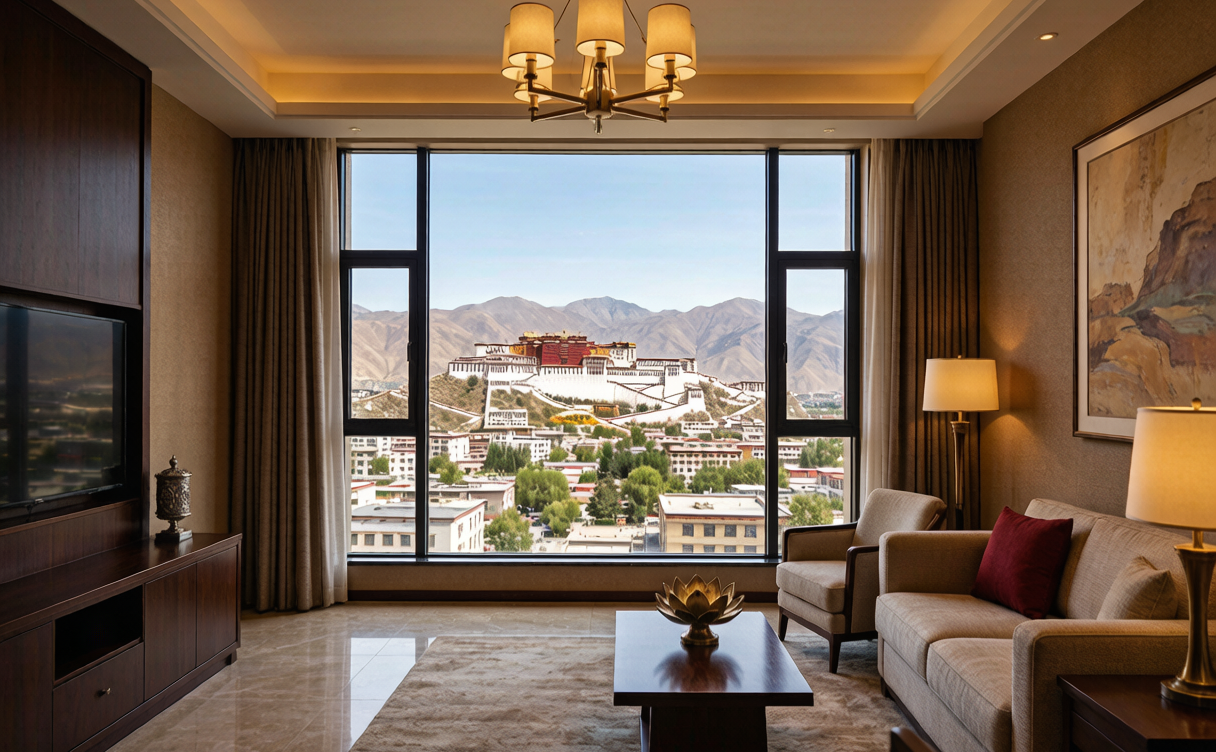
| Potala front (Chengguan west) | 25–35 min | 5–15 min | ¥400–2,800 | View rooms, international-standard heating, older travellers |
| Riverside / Liuwu new town | Taxi, 20–25 min | Taxi, 20 min | ¥250–700 | Longer stays, railway arrivals, quieter nights |
Which area is best for a first visit?
The Barkhor, almost always. You can walk the kora in the evening, eat without a taxi, and retreat to your room when the altitude makes your head swim. The trade-off is noise: the circuit is active from before dawn, and rooms facing the ring get the clatter of handcarts and conversation through single-glazed windows. Ask for a courtyard-facing or rear room, and check whether the hotel has double glazing — a detail that matters far more here than star rating.
The Potala front is the better choice if you are travelling with parents, if you want a guaranteed warm room in winter, or if the photograph of the palace lit at night from your window is the point of the trip. Rates there run higher, and the streets empty after dark, so you will take short taxi rides for dinner. Our Potala Palace guide maps the approach roads and the timed-entry queue, which is worth reading before you fix a hotel on the wrong side of the complex.
What Lhasa hotels cost, by tier
Lhasa has the widest price spread of any Chinese city I book in: the same night can cost ¥180 in a family guesthouse or ¥2,600 in a five-star suite, and both are a ten-minute walk apart. What changes with the money is heating reliability, bathroom quality, oxygen supply and English at the desk — not location.
| Tier | Typical peak (May–Oct) | Typical winter | What you actually get |
|---|---|---|---|
| International five-star | ¥1,200–2,800 | ¥700–1,600 | Central heating, humidifiers, oxygen supply in rooms, English front desk, western breakfast |
| Boutique / courtyard | ¥450–900 | ¥280–600 | Tibetan decor, small courtyards, rooftop views, thinner walls, staff who arrange guides |
| Mid-range Chinese chain | ¥300–550 | ¥180–350 | Reliable hot water, air conditioning that also heats, basic breakfast, little English |
| Guesthouse / family inn | ¥120–300 | ¥90–180 | Thick quilts, shared or simple bathroom, electric blanket, no lift; confirm foreigner registration first |
Why are Lhasa hotel prices so seasonal?
Because demand is almost entirely tourist and the supply is fixed. July and August, the National Day week in early October, and the weeks around Losar — Tibetan New Year, usually February or early March — are the pressure points; Losar is the one to watch, because pilgrimage traffic fills the cheap rooms and many family-run places close to celebrate. Late April to June and September are the sweet spot: dry, sunny, 15–22°C by day, and rates 30–40% below the summer peak. Our month-by-month guide to the best time to visit Tibet covers the festival calendar in more detail.
Oxygen, heating, hot water: the three things that decide your first night
Altitude is not a marketing line here. At 3,650 m the air holds roughly 60% of the oxygen you are used to at sea level, humidity often sits near 20%, and the temperature swings 15°C between afternoon sun and 3 a.m. The three hotel features that make the difference are oxygen, real heating and reliable hot water — in that order.
Do I need an oxygen room?
Most travellers do not, and the hotels that sell it hardest know that. A room with an oxygen concentrator or an enriched-air supply helps if you have slept badly at altitude before, are over 60, or arrive straight from a flight rather than the train. Otherwise a canister on request (typically ¥30–50 at the desk) plus a slow first day is enough. What genuinely helps is a humidifier, because the dry air is what wakes you at 3 a.m. with a sore throat, and most mid-range and up hotels can provide one if you ask at check-in rather than at midnight.
Is the heating actually warm in winter?
In the five-stars and newer chains, yes — proper radiators or underfloor heating. In guesthouses it is usually a split air-conditioner plus an electric blanket, which is adequate but not cosy, and in a few older courtyard buildings the bathroom stays cold all night. Ask two questions before booking a winter stay: is there heating in the bathroom, and is hot water 24 hours or solar-only? Solar systems are common and on a cloudy December morning the shower can run lukewarm until the tank reheats.
What is the bathroom, plug and payment situation?
Four-star and up means a seated Western toilet, paper provided, and a shower with decent pressure; mid-range chains are the same but with thinner towels. In guesthouses expect a squat pan, sometimes shared, and bring your own paper and sanitiser — the same rule applies at monasteries and public toilets around the Barkhor. Sockets are 220V with two flat pins (Type A/C, occasionally Type I), so a universal adapter covers everything. Deposits are typically ¥200–500, pre-authorised on a card at the big hotels and taken in cash at small ones. International cards work at the international brands; guesthouses usually want WeChat Pay, Alipay or cash, and foreign cards fail at a fair number of ATMs in the old town — draw yuan at the airport before you drive in.
Booking as a foreigner: permits, registration, and the front desk
Tibet is not an ordinary Chinese province to visit, and two separate rules apply to your booking.
You need a permit before you arrive. Foreign passport holders cannot travel in Tibet independently; you need a Tibet Travel Permit arranged through a registered agency, normally as part of a guided tour, and you will be asked for it when you check in for the flight or train to Lhasa. Apply 15–20 days ahead — the process needs your passport scan and Chinese visa page, and it cannot be rushed. Our guide to Tibet Travel Permits for foreigners covers the additional Alien’s Travel Permit you need for Shigatse, Everest Base Camp or Nyingchi.
Not every hotel can register you. Chinese hotels must be licensed to accept foreign guests, and a handful of small inns in the old town are domestic-only. When you book, filter for properties that list foreign passports, and if you are booking a family guesthouse directly, ask the question in writing before you pay a deposit. At check-in the desk scans your passport and files a police registration for you; it takes a few minutes and you should not be asked to do it yourself.
Can any hotel in Lhasa check in a foreign passport?
No. The licence is per property, and it is not always obvious online — a listing may accept your booking and still fail at the desk. Book through a platform that shows foreigner-friendly confirmation, or stay with the established properties: the international brands near the Potala, the long-running boutique hotels in the Barkhor lanes, and the bigger Chinese chains. Our shortlist of boutique hotels in Lhasa’s old town are all properties that regularly take foreign guests.
Getting from the airport or the station to your hotel
Gonggar Airport is about 60 km south of the city, and Lhasa railway station is 20 km west of the Barkhor. Neither is walkable, and the altitude makes hauling luggage harder than the distance suggests.
| Option | Cost (typical) | Time | Notes |
|---|---|---|---|
| Airport shuttle bus | ¥30 per person | About 70 min | Leaves from outside Gate 5 at Terminal 3; terminates on Nyingchi Road, 10–15 min walk from the Potala. Tickets via the 拉萨空港快线 mini program; buses follow incoming flights, including late arrivals |
| Taxi (negotiated) | ¥130–150 low season, ¥200–250 peak | 45 min | No meters on this route; agree the total including tolls before you get in |
| Ride-hailing | ¥180–260 | 50–60 min | Price shown upfront, which removes the haggling; works well for 2–4 people with bags |
| Hotel pickup | ¥300–500 | 45 min | Worth it if you are arriving late with children or worried about altitude |
| From the railway station | Typically ¥40–60 by taxi | 25–35 min | Trains from Xining arrive after a 21-hour climb; the Qinghai–Tibet train guide explains the oxygen supply on board |
Take the bus if you are alone, the taxi if you are two or more, and the hotel car if it is your first high-altitude arrival. The shuttle drops you on Nyingchi Road, which is fine for the Potala front but a ¥10–15 taxi from a Barkhor courtyard alley — worth knowing at 9 p.m. with a suitcase.
Rooms worth paying extra for
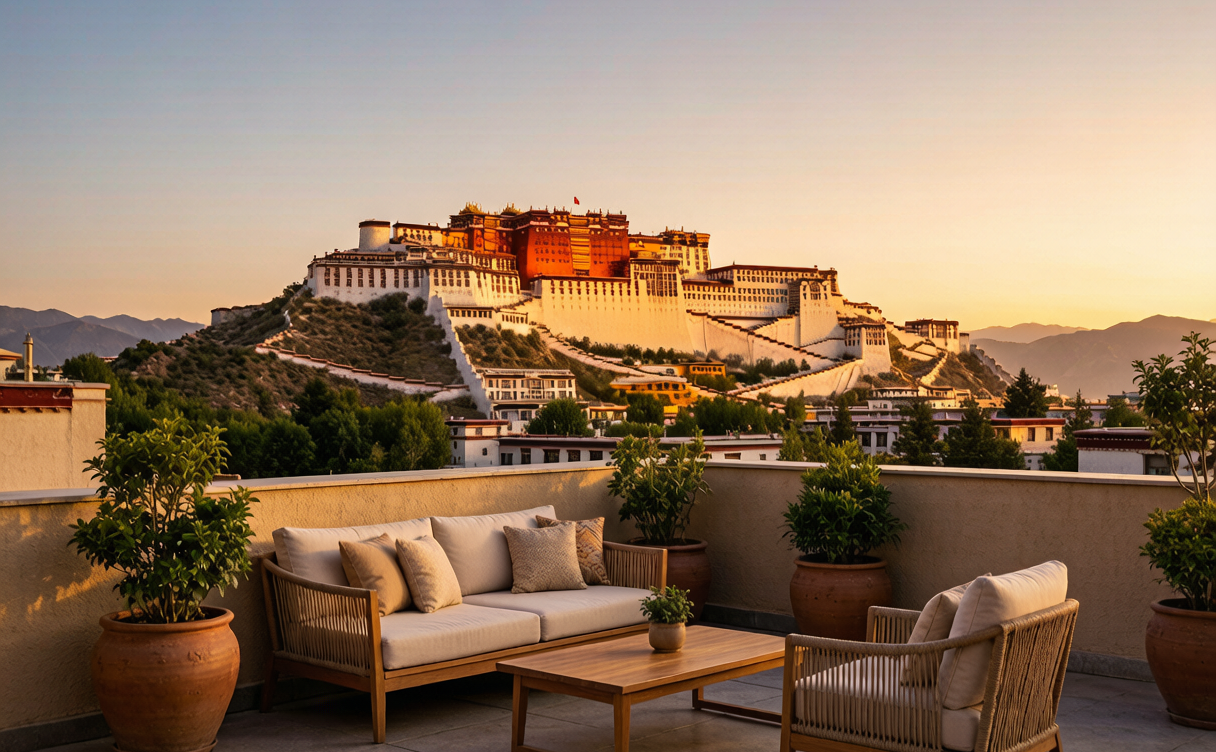
Three upgrades earn their money in Lhasa. A Potala-view room on a high floor, because the palace is lit until late and the view is the one photograph you will keep. A courtyard room in the Barkhor instead of a street-facing one, for the noise reason above. And a lower floor if you are arriving by air and feeling the altitude — Lhasa lifts are slow and small, and climbing four flights with a bag at 3,650 m is a genuinely unpleasant introduction.
At the top of the market, the international five-stars near the Potala and the long-established resorts on the eastern edge of the old town set the standard for heating and oxygen; the St. Regis, Shangri-La and InterContinental names are the ones most foreign travellers recognise, and all three are set up for altitude. In the middle, the Barkhor’s courtyard boutiques — the kind of places with a rooftop terrace and a wood-burning stove in the lobby — trade facilities for atmosphere. At the bottom, family guesthouses around the Jokhang offer thick quilts and shared bathrooms at a third of the price; check the registration question first.
Wherever you land, keep the first afternoon empty. Walk the Barkhor slowly, drink water instead of beer, and eat something plain — the guide to Tibetan food will tell you what settles well at altitude and what does not.
A three-night plan built around your hotel
Night one: arrive, check in, walk 20 minutes, sleep. Day two: Jokhang in the morning when the pilgrim queue is longest and most photogenic, the Barkhor at midday, and the Potala in the afternoon on a timed slot you booked the day before. Day three: a monastery outside the city — Sera for the monk debates in the afternoon, or Ganden for the views — then an early dinner. Day four: leave, or extend east.
This is deliberately unambitious. Groups that stack the Potala, Jokhang and a monastery into one day spend the second day in bed with a headache, and the hotel becomes the whole trip. If you are continuing overland, the Lhasa and Tibet travel guide lays out the onward routes; if you are coming from the east, the Chengdu guide covers the flights with the most reliable connections, and the Xining guide covers the rail alternative that acclimatises you gradually. Leave by rail and the natural next stop is the Terracotta Army — our Xi’an travel guide explains how to connect the plateau with the old capital.
Frequently asked questions
How much does a good hotel in Lhasa cost per night?
Typical peak-season rates run ¥300–550 for a reliable mid-range chain, ¥450–900 for a courtyard boutique and ¥1,200–2,800 for an international five-star. Winter drops 30–50%. Rates swing hardest around Losar and the first week of October.
Do Lhasa hotels provide oxygen?
Most four- and five-star properties have oxygen supply or concentrators in rooms, and mid-range hotels can usually lend a canister for ¥30–50 a day. Guesthouses generally do not, so ask before booking if you know you struggle at altitude.
Can I book a Lhasa hotel without a tour?
You can book the room, but you cannot legally travel in Tibet without a permit arranged by a registered agency, usually as part of a guided itinerary. Confirm the permit before you pay for accommodation, because it is checked when you board the flight or train.
Is the Barkhor too noisy for light sleepers?
Street-facing rooms are noisy from before dawn until late, since the kora runs around the clock. Ask for a courtyard-facing room or a higher floor, and check for double glazing — it is the single most useful question you can put to a Barkhor hotel.
How far is Lhasa airport from the hotels?
Gonggar Airport is about 60 km south, roughly 45 minutes by car or 70 minutes on the ¥30 shuttle, which terminates on Nyingchi Road near the Potala. Allow three hours before departure for the return, since the airport is small and the check-in queue is slow.
For regional context and official notices on travel in the Tibet Autonomous Region, the tibet.cn portal publishes government and tourism announcements, though not in English for every item. Hotel rates can be compared by neighbourhood on Trip.com, which lists Lhasa properties that accept foreign passports.
Pick the neighbourhood for the walk you want at 7 a.m., pay for heating rather than a view if you are travelling between November and March, and settle the permit and the registration question before anything else. Everything else in Lhasa — the pilgrims, the palace, the light on the plateau — arrives on its own schedule.