

There is no border post where you can simply show up and walk into the plateau. To set foot in Tibet, China as a foreign visitor you need paperwork arranged in advance, arranged by somebody licensed, and arranged before your flight or train ticket is non-refundable. This Tibet travel permits guide explains exactly which documents apply to you, how long the process takes, what the rules look like in practice at the checkpoints, and where people go wrong when they try to save money by booking a seat first and the paperwork second.
Start with the good news: Tibet has been open to foreign individual travellers for years, the process is well documented, and every permit I describe below can be handled by a licensed agency in Lhasa. The complexity is real but it is manageable, and it is mostly a matter of timing.
[CTA] If you are planning a Tibet, China trip this year, sort the paperwork before you book anything non-refundable, and read our Lhasa travel guide for what to do once you land. Fill in your dates below and we will tell you which permit class you fall under.
Two weeks is comfortable, three is realistic in peak season, one is a gamble.
[/CTA]
The Two Documents That Matter
In practice foreign visitors deal with two papers. The first is the Tibet Travel Permit, often called the TPS or Tibet permit, issued by the Tibet Autonomous Region public security authorities and stamped with your passport number, name in Latin characters, and the route and dates you are cleared for. The second is the Military Permit, required when your itinerary touches restricted border counties — parts of the far west and south of the region, close to the Himalayan frontier.
Most standard Lhasa-based itineraries need only the first one. Add Everest Base Camp, Mount Kailash, or the far western counties and the second comes into play. Your agency files for both; you never queue for either.
Tibet Group Visa and the Question of a Regular Tourist Visa
This is where most first-timers get confused, because the advice online swings between two contradictory claims: that you must join an organised tour, and that you can travel independently. The honest version is that the Chinese tourist L visa works fine, but your Tibet permit has to be issued against a filed itinerary, which means somebody with a licence has to submit it for you. In other words, you travel on your own schedule but through an agency, not as a forced shopping tour.
The so-called Tibet group visa is a notation some consulates still apply to L visas for travel to the region, and some travel agents recommend it for peace of mind. What it does not do is let you skip the Tibet permit. Ask your agency early whether your consulate issues it, because a couple of mission configurations take longer.
For most nationalities the answer to how to get a Tibet permit is the same answer: one email to a licensed operator with your passport scan, and they carry the filing. Nationality only changes the paperwork around the Chinese visa itself, not the plateau permit, which is issued on the same form for everyone.
How to Get a Tibet Permit Without a Headache
You apply through a travel company holding a Tibet travel licence. Send these by email: passport scan (photo page), passport size photo, your flight or train number, your first-touch date in Lhasa, and your hotel name. Costs typically land between 300 and 700 RMB for the permit itself, with car, driver and guide quoted separately by the day.
Lead time runs from five working days in the low season to three weeks in May, September and October. If you are arriving from a neighbouring country in Asia and want to fold Tibet into a longer trip, apply for your Chinese visa first, then the permit, then the transport.
[CTA] Booking the wrong sequence is the single most expensive mistake on this route. Tell us your arrival city and we will stage the application in the right order, then match you with a licensed operator.
Most rejections are administrative, not political, and they are fixable in a day.
[/CTA]
What the Tibet Travel Restrictions Feel Like on the Ground
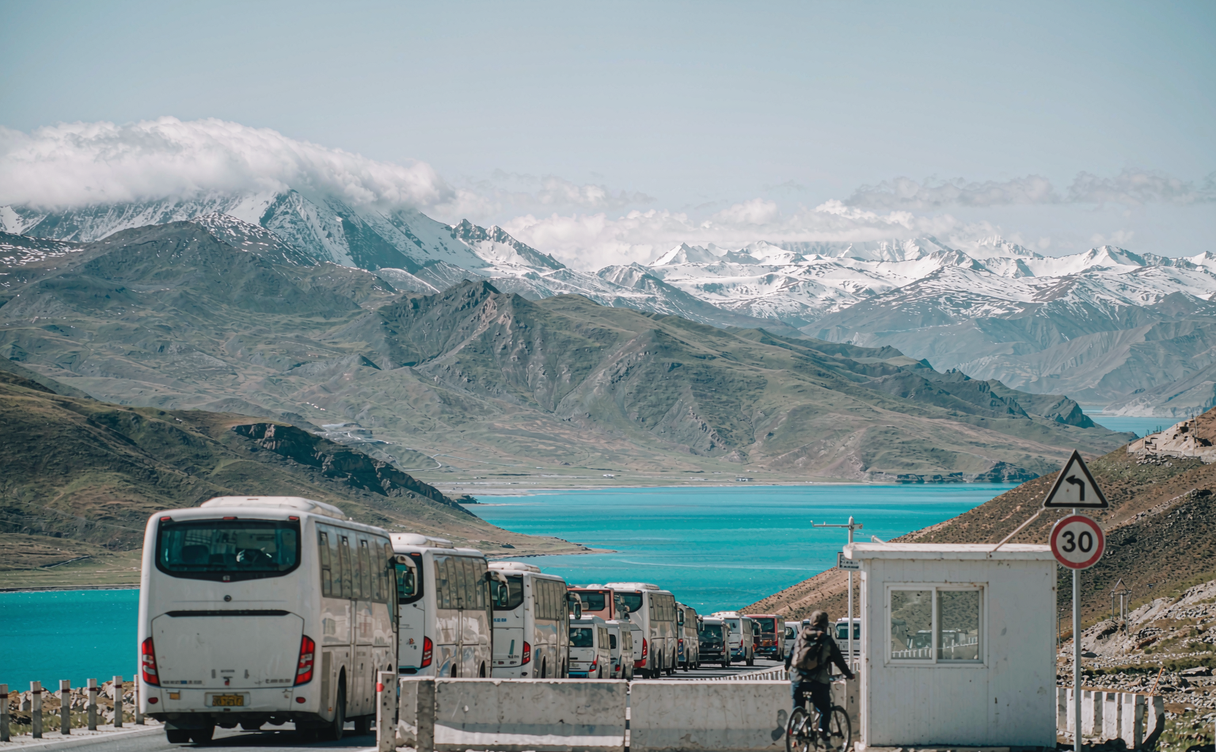
Tibet travel restrictions are often described in alarming terms, then rarely explained. On the ground you meet them as three checkpoint stops, mostly on the road out of Lhasa, where police or border officials scan your passport, check the validity date on your Tibet permit, and sometimes photograph you and the vehicle. Waiting takes five minutes at the busiest and twenty five at the worst hour of a holiday weekend.
The restrictions that actually affect a normal itinerary are narrow: you cannot detour into restricted counties without clearance, you cannot hike off marked routes near the frontier, and you will be with a guide in a registered vehicle. Inside Lhasa and around the mainstream monasteries none of this is visible.
Tibet Tour Permit Tips From People Who Have Done It
Treat the permit as route-specific. If the paper clears you for Lhasa and Yamdrok Lake but your driver wants to shortcut over a pass, expect to be turned around. Carry the printed permit in your hand luggage, with a photocopy of your passport, at every stop.
Photograph your permit the moment you receive it, because agencies send scans and the paper itself is thin. Keep the paper dry — it is laminated but not immortal. And never let anyone tell you the permit is unnecessary because you will arrive on an international flight to Lhasa; it is checked at the airport arrivals hall as often as on the road.
Getting Into Tibet, China: Train, Flight, Land
Three ways in. The Qinghai Tibet train from Golmud to Lhasa takes around twelve to thirteen hours overnight, with hard-sleeper berths at roughly 200 to 300 RMB and soft sleeper around 400 to 500; the scenery through Kunlun and Tanggula is the reason people choose it. Flights into Lhasa Gonggar airport run about an hour from Chengdu, two from Xian, and are the fastest option if you are short on time.
Overland from Nepal has been inconsistent for years at Kodari and Gyirong, so if your plan depends on a land arrival, confirm with your agency and your embassy before buying. A useful read before you decide is our China Tibet train guide, which breaks down berths, jet lag and altitude on the Golmud leg.
After the Paperwork: What Your Days Look Like
Once you are cleared, the region opens up properly. Most itineraries start with two acclimatisation days in Lhasa at 3,650 metres, then a drive south to Yamdrok Lake and the monastery on the hill above it, then the Potala Palace and the three great monasteries of Drepung, Sera and Tashilhunpo.
A couple of Tibet tour permit tips from the ones worth repeating: never accept a quote that bundles a permit but names no operator licence number, and never agree to a date range that does not cover your full stay. Tibet permit for foreigners questions almost always come down to time, not money. For the weights and timings of the classic routes, see the Yamdrok Lake guide for the first day trip most people take out of the capital, and the Drepung Monastery guide for the largest of the three monasteries above Lhasa. If your permit goes further west, Tashilhunpo Monastery in Shigatse is worth a full morning on its own, and it is the one people wish they had given more time to.
Monument architecture, not paperwork, is what people remember. Before you go, read the Potala Palace listing on the UNESCO World Heritage site — worth doing the night before, not the morning of.
The Mistakes That Cost People Trips
Booking a train to Lhasa before the permit is approved is the classic. So is arriving in Lhasa on a flight you cannot rebook when the filing needs an itinerary. Third is trusting a booking site that sells a Lhasa hotel package with no permit at all — if the price looks too low for a full day in a registered vehicle, the permit is missing.
One more: leaving the application to the week of arrival. In peak season the authority needs time, and no agency can fast track it by magic. A rejected filing usually means one of three things — a name spelling that does not match your passport machine-readable zone, a date range that ends before your return leg, or a permit already issued to someone using your passport number by accident. Read every line of the scan before you sign anything.
A Sensible Order of Operations
Secure your Chinese visa, choose your month, pick Lhasa as the entry city, apply through the agency for the Tibet travel permit, then buy transport once the paper exists. Plan the back half of the trip around your altitude tolerance rather than your energy, because the first two days on the plateau are not negotiable.
For a comparison of overland routes from the east, read the Sichuan Tibet highway guide — the G318 drive from Chengdu is an adventure, but it is not a shortcut around the paperwork.
[CTA] Still deciding? Send us your nationality and intended month. Rules differ by passport, and we will spell out your exact permit list, the likely lead time, and what it will cost before you commit to anything.
We would rather talk you out of a rushed application than fix a rejected one later.
[/CTA]