

Most travelers who come to Fujian fly straight into Xiamen and never set foot in Fuzhou, which is a real pity. The provincial capital keeps a compact, walkable historic core that is one of the best preserved Ming and Qing residential quarters anywhere in southeast China. Any useful Sanfang Qixiang guide has to start with the name itself: “Sanfang” means three lanes, and “Qixiang” means seven alleys, a tidy grid of narrow streets where scholar-officials and wealthy merchants built timber courtyard homes over the last eight hundred years.
The district sits just west of the central Wuyi Road, roughly a fifteen-minute taxi ride from Fuzhou Railway Station and an easy metro hop from the Dongjiekou area. You do not need a ticket to walk the lanes, which is a big part of why it works so well as a low-stress afternoon. The shops, cafes, and museums generally open around 9 a.m. and wind down near 9 p.m., though the streets themselves stay busy well into the evening. If you are building a wider Fujian plan, our Fuzhou travel guide covers hotels near the old town and how to get in from the airport.
Reading the map before you walk
The three lanes run north to south on the western half of the block, while the seven alleys sit parallel on the east. The main commercial spine is Nanhou Street, which gets crowded on weekends but is worth a single stroll for the snack stalls and the restored shopfronts. The quieter side lanes are where you will find the converted residences, small exhibition halls, and the kind of hush that makes the wooden lattice windows worth a photograph.
A sensible Fuzhou old town walking route begins at the north end of Yijin Lane, cuts across to the museum residences on Wenru Lane, and finishes at the south gate near the snack cluster on Nanhou Street. Plan on two to three hours if you want to step inside the paid courtyards, and longer if you stop for tea. Comfortable shoes matter: the lanes are paved with flat stone slabs that turn slick after rain.
Walking the three lanes
Yijin Lane is the northernmost and the calmest of the three. It is lined with low timber houses whose carved doorframes have been carefully repaired, and it is where you will find a few independent bookshops and tea studios that have moved into old buildings. Early morning is the best time here, before the day-trippers arrive from the high-speed trains.
Wenru Lane sits in the middle and carries most of the museum weight. The former residence of Lin Zexu, the Qing official best known outside China for the Opium War era, is the headline stop: a calm, low compound with a pond, a reading studio, and a small exhibition on his career. The residence of Yan Fu, an important translator and thinker who introduced Western ideas to a Chinese readership, is smaller and almost always quieter. Both are covered by the combined museum pass if you buy the through ticket at the main gate.
Guanglu Lane forms the southern edge and feels more lived-in, with residents still hanging laundry and riding electric bikes through the narrow mouth. It is a good reminder that this is a neighborhood, not a sealed museum set, and the slightly rough edges are part of the charm.
The seven alleys and what hides between them
The alleys are narrower than the lanes and easy to skip, but they hold some of the better photo corners. The alleys connect the lane system like rungs on a ladder, and several have been given over to craft demonstrations: paper umbrellas, lacquerware, and the local bodiless lacquer technique that Fuzhou is quietly famous for. If you only pick one, walk the stretch that opens onto the back wall of the Lin Zexu residence, where the light falls nicely in the late afternoon.
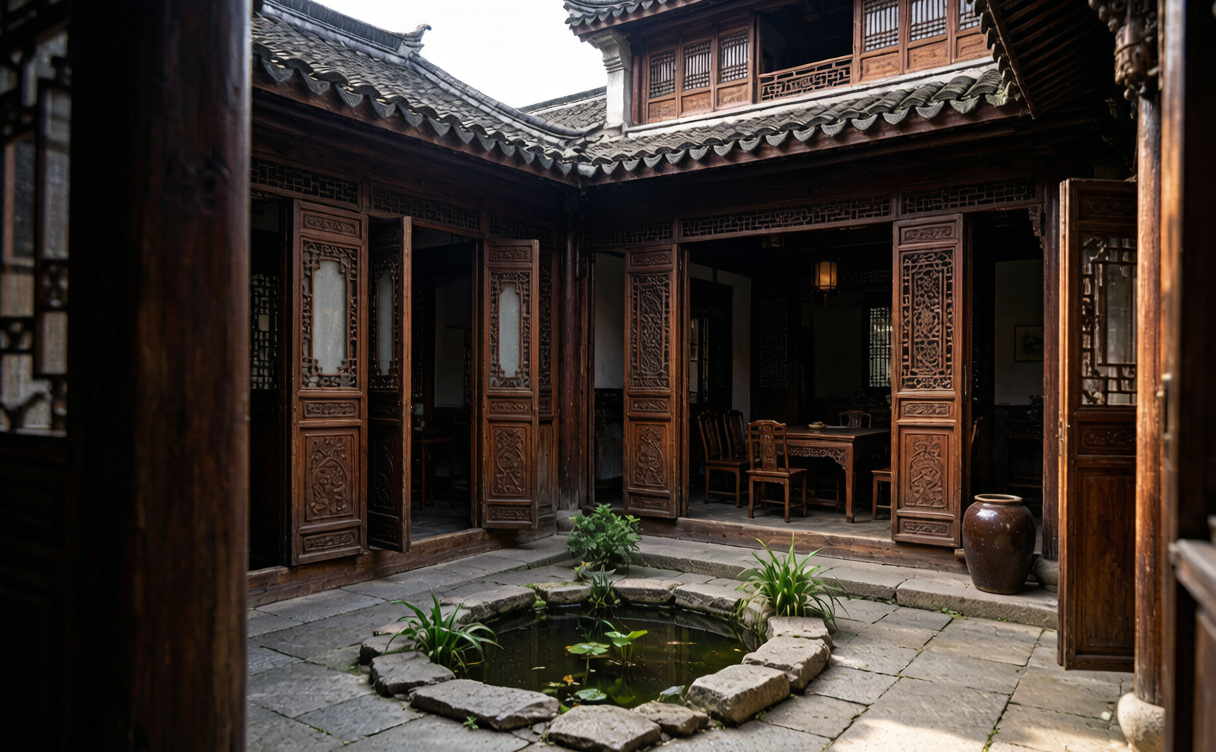
Take your time in the gaps between buildings. The district was laid out so that each residence opened onto a lane but turned its back to the alley, which means the alley side shows you plain whitewashed walls and the occasional moon gate rather than the decorated facades. It is a small lesson in how privacy was built into the old city.
Courtyard museums worth the ticket
Beyond Lin Zexu and Yan Fu, a handful of other residences open to visitors on a rotating basis, and the ticket office posts which ones are active that month. The standard combined pass covers two or three courtyards and costs a modest sum that is easy to justify if the weather keeps you indoors. Inside, expect the same grammar everywhere: a screen wall at the entrance to block straight-line views, a central courtyard for light and rain, and carved timber screens that slide open to connect rooms.
The carpentry is the real attraction. Fuzhou’s builders favored softwood frames with intricate bracket sets, and many of the surviving screens show scenes from opera and folklore cut with a steady hand. Guides at the door speak limited English, so a translation app helps, or simply wander and read the bilingual placards.
Eating your way through the lanes
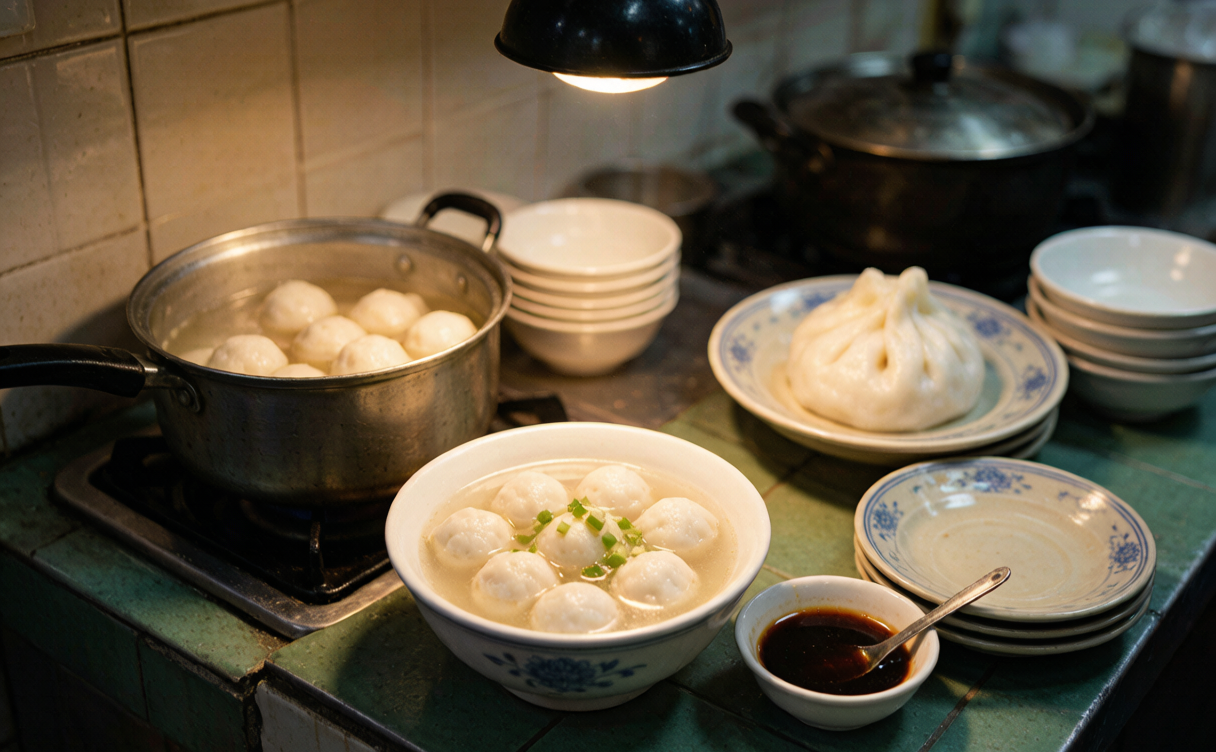
You cannot write a Sanfang Qixiang guide without spending real time on the food. Fuzhou snacks run lighter and a little sweeter than the rest of Fujian, and the lanes are the single easiest place in the city to sample a spread in one walk. The dish to try first is Fuzhou fish balls, pork-stuffed fish paste dropped into a clear broth and sold by the bowl at counters along Nanhou Street. Next come the steamed rice cakes called zheng jiao, and the red-yeast rice wine snacks that appear near festival dates.
For a proper sit-down, step off the main spine into a side-alley restaurant and order a few Min dishes to share. Our Fujian Min cuisine guide explains the sweet-and-sour balance and the seafood-heavy pantry that defines the local table. Budget around 40 to 70 yuan per person for a snack crawl, and roughly double that if you sit down for a meal with a local soup and a vegetable dish.
A Sanfang Qixiang night visit
The Sanfang Qixiang opening hours are effectively all day for the streets, with the museum buildings closing around 5 p.m. The best light for photography is the first hour after the museums unlock, before tour groups fill the lanes. A Sanfang Qixiang night visit is a different mood entirely: the lanterns come on, the worst of the daytime crowd thins after 8 p.m., and the timber facades glow under warm light. Street food stalls stay open latest, so dinner here is simple and cheap.
If you enjoy browsing evening food streets in general, the wider China night markets guide covers what to expect in other cities, but Fuzhou’s lanes are calmer and more historic than a typical night market, and easier to enjoy if you dislike being jostled.
Best season and practical timing
Spring and autumn are the comfortable seasons, with mild temperatures and low humidity. Summer is hot and sticky, so start early and use the shaded lanes and tea houses to break up the heat. Winter is damp and cool rather than freezing, and the lanes are nearly empty, which photographers tend to love. Avoid the first week of October and the Spring Festival if you can, when domestic tourists pack the narrow streets.
Give the district a half day on a normal visit. If you are slow with museums and snacks, a full day is comfortable and lets you catch both the morning calm and the evening glow. Fuzhou works well as a stop between the coast and the interior, and many travelers pair it with Quanzhou and Xiamen to the south, or use it as a base before heading into the upland villages of the province.
For a broader picture of preserved towns across the country, see our best ancient towns in China list, which rates Sanfang Qixiang alongside canal towns and walled cities elsewhere.
Getting there and small comforts
Fuzhou’s metro reaches the edge of the old town on Line 1 near Dongjiekou, followed by a ten-minute walk. Taxis and ride-hailing apps are cheap and abundant, and the drivers know the district by its Chinese name. Public toilets near the main gates are clean, and there are tea houses and cafes at regular intervals if you need a rest or a charge for your phone.
The area is managed as a national historic and cultural block, and official tourism information, including preservation status and seasonal events, is published by the Ministry of Culture and Tourism of China.