

It happens on about day nine. You are standing in a Jingdezhen ceramics studio holding a tea set that will not survive a baggage carousel, and your suitcase is already 4kg over. Shipping souvenirs home from China is straightforward once you know which counter to walk into, but the price gap between the cheapest and most expensive option is enormous — often four times — and a handful of items will get your parcel opened, held or destroyed.
This guide covers the four realistic shipping routes, what each costs, the packing that actually protects ceramics, the prohibited list, and what to do when a parcel goes missing.
Ship or Carry? Do the Maths First
Excess baggage on a long-haul flight out of China typically runs ¥800–1,500 (about US$110–210) for one additional checked bag, bought at the airport. An additional bag bought online in advance is usually cheaper. Against that, a 10kg sea parcel might cost ¥400 and a 10kg express parcel ¥1,200.
The rough rule:
- Under 5kg and unbreakable — carry it. Shipping rarely wins.
- 5–20kg, not urgent — ship by sea or economy air.
- Fragile at any weight — ship it, professionally packed. Airline handling destroys ceramics.
- High value, insured — express courier, always.
- Anything you want a tax refund on — carry it. Goods must physically leave China with you to qualify, as our China departure tax refund guide explains. Mail it and the refund is gone.
Also check your home country’s import threshold. Most allow personal gifts under a modest value duty-free; above it you pay import duty, VAT and a broker fee on arrival, which can add several hundred renminbi to the true cost.
Your Four Options, Compared
| Service | Typical cost, 5kg to Europe/US | Transit time | Best for |
|—|—|—|—|
| China Post surface/sea | ¥250–450 (US$35–63) | 6–12 weeks | Books, textiles, non-urgent bulk |
| China Post air parcel / e-packet | ¥400–700 (US$56–98) | 2–5 weeks | Mid-weight, low-value goods |
| China Post EMS | ¥600–950 (US$84–133) | 7–15 days | Balanced cost and speed |
| SF Express International | ¥700–1,100 (US$98–154) | 5–10 days | Reliable tracking, good app |
| DHL / FedEx / UPS | ¥1,100–2,200 (US$154–308) | 3–6 days | Fragile, valuable, urgent |
Prices are indicative for 2026 and vary by destination, dimensional weight and fuel surcharge. Ask for a quote by both actual and volumetric weight — a box of silk lanterns is light but bulky, and you pay on volume.
China Post EMS is the workhorse, and the China Post EMS international parcel cost sits neatly between cheap surface mail and express couriers. It is available in every city, accepts walk-ins, handles customs paperwork itself, and tracks reasonably well. SF Express international shipping from China (顺丰) has improved sharply; its app has an English interface and its couriers will collect from your hotel. The integrators — DHL, FedEx, UPS — cost roughly double but are the only sensible choice for anything you would be upset to lose.
Step-by-Step: Sending a Parcel from a China Post Branch
1. Find a branch that handles international post. Not all do. Green signage reading 中国邮政; ask your hotel to confirm the nearest international counter, ideally by phone.
2. Bring your passport. Real-name registration applies to all parcels in China. No passport, no parcel.
3. Do not seal the box. Staff will inspect the contents before it is closed. Arrive with everything loose or lightly wrapped.
4. Buy packaging on site. Boxes cost ¥10–40 depending on size, plus tape and bubble wrap. Post office boxes are sturdier than shop boxes.
5. Choose the service. Say EMS for speed, 航空 (air) for a middle option, 水陆路 (surface) for the cheapest. Ask for the price of each before deciding.
6. Complete the CN22/CN23 form. This is the China parcel customs declaration tourist shipments live or die by, and English is fine. Describe contents specifically — “green tea, 500g” and “ceramic teapot, 1 pc”, not “gift” or “souvenirs”. Vague declarations are the single biggest cause of delay at the destination.
7. Declare a realistic value. Under-declaring to dodge duty is a customs offence in most destination countries and voids your insurance. Over-declaring costs you duty you did not owe.
8. Add insurance. Usually 1–3% of declared value, capped. Worth it above ¥1,000.
9. Pay and keep the receipt. Cash, Alipay and WeChat Pay are accepted almost everywhere. Photograph the tracking number before you leave the counter.
10. Total time on site: 30 to 60 minutes, longer at weekends. Bring patience and a translation app.
Using SF Express and Hotel Pickup
If a post office queue does not appeal, SF Express will collect. Book through the SF Express mini program inside WeChat, or ask your hotel’s front desk to call — most business hotels do this daily and will hold the parcel for the courier if you have checked out. You will need your passport number for the booking and your ID at handover.
Pack before the courier arrives, but again leave the box open for inspection. The courier weighs and measures on the spot with a handheld terminal, quotes the price, and takes payment by mobile wallet. If you have not yet set up payments, our guide to Alipay and WeChat Pay for foreigners covers binding an overseas card — cash is not always accepted by couriers.
Many larger shops will also ship for you. Ceramics studios in Jingdezhen, tea merchants in Hangzhou and carpet dealers in Xinjiang, China routinely arrange international freight and pack far better than you will. Get the quote in writing, insist on a tracking number, and pay by card or wallet rather than cash so there is a record.
What Cannot Be Mailed Out of China
This list is not negotiable, and enforcement is consistent. Prohibited or heavily restricted for export by post:
- Antiques and cultural relics. Anything genuinely pre-1949 requires official authorisation and a red wax seal. Buy from licensed dealers who provide the export certificate, or buy reproductions.
- Ivory, coral, tortoiseshell, and products from protected species — including some traditional medicines. These are also illegal to import almost everywhere.
- Alcohol and liquids above small limits by air; most couriers refuse spirits outright.
- Lithium batteries and power banks, and devices containing them, on most air services. Surface post is also restricted.
- Aerosols, lighters, matches, perfumes and nail polish — flammables of any kind.
- Fresh food, meat, seeds, plants and soil. Dried and sealed tea is generally fine; check your own country’s rules, as some are strict about plant material.
- Counterfeit branded goods. Seized at both ends.
- Currency above declaration thresholds, and any weapon-like object, including decorative swords.
Sealed, commercially packaged tea is the classic China parcel and travels well. Loose tea in a paper bag may be questioned. Traditional medicine is the grey area — many formulations contain restricted animal or plant material, and the safest approach is not to send it.
For the current prohibited and restricted export lists, check the General Administration of Customs of China before you buy anything unusual, and verify your home country’s import rules too.
How to Pack Tea and Ceramics for Shipping
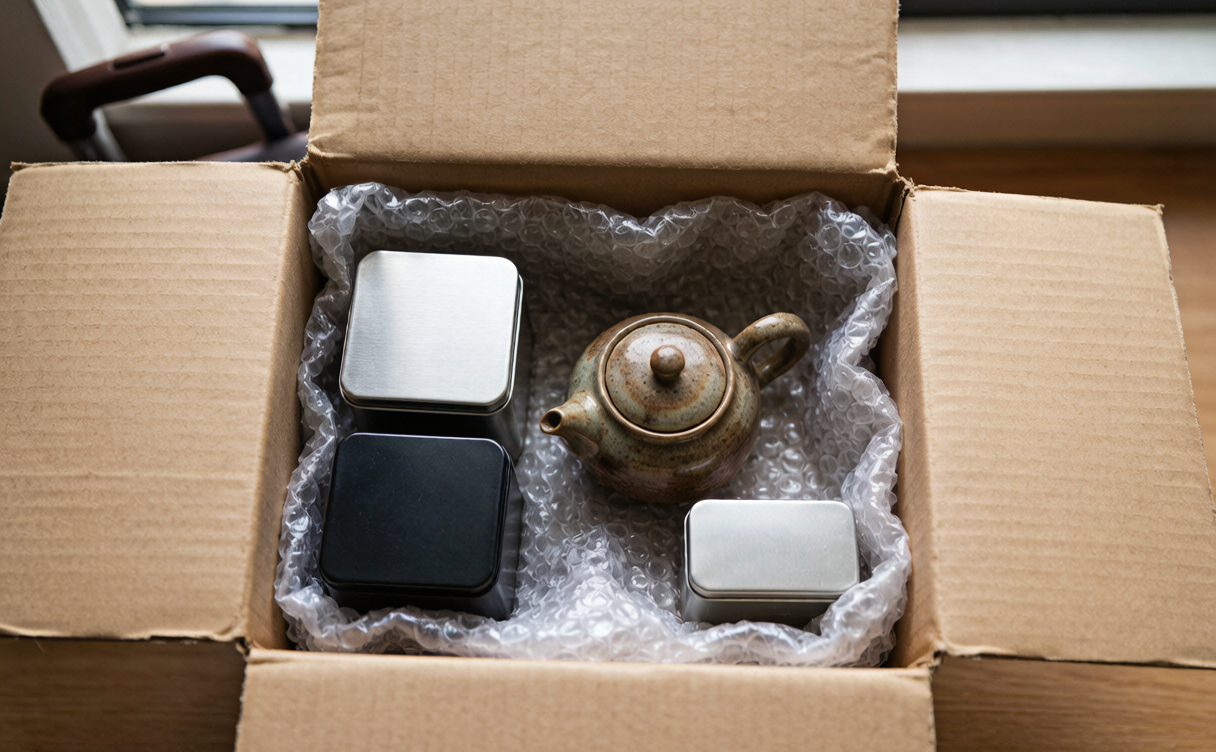
Ceramics need double-boxing. Wrap each piece in bubble wrap until it feels like a cushion, fill every cavity — teapot spouts and lids especially — then place the wrapped pieces in an inner box with at least 5cm of crumpled paper on all sides. Put that box inside a larger one with another 5cm of padding. Lids should be wrapped separately from bodies. A well-packed box should make no sound when shaken.
Tea absorbs odours, so keep it in its original sealed tins or foil pouches, tape the lids, and do not pack it beside anything scented.
Silk, embroidery and scrolls need a plastic layer against moisture, especially on a six-week sea shipment. Roll scrolls rather than folding and ship them in a rigid tube.
Label the box with your destination address in capital Roman letters and your phone number in international format, and put a duplicate copy of the address inside.
When It Goes Wrong
Tracking has not updated for two weeks. Normal for surface mail, and common for air parcels queuing at destination customs. Give it 30 days before escalating.
Customs at the destination has held it. You will usually get a letter or SMS asking for an invoice and a duty payment. Respond quickly — unclaimed parcels are returned or destroyed.
The parcel arrives damaged. Photograph the box before opening it, then the contents. File with the carrier at the destination end within their claim window, usually 14 to 30 days.
It never arrives. File a trace using your tracking number. Compensation without insurance is minimal — often a few hundred renminbi regardless of value.
Common pitfalls: sealing the box before you reach the counter; writing “gift” on the declaration; forgetting your passport; shipping something you could have claimed tax back on; and leaving all of this to your final morning. Do it three or four days before departure so there is time to fix problems.
Plan the shopping side properly and the shipping becomes a footnote — our China shopping and souvenirs guide covers what is genuinely worth buying, the packing list for first-timers explains how to leave suitcase room in the first place, and the China travel guide for first-timers sorts the apps and paperwork you will need at the counter.