

The first time I walked through the gate of the Humble Administrator’s Garden, I stopped talking mid-sentence. A narrow doorway opened onto a wide pond, a pavilion floating on the water, and a willow tree leaning so perfectly toward the reflection that it looked painted. This is the garden people mean when they say “Suzhou garden” — the one that shows up on postcards, the one UNESCO lists first, and the one I tell every friend to visit before anything else in the city.
Zhuozheng Yuan (拙政园), as locals call it, is the largest of Suzhou’s classical gardens and widely considered the finest. I’ve been three times now, in different seasons, and it has never felt the same twice. Below is everything I wish someone had handed me before my first visit: how to get there from Shanghai, what to actually look at, and how to dodge the worst of the crowds.
Getting There from Shanghai
Suzhou sits about 100 km west of Shanghai, and the train is the only sane way to do it as a day trip. I always take the high-speed rail (G-train) from Shanghai Hongqiao Railway Station. Trains leave roughly every 10–20 minutes, and the ride takes 23–30 minutes. Buy your ticket on the 12306 app or at the station; I recommend arriving 30 minutes early during holidays.
Get off at Suzhou Railway Station (苏州站), not Suzhou North. From the main station exit, the garden is only about 1.5 km away. I usually hop in a taxi (10 minutes, ¥12–15) or walk 20 minutes straight down Renmin Road. The garden’s north gate onDongbei Jie is the entrance you want.
If you’d rather not navigate transit yourself, the Suzhou travel guide on our site lays out buses, taxi apps, and a full half-day walking route that pairs this garden with the nearby museum.
What to See
The garden covers about 5.2 hectares, and it’s split into two distinct halves. Most visitors only see the eastern and central sections, which is a mistake. Here’s how I divide it:
The Central Section (the heart)
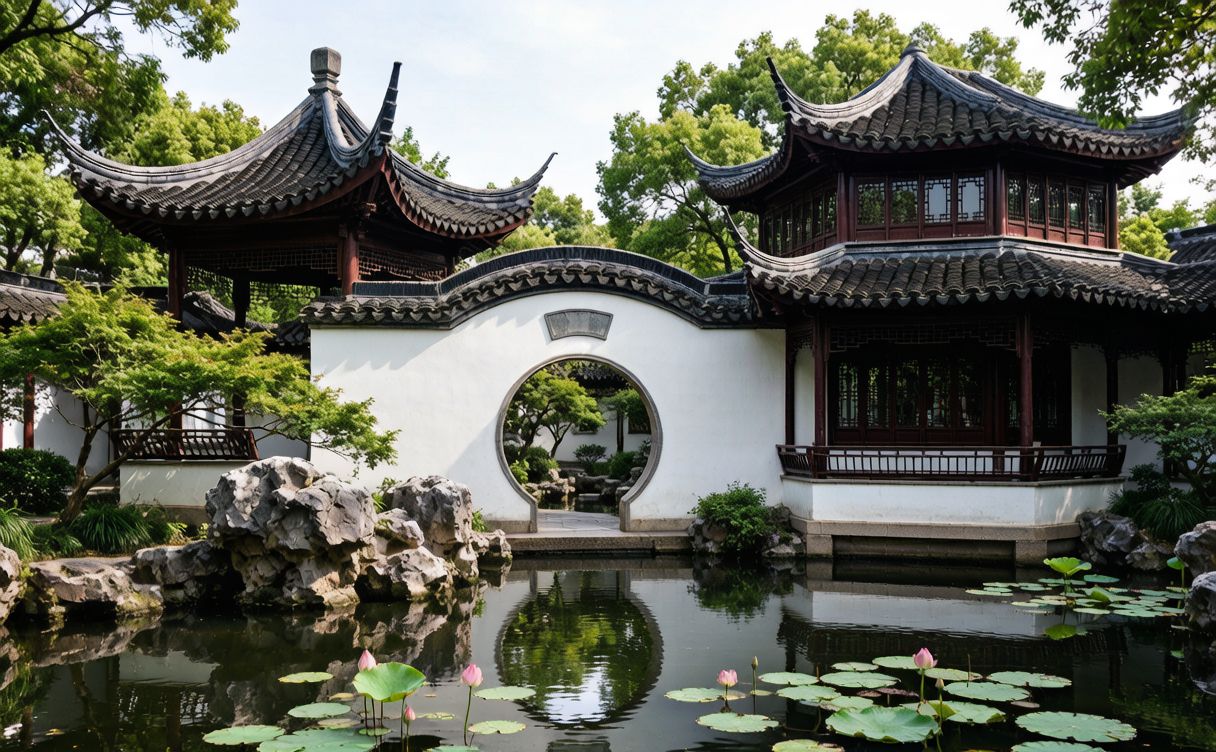
This is the postcard view. A central pond dominates the space, with the Faraway Fragrance Hall (Yuanxiang Tang) sitting right on the water’s edge. I like to sit on the stone steps here for ten minutes and just watch the koi. North of the pond, the Lotus Pavilion and Seeing-from-Afar Tower give you the classic layered perspective — water, bridge, roof, tree, sky — that Suzhou gardens are famous for.
The Western Section
Smaller and quieter, with a complementary pond and a long, covered corridor I find more peaceful than the central crush. The Tower of Floating Green (Fuliang Ge) is my favorite spot for photos without a hundred strangers in the frame.
The Eastern Section
More open and somewhat reconstructed, with lawns and a large rockery. I treat this as the warm-up or cool-down, not the main event.
A Bit of History
Knowing the backstory made me look at the place differently. The garden was built in 1509 by Wang Xianchen, a retired imperial censor who’d had enough of court politics. The name comes from a line in a Jin-dynasty essay about a humble official who tended his own vegetables — Wang saw himself as that man, stepping back from power. Over the centuries the property was split, sold, merged, and damaged, then restored in the 20th century. When I stand by the pond now, I like that I’m walking the same layout a frustrated bureaucrat designed 500 years ago to console himself. It’s a quiet, very Chinese idea of retirement.
Garden Highlights
After three visits, these are the corners I return to every time:
- Lotus blooms in summer. The pond fills with lotus from June to August. Go early and the whole surface smells faintly sweet. It’s where the garden gets its name — the original owner, a retired official, wrote of living simply among vegetables and lotus, a “humble administrator.”
- The borrowed scenery trick. Stand on the west embankment and you’ll “borrow” the pagoda of the nearby North Temple Pagoda into your view. Suzhou designers used this trick everywhere, pulling distant landmarks into the garden frame.
- The covered corridors. Nearly 1 km of roofed walkways connect the spaces, so you stay dry in rain and shaded in summer. I’ve walked them slowly in a downpour and enjoyed it more than a sunny afternoon.
- Seasonal color. March apricot and April peony, November maples. Timing your visit by flower is the easiest way to beat crowd fatigue.
Tips
These are the things that actually changed my experience:
- Go at opening, not after lunch. The gate opens at 7:30 a.m. (summer) or 7:30–8:00 (winter). I arrive 15 minutes early. The first hour is magical and nearly empty. By 10:30 it’s packed.
- Buy tickets online. The official WeChat mini-program or Trip.com. Entry is ¥70 (peak season, April–October) or ¥50 (off-season). Scanning a QR code at the gate saved me a 40-minute queue.
- Avoid Chinese public holidays entirely. May Day (May 1–5) and National Day (Oct 1–7) turn the paths into a slow human river. If your trip overlaps, pick a weekday and go at open.
- Hire a guide for one loop. The on-site English audio guide (¥20) explains the symbolism. I got far more out of the rockery once I knew the “lion” shapes were intentional.
- Pair it with the Suzhou Museum. It’s a 5-minute walk west, free, and a calm, air-conditioned follow-up. The Shanghai Museum guide helped me understand the collected pieces I saw there.
- Wear real walking shoes. Paths are flat but uneven stone, and you’ll cover 2–3 km looping everything. I once wore dress shoes and regretted it by pavilion three.
- Toilets are inside, near the east gate. I note their location on entry so I’m not hunting mid-visit.
- Don’t eat in the garden. There’s no food inside and picnics aren’t allowed on the lawns. I grab a steamed bun on the street before entering and save lunch for the canal area afterward.
Best Time
Spring (March–May) and autumn (September–November) are the clear winners. Spring brings peonies in the special peony courtyard; autumn brings cool air and red maples. Summer is lush but hot and crowded; winter is cold but empty and quietly beautiful after a light snow.
I’d rank my visits: an April weekday morning first, a November weekday morning second, and any summer afternoon last. If you’re building a longer Yangtze-Delta trip, this garden pairs naturally with Hangzhou’s West Lake — the Hangzhou travel guide covers the train between the two cities in about two hours.
One practical note on weather: Suzhou gets sticky and 35°C in July and August, with sudden downpours. The covered corridors help, but I still found mid-summer afternoons draining. If you must come in summer, the lotus is the payoff, and I’d go at 7:30 open and leave by 10:00. Winter (December–February) is cold but the light is clean and the place is yours — I had whole pavilions to myself on a February morning, which felt like a small private estate rather than a tourist site.
For a slower, more traditional version of the same water-town atmosphere, I also recommend reading our Best ancient towns in China before you lock in your itinerary — Tongli and Luzhi are both short hops from Suzhou and make an easy half-day add-on.
Good to Know
The Humble Administrator’s Garden is part of the UNESCO World Heritage Site “Classical Gardens of Suzhou,” inscribed in 1997 for its outstanding representation of Chinese landscape garden design. If you want the official description and the full list of the nine included gardens, the UNESCO page is the authoritative source: Classical Gardens of Suzhou — UNESCO. I keep it bookmarked whenever I’m double-checking facts for a trip.