

I almost missed Xitang. It was my second trip to China, and I had Wuzhen and Zhujiajiao already pinned on a map like trophies. Then a cab driver in Jiaxing, chewing on a sunflower seed, waved a hand and said, “Go to Xitang — less show, more real.” He was right. Xitang is the Jiangnan canal village that still breathes: a lattice of rivers, stone bridges, and roofed lane-galleries where old women hang washed laundry and sell steamed greens from woks set right on the water’s edge. I arrived at dusk, paid nothing, and walked straight in.
Most tourists only know the ticketed scenic strip. I learned the trick on night one — and I’ll share it below, because Xitang rewards the curious far more than the cautious.
Why Xitang Stuck With Me
The thing about a Jiangnan water town is that they all look like postcards from a distance: black-tile roofs, white walls, a slow brown river. What makes xitang water town different is the tangnong — covered lane galleries that run for more than a kilometer along the canals. These aren’t tourist props. They’re weathered timber roofs held up by thin posts, and locals have used them for centuries to walk dry through Zhejiang rain. I sheltered under one during a sudden downpour, eating a sticky rice dumpling from a stall, watching boats glide past at eye level. That half hour is one of my clearest memories of China.
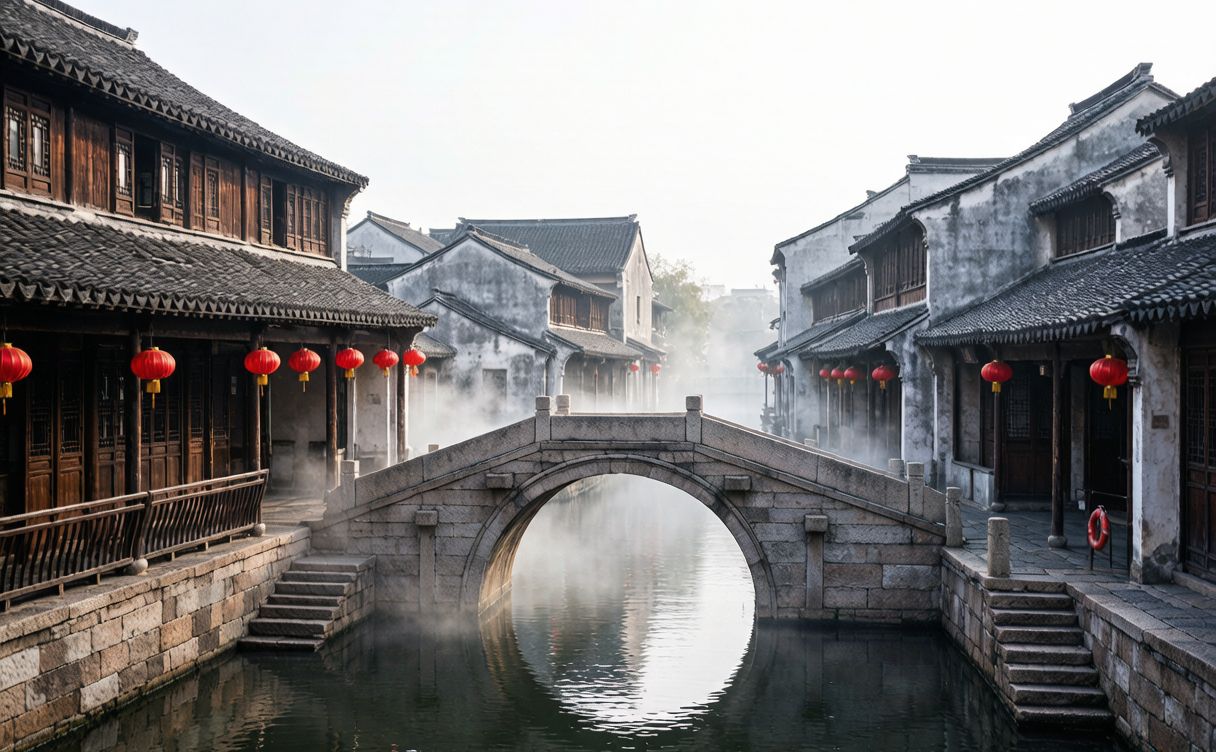
Xitang is also older and looser than its polished cousins. It dates back over a thousand years, and the old town still has nine rivers threading through it, crossed by more than a hundred stone bridges. Some are simple single arches; others, like the Song dynasty–era bridges, have worn steps you can feel underfoot. It never felt like a museum. It felt like a place people actually live.
Getting to Xitang from Shanghai or Hangzhou
Xitang sits in Jiashan County, Zhejiang province, roughly 80 km southwest of central Shanghai and about 100 km north of Hangzhou. For foreign visitors, the easiest hub is Shanghai.
- From Shanghai: High-speed trains run from Shanghai Hongqiao or Shanghai Station to Jiashan South (嘉善南) in about 25–40 minutes. From Jiashan South, a taxi or bus gets you to the Xitang ancient town gate in 20–30 minutes. Budget around 25–40 RMB for the final hop.
- From Hangzhou: Trains to Jiashan South take roughly an hour, or you can take a long-distance coach. If you’re already exploring the lakes and temples, pair it with a few days in the city using our Hangzhou travel guide.
- By car or tour: Many Shanghai day tours include Xitang, but I’d skip the cattle-call buses. Arriving independently lets you stay past the 5 p.m. day-tripper exodus — which is exactly when the town turns magical.
If Chinese trains intimidate you, our high-speed train guide for foreigners walks through booking with 12306 and what to expect at the gate.
The Ticket Scam (It Isn’t One) — Free Lanes vs. the Scenic Zone
Here’s the real talk nobody puts on the brochures. Xitang has a walled “scenic area” that costs around 95 RMB and includes a handful of small museums and a boat ride discount. But unlike some towns that fence everything off, Xitang’s lanes spill into ordinary residential streets that you can walk for free, any hour.
On my first evening I simply walked in through a side lane near the bus stop and nobody stopped me. The next morning I bought the ticket to see the enclosed sights — the Wine Warehouse, the Woodcarving Museum, the Zhuresidence. Were they worth it? Mildly. The ticket’s real value is the evening boat ride and the freedom to wander the headline bridges without a side-eye. My advice: skip the ticket if you’re on a tight budget and just soak the free lanes; buy it if you want the boat and the museums.
A word of warning: touts near the gates will offer “cheap entries” or “homestay deals.” Politely decline. Book your stay through a normal platform and buy tickets at the official window.
What to Actually Do in Xitang
Walk the covered galleries at night. This is non-negotiable. After dark, red lanterns hang along every canal and reflect in the water like a spilled string of pearls. The tourist shops dim, the beer bars hum, and the whole town glows. I spent one night just walking the tangnong loop, buying a 10-RMB maltose candy and listening to a guy play guitar on a bridge.
Cross the stone bridges at golden hour. The Taiping Bridge and the Wenchang Bridge are the photogenic ones, but I preferred the unnamed single-arch spans where old men fish with long rods. Bring a real camera or just your phone — the light at 6 p.m. is forgiving.
Eat on the water. Xitang’s food is modest but good: qingtuan (green rice dumplings), steamed river fish, and a wicked local yellow wine (huangjiu) served warm. I found a tiny floating restaurant where the owner poured me a glass “on the house” after I butchered three Mandarin tones ordering tofu. That’s the kind of moment you can’t script.
Do a nighttime rowboat. Official boats leave from the main piers; a shared ride is cheap and quiet. The rower punts slowly past the lit windows and you’ll understand why poets called this region “the land of fish and rice.”
Where to Stay
Staying overnight is the single best decision you can make, because the day-trippers leave and the town becomes yours. Options range from slick boutique inns inside the scenic zone to family-run guesthouses just outside the gates for half the price.
I stayed in a renovated canal-side guesthouse for about 280 RMB a night — paper lanterns in the room, frogs croaking outside, and a host who left boiled eggs at my door. Book early for weekends and Chinese holidays; the good riverside rooms vanish fast. If you want to compare the wider field of preserved towns and pick your style, our guide to China’s best ancient towns covers Xitang alongside Wuzhen, Fenghuang, and Pingyao.
Best Time to Visit Xitang
Spring (April–May) and autumn (September–November) are ideal — mild, green, and not sweltering. Summer is hot and crowded with domestic tourists, though the evening boat rides make it bearable. Winter is cold, but the off-season quiet and occasional mist on the canal are hauntingly beautiful, and you’ll have the tangnong almost to yourself.
Avoid the big holidays — National Day (early October) and Spring Festival — unless you enjoy shoulder-to-shoulder photo ops. A regular weekend is busy enough.
One practical note: if you’re building a longer China itinerary, our best ancient towns in China comparison is the fastest way to decide whether Xitang, Wuzhen, or Zhujiajiao fits your route. And for the classic Zhejiang water-town experience done at scale, the Wuzhen water town guide from Hangzhou is the natural companion read.
A Few Honest Tips
- Cash vs. card: Alipay and WeChat Pay rule here, but small stalls may prefer cash. Read our cash-in-China guide for 2025 before you go.
- Get there late, leave late. Arrive after 4 p.m. to dodge the coach-bus crowds and catch the lanterns.
- Wear grippy shoes. The stone lanes are slick after rain — I nearly sat down on one bridge approach and still think about it.
- Respect the residents. People live here. Keep your voice down in the non-scenic lanes and ask before photographing anyone’s doorway.
Final Word
Xitang isn’t the grandest water town in China, and it doesn’t try to be. It’s the one that lets you in — literally, through its free lanes, and figuratively, into the rhythm of canal life that’s been running for a thousand years. Go for the lanterns, stay for the silence after the day-trippers leave, and let the tangnong keep the rain off your shoulders.
For official background on the region’s canal heritage and visitor information, see the Jiashan County tourism portal (Chinese; use your browser’s translate).