

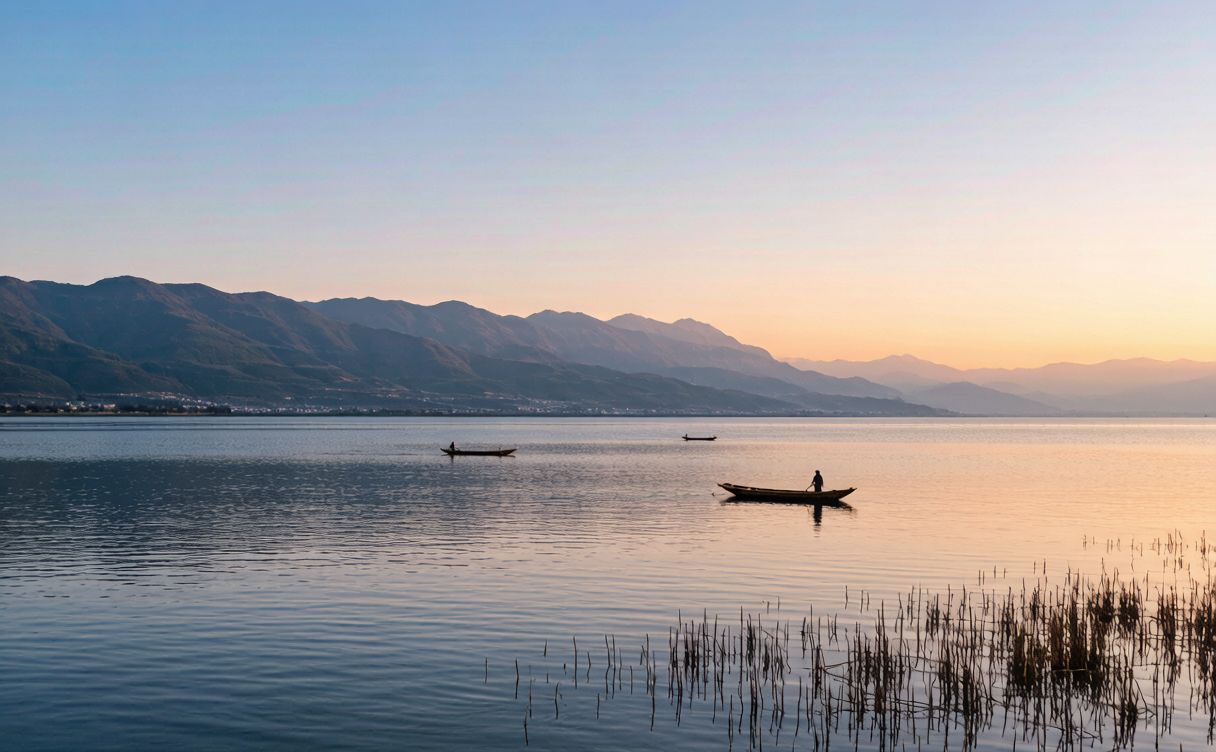
The first time I saw Erhai Lake, I was still half-asleep on a sleeper bus from Kunming, and the 6 a.m. light was doing something unfair to the water. It wasn’t blue so much as it was a slab of polished jade tipped on its side, with the Cangshan mountains standing behind it like a row of sleeping giants. I had come for “one of those Yunnan lakes” and instead found the place I now send every friend who asks me where to slow down in China. Erhai Lake is the highland mirror that Dali grew up around — a 250-square-kilometer freshwater stretch at 1,972 meters, ringed by Bai villages, pine forest, and a cycling path so flat it makes you feel athletic even when you are not.
I have biked its shore at dawn, gotten gently lost in a fishing hamlet, and watched a storm roll across the water that turned the whole valley silver. This is a first-person, no-fluff guide to the lake I keep coming back to — how to reach it from Dali Old Town, where to ride, what the “ecological corridors” actually are, and when to go so the light does the work for you.
Why Erhai Lake Is the Soul of Dali
Dali sits on Erhai Lake’s western shore, and the two are impossible to separate. The Bai people have fished and farmed here for over a thousand years, and the lake still feeds the city — literally, with carp and crayfish, and culturally, as the reason anyone settles. The name Erhai means “Ear Lake,” and from above the crescent shape does look like an ear pressed against the mountains.
My favorite useless fact to tell fellow travelers: on a still morning the water reflects Cangshan so cleanly you can’t tell where the ridge ends and the sky begins. I learned this the hard way trying to photograph a “mountain” that was actually a cloud. A local grandfather laughed at me for a full minute, then offered me a fried erkuai (rice cake) and pointed out where the real summit was. That is the Erhai Lake experience in one scene — humbling, beautiful, and free.
For the bigger Yunnan picture, pair this read with our Dali Yunnan travel guide before you book.
The Lakeside Cycling Loop (dali lake cycling)
If you do one thing here, make it the loop. Dali lake cycling is the region’s signature slow adventure, and it rewards the lazy. The full ring road is roughly 120 km, but almost nobody does it in one go. The classic, gentle ride is the ~20 km stretch from Dali Old Town south to the villages of Caicun, Longkan, and on toward Xizhou, much of it on the dedicated ecological corridor (shengtai langdao) — a car-free, tree-shaded bike path built right at the water’s edge.
I rented a battered single-speed for 20 yuan a day and set off at 7:30 a.m. to beat both the sun and the tour buses. Within an hour I had the path mostly to myself: egrets lifting off the reeds, old women in indigo Bai aprons raking weeds, and a stretch where the road narrows to a boardwalk floating a meter above the shallows. That boardwalk is the single best cycling moment in Yunnan, and I will die on that hill.
A few practical notes from my rides:
– Rent near the north gate of Dali Old Town — dozens of shops, haggle a little, and check the brakes. E-bikes are welcome on the corridor too if hills scare you.
– Go clockwise (south first) so the Cangshan view stays on your left and the light is behind you in the morning.
– Carry water and a rain shell. Weather flips fast at 2,000 m, and the one time I skipped the shell I got hail-dimpled near Wase.
For a different kind of pedal-powered scenery, our Guilin Longji rice terraces guide covers terrace hiking instead of lake loops.
Bai Fishing Villages and the Ecological Corridors
The “ecological corridors” deserve a word, because the phrase sounds like bureaucracy and is actually lovely. After years of lakeside overbuilding and algae blooms, Dali County ripped out lakeside hotels and restored a continuous green belt — the shengtai langdao — protecting the shoreline and giving people back the water. Where there were once fences and resorts, there is now reed, wetland, and public path. It is a rare Chinese conservation win you can literally ride your bike through.
The villages along it are the real draw. Xizhou is the showstopper: a preserved Bai town of white-washed courtyards with hand-painted “wind, flower, snow, moon” wall motifs, and the best xizhou baba (a crispy stuffed flatbread) in the province — I ate three in one sitting and regret nothing. Caicun is the low-key launch point for boat trips and the quietest corridor section. Shuanglang, on the eastern shore, is the famous one — photogenic, yes, but now crowded and resort-ified; go for a sunset drink, not a full day. Wase and Haidong on the east give you the classic postcard view back across the water to Cangshan, which is why I always save the east shore for late afternoon.
One anecdote I tell everyone: in a tiny hamlet near Caicun I stopped to photograph fishing nets and a Bai woman invited me in for three-cup tea (sanchaju) — bitter, sweet, and finally floral, poured in a ritual that took twenty minutes. She spoke no English; I speak poor Mandarin; we communicated entirely through hand gestures and shared laughter. That is the village Erhai Lake I hope you find.
How to Visit Erhai Lake from Dali Old Town
Dali Old Town is your base, and Erhai Lake is never more than a short hop away.
- By bike or e-bike: 20–40 minutes to the western corridor. Best for the south shore.
- By bus: local buses (and the occasional tourist shuttle) run from Dali to Xizhou and Shuanglang for a few yuan; ask at the north gate station.
- By boat: ferries and private charters leave from Caicun and Longkan wharves. A classic loop is Caicun → a lake crossing → Shuanglang, but confirm schedules — they shift with season and weather.
- By car or driver: easiest for the full ring, especially the east shore, where buses are sparse. A day driver costs roughly 300–500 yuan and lets you stop for every photo.
I once tried to “save money” by combining three buses to reach Shuanglang and arrived at sunset having missed the light entirely. Lesson learned: for the east shore, pay for the car or rent the e-bike and commit early.
If you want to chain this with more Yunnan, our Lijiang Old Town travel guide is the usual next stop two hours north, and the Tiger Leaping Gorge trek makes a spectacular follow-up hike.
Best Season for Erhai Yunnan
Timing is everything, and Erhai Yunnan has a clear winner. Spring (March–May) and autumn (September–November) are the sweet spots: mild, dry, and clear, with the famous “clear breeze, bright moon” (feng hua xue yue) weather Dali is known for. March–April brings wildflowers along the corridor; October gives you golden rice and clean mountain air.
Summer (June–August) is lush and green but rainy and foggy — the lake can vanish behind cloud for days, though the storms are dramatic. Winter (December–February) is cold but stunningly clear, with occasional snowfall on Cangshan that turns the whole scene into a ink-painting. I went once in January, rode at noon in a t-shirt, and watched a snowcap form on the peaks by 4 p.m.
Avoid the week-long Chinese public holidays (May 1, National Day in early October, Spring Festival) unless you enjoy sharing your boardwalk with ten thousand strangers. Our best time to visit China guide maps the crowd calendar in detail.
Where to Stay by the Lake
You have two philosophies. Stay in Dali Old Town for food, buzz, and easy transport, then ride out to Erhai Lake daily — this is what I do, and it suits most first-timers. Or stay on the shore for sunrise over water: Shuanglang and the quieter Haidong villages have design hotels and guesthouses with lake-view rooms, though prices climb and the east shore restaurants are touristy.
My personal pick: a mid-range guesthouse in Dali Old Town’s north end, bike rented from the same family for two days, and one splurge night in a Shuanglang lakefront room just for the dawn. That combo gave me both the town’s noodle stalls and the lake’s silence.
For deeper Yunnan beyond the lake, the Shangri-La Yunnan travel guide covers the high plateau north of here, where the air gets thinner and the monasteries start.
Authoritative source: For official routes, festival dates, and conservation updates, the Yunnan Provincial Culture and Tourism Department’s English portal at Yunnan Tourism is the most reliable planning reference.
Erhai Lake rewards the slow traveler more than almost anywhere I have been in China. Ride the corridor at dawn, eat too much xizhou baba, and let the Bai villages do the rest.