

I met the best Tai Chi teacher of my life at 5:40 a.m. on a stone terrace 1,600 meters up Wudang Mountain, half-blind with altitude and jet lag, watching a 70-year-old Taoist priest in a faded blue robe move his arms so slowly the valley mist seemed to drift along with him. No music, no crowd, just breath and gravity. Wudang Mountain isn’t a single peak you check off — it’s a sprawling sacred range in northwestern Hubei, dotted with centuries-old monasteries and the reputed cradle of Tai Chi itself. I came for a photo of the Golden Summit and left with sore legs, a new morning habit, and a healthy suspicion of every “ancient wisdom” souvenir stall on the way down.
Why the Wudang Mountains Are the Cradle of Tai Chi
Here’s the claim that pulls most foreigners up this mountain: the wudang mountains tai chi connection is real, or at least rooted in a very old story. Legend credits a 14th-century Taoist named Zhang Sanfeng with watching a snake and a crane fight, then distilling that motion into a soft, circular martial art — Tai Chi (taijiquan). Whether or not Zhang ever lived, the Ming dynasty turned this range into the imperial headquarters of Quanzhen and Wudang Taoism, and the slow, flowing forms practiced here for 600 years are the direct ancestors of the Tai Chi you now see in parks from Berlin to Brooklyn.
What surprised me is how un-athletic it looks until you try it. On my second morning I joined a public lesson on the terrace below the Nanyan Palace. After ten minutes of “just shift your weight,” my thighs were trembling and the priest was smiling. He said, through a translator, “Strong is easy. Soft is work.” I’ve paid for gym memberships that taught me less in a year.
The Golden Summit (Jinding): What the Climb Buys You
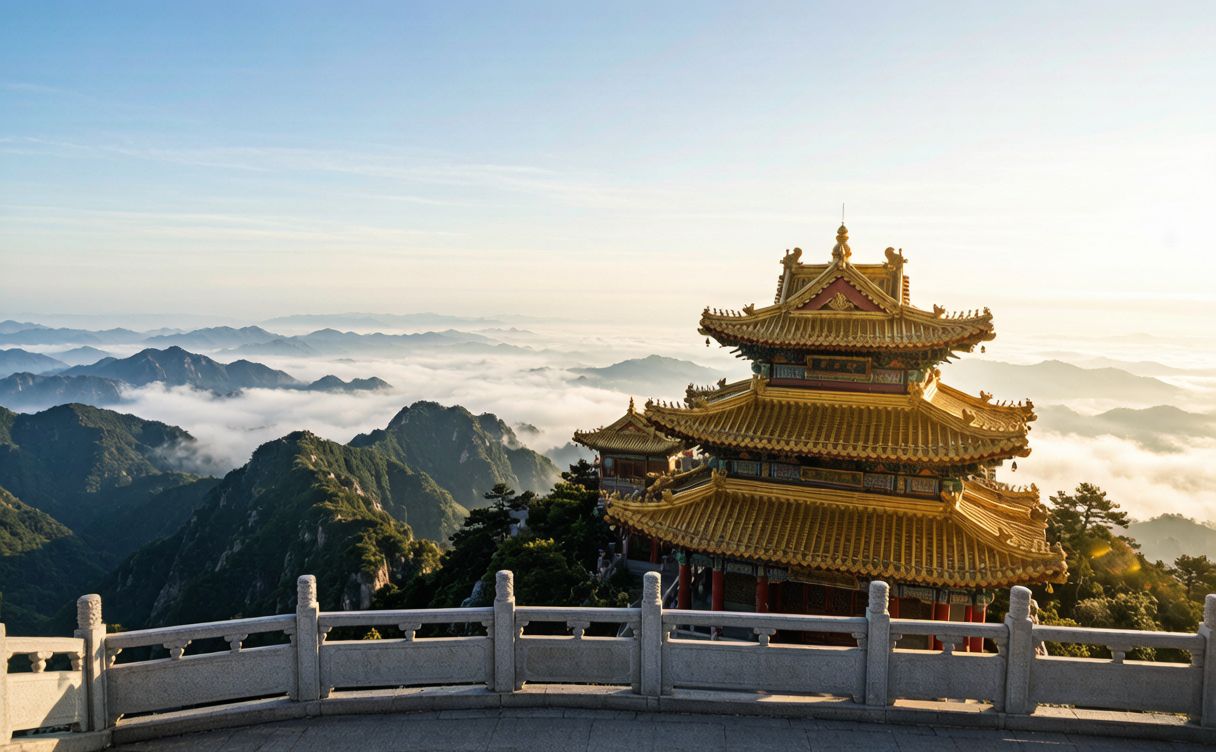
The payoff of any Wudang trip is the Golden Summit, or Jinding — a gilded copper temple to the god Zhenwu perched on the highest crag of Tianzhu Peak (1,612 m). The summit hall is small, but the roof is solid bronze gilt, and on a clear day the view rolls out over a sea of green ridges that genuinely looks like a Chinese landscape scroll come loose from its frame.
Getting there is the deal. You can take the cable car most of the way, then climb the final 600-odd stone steps — or, if you enjoy suffering, hike the whole mountain path from the ticketing gate. I did the cable car up and walked down, and the walk down was the better choice: the switchbacks pass half-ruined shrines and quiet viewpoints the cable car passengers never see. When I watched the monks at the summit light incense at dawn, the whole gilded roof caught the first light and for a second I understood why emperors funded all this. Then a loudspeaker announced the 8 a.m. ticket-scan crowd, and the spell politely ended.
Ancient Wudang Temple Complexes You Can Actually Walk Into
The mountain holds more than thirty wudang temple sites, and the good news for visitors is that several are genuinely open, lived-in, and worth your time rather than roped-off museum pieces.
Nanyan Palace (南岩宫)
Built into a cliff face, Nanyan is my favorite. A narrow stone path runs along the rock with a swallow’s-eye drop on one side and carved niches on the other. The famous “Dragon Head Incense” burner juts straight out over the void — historically the bravest (or most desperate) pilgrims burned incense there; today it’s fenced, wisely. I spent an hour just leaning on the rail watching clouds pour through the gorge below.
Purple Cloud Temple (Zixiao Gong)
Lower down and easy to reach, Zixiao is the grand, postcard monastery: sweeping tiled roofs, a chained courtyard of old cypresses, and a hall still used for Taoist ceremonies. A local told me the best time to catch real chanting is around 7 a.m. before the tour buses; he was right, and I’ve learned to trust anyone in Wudang who mentions a clock over a camera.
Yuxu Palace and the Others
Near the mountain’s base, Yuxu Palace is vast, partly restored, and wonderfully empty compared to the summit. If you have a second day, the lesser temples — Wulong, Yuzhen — reward slow walkers with few other foreigners in sight.
How to Reach Wudang Mountain from Wuhan and Shiyan
The practical gateway is Wudangshan town, served by its own high-speed rail station (Wudangshan West), not the mountain itself. Most travelers fly or train into Wuhan, Hubei’s capital, then continue west. If you’re already in Wuhan, pair the trip with the riverside history of the Yellow Crane Tower before heading into the highlands.
- From Wuhan: High-speed trains run Wuhan → Wudangshan West in roughly 2.5–3.5 hours. From the station, buses and taxis cover the final 20–30 km to the scenic-area gate.
- From Shiyan: Shiyan is the nearest city and has an airport; the drive to the gate is about 40–60 minutes. Many visitors fly into Shiyan directly to skip Wuhan entirely.
- Trains generally: Book through the official 12306 app or a major Chinese travel platform. Foreign card payment can be finicky, so read up on how outsiders actually buy seats in our China high-speed train guide for foreigners.
I made the classic rookie error of assuming “Wudangshan” station meant “top of the mountain” and booked a hotel in town, not at the gate. It worked out — town is cheaper and has better noodles — but factor in the transfer time or you’ll miss the sunrise queue.
Best Time to Visit (and When to Stay Home)
Spring (April–May) and autumn (September–October) are the sweet spot: cool, clear, and free of school-holiday crowds. The whole range glows in October when the maples turn. Summer is hot, humid, and packed with domestic tour groups; Chinese National Day (early October) is the single worst week to be anywhere famous in China, so dodge it. Winter is cold and sometimes icy on the upper steps, but gloriously empty, and the Golden Summit in snow is the kind of shot that justifies frozen fingers. If you’re weighing several regions, our month-by-month best-time-to-visit-China planning covers the trade-offs in detail.
What to Wear and How to Behave at the Temples
This is the part first-timers get wrong. You’ll be climbing a lot — wear real broken-in sneakers or lightweight hiking shoes, not fashion trainers. The stone steps are uneven, sometimes wet, and the final push to Jinding will humble whichever calf you favor. Mornings on the summit sit near 10–15°C cooler than the base, so pack a light layer even in summer; our China packing list for first-timers covers the layering logic in detail.
At active wudang temple halls, dress modestly: cover shoulders and knees, skip the loud slogans, and ask before photographing any monk or ceremony. Incense is sold at every gate — buy a small bundle, light it respectfully, and you’ll fit in better than the people who treat the courtyard like a food court. A monk at Zixiao watched me fumble a bow, corrected my hand position without a word, and nodded. That small kindness is the real souvenir.
Final Thoughts
Wudang Mountain rewards the early, the patient, and the moderately fit. Go for the Golden Summit, stay for the quiet temples, and don’t be shocked when the slow-moving old man on the terrace quietly outperforms you. It’s a Taoist sacred mountain that also happens to be the cradle of the world’s most practiced martial art — and unlike a lot of “birthplaces” on the tourist trail, the practice here is still alive.
If you want the bigger picture, the range slots neatly into a central-China loop, and the best things to do in China include several sites that pair naturally with a Hubei detour. Travelers coming from the southwest can also fold it into a longer route using our Chongqing travel guide as a launchpad. The entire Ancient Building Complex in the Wudang Mountains is inscribed by UNESCO as a World Heritage Site, which is about as authoritative a stamp of significance as a sacred mountain can earn (Ancient Building Complex in the Wudang Mountains, UNESCO).