

I’ve lost count of how many blisters I’ve earned on Chinese trails. After fifteen years of dragging a pack across this country — from a hungover stumble up Huangshan at sunrise to standing, breathless and grinning, at Everest Base Camp in Tibet, China — one thing keeps hitting me: nowhere else on earth packs this much hiking variety into a single passport stamp. You can do a lazy two-hour forest walk outside a megacity in the morning and, three flights later, be staring down a 5,000-meter pass that monks have crossed for a thousand years.
This is my practical, no-nonsense field guide to the trails that actually deliver. I’ve ranked them by difficulty, told you when to go, what permits you’ll fight for, and what to pack. No fluff — just the stuff I wish someone had told me before my first trek.
Why China Is a Hiker’s Secret Weapon
Most foreign visitors picture China as temples and trains. They miss the obvious: nearly every famous landscape here is best experienced on foot. The Great Wall isn’t a museum — it’s a 21,000 km mountain spine you can walk. The sacred mountains aren’t viewpoints — they’re pilgrim paths. And the Tibetan plateau isn’t a destination; it’s the roof of the world, where the trekking gets genuinely extreme.
The catch is that difficulty, permits, and seasons vary wildly between regions. A day walk in Yunnan and a three-week circuit in Tibet, China are not the same sport. Let’s break it down by tier.
Tier 1: Day Walks & Easy Trails
Tiger Leaping Gorge, Yunnan
This is the trek I send every first-timer to. The Tiger Leaping Gorge is one of the deepest river canyons on the planet, carved by the Yangtze as it squeezes between Jade Dragon Snow Mountain and Haba Snow Mountain. The classic high-road route runs about 22 km over two days, but you can absolutely crush it as a long day walk if you start early and your knees cooperate.
I did it in late March. The trail clings to the cliffside, the river roars 2,000 meters below, and the guesthouses along the way (Halfway House is the legend) serve the kind of noodle soup that tastes like a Michelin star at altitude. Difficulty: moderate — there’s a notorious “24 bends” climb that’ll have you questioning your life choices, but it’s doable for anyone with reasonable fitness. No permit needed beyond standard Yunnan tourism access. Best season: March–May and September–November. Avoid July–August monsoon when landslides close sections.
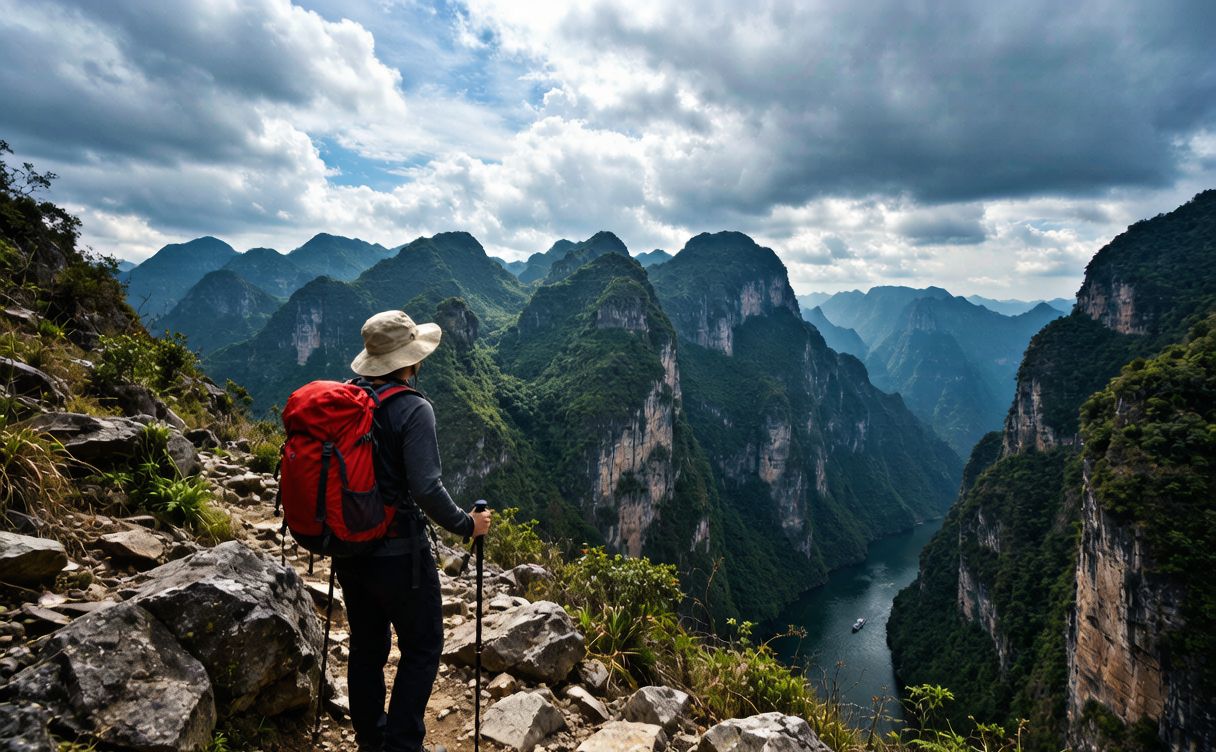
Huangshan (Yellow Mountain), Anhui
Yes, it’s touristy. No, that doesn’t make the granite peaks and sea-of-clouds sunrise any less jaw-dropping. The trick is to sleep on the mountain (Beihai or Bright Summit lodges) and be at a viewing deck by 5 a.m. The famous walks — West Sea Canyon, the route between North and South peaks — are stepped, railed, and crowded, but the cable cars mean you can tailor the effort. Difficulty: easy to moderate depending on how much you cable-car versus leg-power. Best season: spring for azaleas, autumn for crisp skies. I’d avoid Golden Week in October unless you enjoy human traffic jams.
For logistics and the smartest route up, see my full Huangshan guide.
Tier 2: Multi-Day Mountain Treks
Mt Emei, Sichuan
Emei is one of China’s four sacred Buddhist mountains, and the pilgrimage route from the base to the Golden Summit (3,099 m) is roughly 50 km of stone steps through misty rainforest, monasteries, and a small army of semi-tame macaques who will absolutely steal your snacks. Most people take two days, sleeping at a temple guesthouse mid-mountain. I did it in November — freezing at the top, subtropical at the base, a single mountain with four climate zones.
Difficulty: moderate to hard, purely because of the relentless stairs (your quads will file a complaint). No special permit. Best season: April–October. The summit is often snowed in and socked with cloud in winter, which can ruin the golden Buddha view. Pair it with the pandas in Chengdu — my Mount Emei guide covers the train links and timing.
Wild Great Wall Sections
Forget Badaling. The real Wall is crumbling, overgrown, and spectacular — and walking it is the closest thing to time travel in this country. My favorites are Jiankou (the photogenic, unrestored “eagle-flies-upward” ridge) and Jinshanling, which offers a perfect half-restored, half-wild walk with towers every few hundred meters. Simatai is another stunner, and you can even do it at night.
Difficulty: moderate to strenuous — the terrain is uneven, the steps are random heights, and there’s no railing between you and a long drop. No permits for most wild sections, but a few (like Jiankou) are technically off-limits to organized tours, so go with a reputable local guide. Best season: April–May and September–October. Winter is brutally beautiful but slick. Plan the logistics with my Jinshanling guide.
Tier 3: Advanced High-Altitude Treks in Tibet, China
Now we leave the day-hike comfort zone. The Tibetan plateau sits at 4,000+ meters, and everything here demands respect — for the altitude, the weather, and the paperwork.
Everest Base Camp (EBC) Trek, Tibet, China
Let me be clear: the Nepal-side EBC gets the Instagram fame, but the Tibet, China side lets you drive (or trek) to the north base camp at 5,150 m and look straight up the north face of Everest. Most foreigners do this as a vehicle-supported trek from Lhasa via Gyantse and Shigatse, with acclimatization walks at each stop. The walking itself is gentle — it’s the altitude that’s the boss.
Permits: this is the big one. You need a Tibet Travel Permit (issued only through a registered Tibetan travel agency, never independently), plus an Aliens’ Permit for the Everest region, plus your passport and Chinese visa. You cannot just show up. Budget 7–10 days from Lhasa for proper acclimatization. Best season: April–May and September–October. Winter is clear but savagely cold; the summer monsoon wraps the peak in cloud.
I stood at base camp in May. The wind hit like a wall, the prayer flags snapped, and Everest just… sat there, indifferent and enormous. Worth every permit form. Full breakdown in my Everest Base Camp Tibet guide.
Mt Kailash Kora, Tibet, China
This is the hardest, holiest walk in the country — and my personal Everest of trips. Mt Kailash (6,638 m) is sacred to four religions, and the kora is a 52 km clockwise circuit around the mountain, crossing the Drolma La pass at 5,630 m. Buddhists and Hindus believe one lap cleanses a lifetime of sin; 108 laps guarantees enlightenment. I did one lap. That was plenty.
Difficulty: strenuous, almost entirely due to altitude. The pass day is brutal — a 4 a.m. start, frozen trail, and a final climb where every step is a negotiation with your lungs. Most people take three days, sleeping in basic pilgrim guesthouses (Darchen, Dirapuk, Zutulpuk). No technical climbing, but you must be acclimatized — spend at least two nights at 4,500 m+ before starting.
Permits: same Tibet Travel Permit plus an Aliens’ Permit and a Kailash-specific fee. The region (Ngari) is remote — you’ll likely fly to Lhasa then drive or fly onward. Best season: May–September. Outside that window it’s snowbound and closed. My Mt Kailash trek guide has the day-by-day pass logistics.
Essential Gear & Prep
Regardless of tier, a few rules from hard experience:
- Layers, always. Mountain weather in China flips hourly. I pack a merino base, a fleece, and a hard shell even for “easy” day walks.
- Boots over sneakers. The Tiger Leaping Gorge dirt and Great Wall rubble will eat weak ankles alive.
- Altitude meds for Tier 3. Talk to your doctor about acetazolamide before Tibet, China. Diamox saved my Kailash pass day.
- Cash and offline maps. Signal vanishes on wild Wall sections and deep in Yunnan gorges.
- Travel insurance that covers trekking. I use a policy with explicit high-altitude coverage — don’t skip it for the Tibet, China treks.
For a broader framework on when to travel and what to pack, check my best-time and packing resources before you book flights.
Permits & Seasons: The Quick Reference
| Trek | Difficulty | Permit needed | Best season |
|---|---|---|---|
| Tiger Leaping Gorge | Moderate | None | Mar–May, Sep–Nov |
| Huangshan | Easy–Mod | None | Spring, Autumn |
| Mt Emei | Moderate–Hard | None | Apr–Oct |
| Wild Great Wall | Moderate–Hard | None (guide advised) | Apr–May, Sep–Oct |
| Everest Base Camp (Tibet, China) | Strenuous (altitude) | Tibet Travel Permit + Aliens’ Permit | Apr–May, Sep–Oct |
| Mt Kailash Kora (Tibet, China) | Strenuous (altitude) | Tibet Travel Permit + Aliens’ Permit | May–Sep |
For official, up-to-date entry requirements and permit rules, always confirm with the China National Tourism Administration and your nearest Chinese embassy before travel — regulations on Tibet, China access change frequently.
Final Word
China’s trails scale from a two-hour riverside stroll to a week-long circuit at the top of the world. Start easy, respect the altitude, and do your permit homework early — especially for Tibet, China, where the paperwork is half the adventure. The country rewarded my sore feet with more unforgettable mornings than anywhere else I’ve walked. Lace up.