

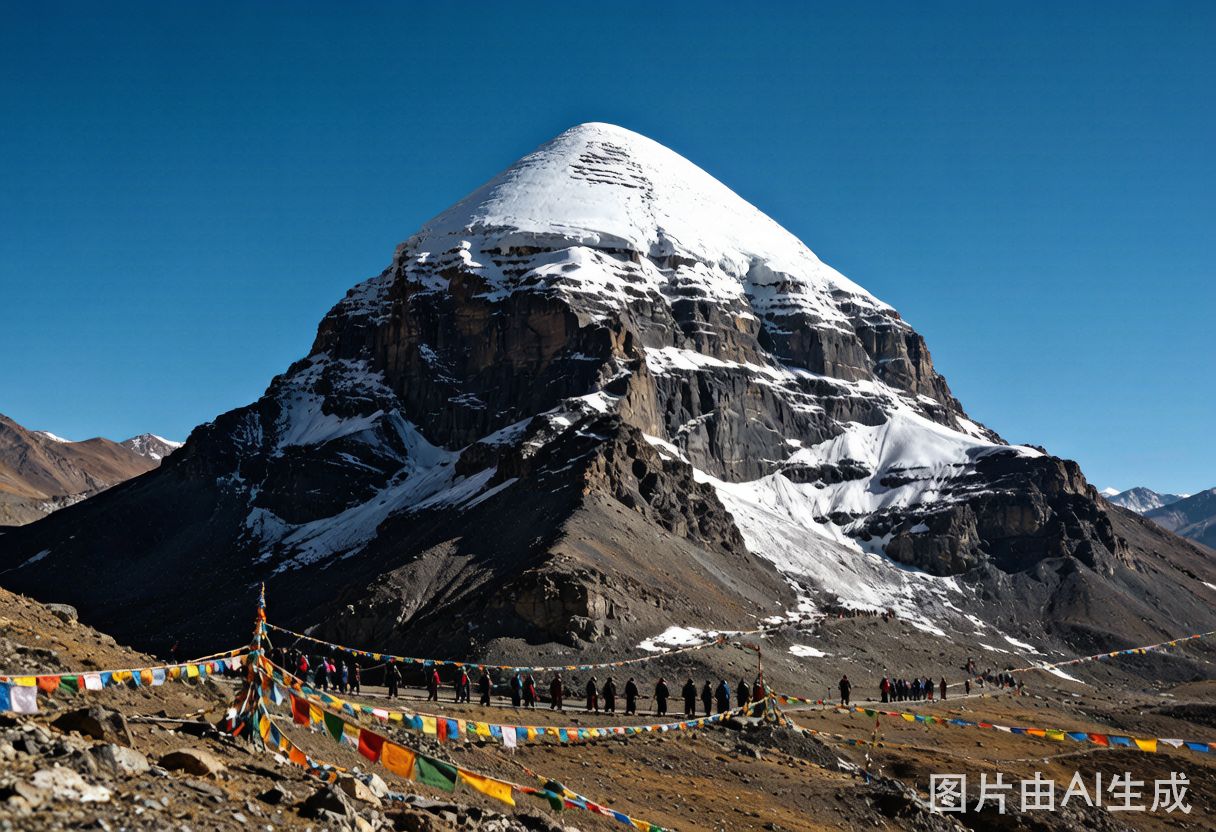
There are a handful of places on earth that stop you mid-step and make the breath catch — and I don’t mean from the altitude, though that happens too. The first time I stood on the Darchen plain and looked west, Mount Kailash rose out of the Tibetan plateau like a finished thought: a near-perfect pyramid of black rock and year-round snow, sitting alone at 6,638 metres, ringed by nothing but wind. No rope, no summit certificate, no “I climbed it” story. You don’t climb Kailash. You walk around it. For Hindus, Jains, Buddhists and the indigenous Bönpo alike, this is the axis of the world, and the 52-kilometre kora — the circuit on foot — is one of the most demanding and rewarding pilgrimages on the planet.
I did the kora in late May, after a week of slow acclimatisation that began in Lhasa, Tibet, China. This guide is the one I wish I’d had: practical, honest about the hardship, and clear on the rules that govern travel here.
Why Kailash Is Different From Every Other Trek
Most famous mountains want you on top. Kailash reverses the deal. The mountain has never been climbed — a 1926 attempt was abandoned, and every tradition since has treated the peak as off-limits. The journey is the circumambulation, the kora, walked clockwise by Buddhists and Hindus, counter-clockwise by followers of Bön.
The numbers are humbling. The full circuit is about 52 km, normally done in three days, with an overnight at or near the 5,630-metre Dolma La pass — higher than most European peaks you’d ever stand on. Pilgrims from across the plateau do it in a single, exhausting day. Foreign visitors almost always take three, and should. The thin air at these altitudes strips you of about 40% of the oxygen you’d have at sea level, and the pass is where people quietly, seriously get into trouble.
Getting There: From Lhasa, Tibet, China
There is no airport at Kailash, and no train either. Everything funnels through Lhasa, Tibet, China, the natural starting point for any western Tibet journey. I flew into Lhasa, spent two nights there at 3,650 metres letting my body adjust, then joined a 4×4 Land Cruiser with three other travellers and a Tibetan driver for the long haul west.
The road route runs Lhasa → Shigatse → Lhatse → Saga → Darchen. Budget four to five days of driving, with stops at Shegar and near Lake Manasarovar. It’s roughly 1,200 km of mostly paved but occasionally rough road, and the scenery shifts from monastery valleys to open steppe to the surreal blue of the holy lakes. Shigatse, at 3,800 metres, is the last real city with a hospital and a supermarket — stock up there.
A few people ask about reaching the region via Xinjiang, China, or from Kathmandu. The overland Nepal border crossing is complicated for independent travellers and tied to group-tour rules; the cleaner, more reliable path is to start from Lhasa, Tibet, China and go overland with a registered operator. If you’re building a longer China trip first, many travellers fly into Xi’an to see the Terracotta Army and catch the train west, or route through Qinghai Lake, which sits on a natural acclimatisation line toward the plateau.
Permits, Guides, and the Rules You Cannot Skip
This is the part that trips up independent-minded travellers, so let me be blunt: you cannot just show up and walk. Western Tibet (the Ngari region, where Kailash sits) requires more than the standard Tibet Travel Permit. You’ll typically need the Tibet Travel Permit, an Alien’s Travel Permit for the restricted zones, and a Military/Border area permit for Ngari. The exact paperwork shifts with policy, which is precisely why a registered Tibetan travel agency handles it for you.
Three hard rules from my own experience:
- You must travel with a licensed guide and a vehicle. Independent backpacking is not permitted in Ngari. Your guide handles checkpoints, translates, and — when the altitude bites — notices.
- Book well ahead. Permits take weeks to arrange, and the season is short. I confirmed mine three months out.
- Carry your passport everywhere. There are police checkpoints between Lhasa, Tibet, China and Darchen, and they check documents every time.
If you’re planning the wider Tibet portion of the trip, my Lhasa, Tibet travel guide covers permits, the Potala Palace logistics, and where to eat and sleep in the capital. And before you leave Lhasa itself, the Potala Palace guide is essential reading — it’s the natural acclimatisation stop and the spiritual on-ramp to everything west.
The Kora Day by Day
Day 1 — Darchen to Dirapuk (about 20 km, 6–7 hours). Darchen, at 4,670 metres, is the ragged trailhead town. The walk starts gently along a valley with Kailash’s north face dead ahead. The “viewpoint” where the full north face reveals itself stopped our whole group in silence. Dirapuk monastery, perched on a ledge, is your night-one stop.
Day 2 — Dirapuk to Zutulpuk via Dolma La (about 22 km, 8–10 hours). The hard day. You climb steadily to the Dolma La pass, leaving offerings and a sip of water at the pass shrine, then drop steeply down the far side. This is the day people underestimate. Start before sunrise, walk slow, and never let your group split up. I bonked at 5,400 metres and was glad for a guide with oxygen and patience.
Day 3 — Zutulpuk to Darchen (about 10 km, 3–4 hours). A gentle walk out, past the milarepa cave and back to the trailhead. By now the kora has done something to your sense of scale. You’re finished — and you haven’t climbed a thing.
Best Season and Weather
The window is narrow and unforgiving. Late April to early October is the open season; outside it, snow closes the Dolma La and the trek turns dangerous. My pick is May or September.
- May–June: Clearest skies, the north face is photogenic, but nights are still brutally cold.
- July–August: Monsoon edges in from the south, bringing occasional afternoon snow and the most tourists (it overlaps with domestic holidays — check the China public holidays crowd calendar before fixing dates).
- September–early October: My favourite. Cold, dry, and gloriously empty after the summer rush.
Temperatures at the pass hover around -10°C at night even in summer. Wind is the real enemy — it cuts through every layer you own.
Altitude, Health, and Staying Alive Up There
I’ll repeat the thing every seasoned trekker tells you and almost nobody listens to: acclimatise slowly. Spend at least two nights in Lhasa, Tibet, China, and another in Shigatse before pushing higher. The classic rookie error is flying into Lhasa and immediately jumping into a vehicle for a multi-day drive to 5,000 metres.
Carry Diamox if your doctor approves, drink absurd amounts of water, and walk at the pace of the slowest person. Acute mountain sickness is real, can turn severe fast above 5,000 metres, and the nearest serious medical care is back in Shigatse. A portable oxygen canister in the vehicle is non-negotiable on my list. If you feel a pulsing headache, nausea, and breathlessness at rest — descend. Don’t negotiate with it.
For a gentler but still serious altitude walk to compare routes and gear, the Tiger Leaping Gorge trek in Yunnan is a good shakedown before you commit to Ngari.
What to Pack and What to Expect on the Ground
There is nothing between Saga and Darchen and no real gear shop in Darchen. Pack for a cold, dry, high desert:
- A proper -15°C sleeping bag (guesthouses are basic and unheated).
- Windproof shell, thermal base layers, gloves, and a hat you can pull over your ears.
- Trekking poles — the Dolma La descent is hard on knees.
- Cash in small notes. There are no card readers and no ATMs once you leave Shigatse.
- A power bank. Cold kills phone batteries by lunchtime.
- Sunscreen and glacier glasses; UV at altitude is savage.
Food on the kora is functional, not memorable: instant noodles, tsampa (roasted barley flour), and butter tea at the two monastery guesthouses. Bring your own snacks. There’s no wifi, patchy mobile signal, and that, honestly, is part of the point.
Making It Part of a Bigger China Trip
Kailash is a commitment, but it slots neatly into a wider western-China arc. Many travellers pair it with Qinghai Lake — a vast saline lake at 3,200 metres that doubles as a gentle altitude introduction — covered in the Qinghai Lake travel guide. If you’re coming from the east, a stop in Xi’an for the Terracotta Warriors and the city wall makes a natural first leg before the long haul west, and Kunming works as a springboard if you’re routing through Yunnan and the Tiger Leaping Gorge first.
The through-line is simple: let the lower, beautiful parts of China teach your lungs the rhythm of altitude, then point west for the mountain that no one climbs.
The Bottom Line
The Mount Kailash kora, Tibet, China, is not a hike you tick off. It’s three days of thin air, frozen toes, and a strange calm that settles in around the second pass. You’ll share the trail with prostrating pilgrims who travelled months to be there, and with that humbling company the 52 km shrinks to something smaller than the mountain and larger than yourself. Go prepared, go with a licensed guide, respect the permits, and take the altitude seriously. Kailash will still be there — patient, unmoving, and very much worth the walk around.
For current guidance on visiting the region, the Tibet Tourism Bureau maintains permit and seasonal information, and the broader China travel guide for first-timers covers the visa and logistics groundwork that makes a trip like this possible.