

I have lost count of how many meals I have eaten on the road in China over the years, but a few are burned into memory: a bowl of hand-pulled beef noodles in a Lanzhou back alley at 6 a.m., a table of strangers in Chengdu passing a sweating bottle of baijiu around a bubbling hotpot, and a dim sum breakfast in Guangzhou where the carts never stopped coming. If you are reading this, you already suspect what I know for sure — China is the single best country on earth for a traveler who plans their days around food. This guide is the hub I wish every first-timer had before they landed. It is practical, it draws on what I have actually eaten and seen, and it points you to our deeper city and dish guides when you want to go further.
What This Guide Covers
- Why China deserves a spot at the top of any foodie’s bucket list (and the eight great cuisines that explain it)
- The best food cities and regions, with the dishes that define each
- A signature-dish cheat sheet by region
- How to eat like a local: night markets, street-food safety, and ordering through apps
- Vegetarian and dietary notes
- A realistic 7-day food itinerary from north to south
- Answers to the questions every visitor actually asks
If you want the deep regional breakdown first, start with our Chinese Food Guide: The 8 Great Cuisines. The rest of this page ties it all together into a trip you can actually eat your way through.
Why China Is a Food-Lover’s Destination
China is not one cuisine. It is a continent of cuisines stitched together by 5,000 years of trade, migration, climate, and plain old regional pride. The shorthand every traveler learns is the “eight great cuisines” (八大菜系) — Shandong, Sichuan, Cantonese, Fujian, Jiangsu, Zhejiang, Hunan, and Anhui. But that tidy list is only the beginning. Spin the map and you find whole culinary worlds that sit outside it: the halal lamb and cumin skewers of Xinjiang, China in the far northwest, the butter-tea and tsampa highlands of Tibet, China, and the Portuguese-influenced egg tarts of Macau, China. The point is simple — the food changes every few hundred kilometers, and almost all of it is eaten fresh, seasonal, and shared family-style.
What makes it so good for travelers specifically? Three things. First, the variety is staggering and genuinely cheap — a transcendent meal can cost you less than a sandwich back home. Second, the culture of eating out is universal: in most cities you are never more than a five-minute walk from a place worth sitting down. Third, food is how Chinese hospitality expresses itself. The quickest way to make a local friend is to show genuine curiosity about what is on their table.
Best Food Cities & Regions
Beijing — Roast Duck and Beyond
The capital is where I tell newcomers to start, if only to stand in line at a proper duck house and watch the carving. Our Where to Eat Beijing Duck guide covers the honest spots versus the tourist traps. But do not stop at duck: zhajiangmian (fried sauce noodles), douzhi (fermented mung bean drink, an acquired taste I have grown to love), and lamb hotpot in winter are all Beijing.
Xi’an — The Muslim Quarter
This is the single best street-food city in the north, full stop. The Xi’an Muslim Quarter Food Guide walks you through the stalls, but the headline act is roujiamo (the “Chinese hamburger”), biangbiang noodles the width of a belt, and cold glutinous rice cakes dusted with walnut and rose. Xi’an sits on the old Silk Road, so the halal flavors here are unlike anywhere else in China.
Chengdu and Sichuan — The Hotpot Capital
If you like heat, Chengdu will ruin milder food for you in the best way. The star is Sichuan hotpot: a cauldron of numbing mala (chili plus Sichuan peppercorn that buzzes your lips) where you boil everything from tripe to lotus root. Our Chengdu Jinli and Kuanzhai Alley guide maps the old lanes where you can graze between hotpot rounds. Pro move: order a “yuanyang” (split) pot so the spice-shy in your group survive.
Guangzhou and the Cantonese South — Dim Sum Heaven
Cantonese food is the China that most of the world thinks it knows, and Guangzhou is its temple. The morning ritual of dim sum — small steamed baskets of har gow, siu mai, char siu bao, and rice noodle rolls — is a must-do. Our Cantonese Food and Dim Sum Guide explains what to order and how the cart system works. Round it out with roast goose, clay-pot rice, and the city’s famous double-skin milk pudding.
Shanghai — Refined and Eclectic
Shanghai blends Jiangnan refinement with global swagger. Think xiaolongbao (soup dumplings) done to a science in nearby Nanxiang, drunken chicken, and hairy crab in autumn. It is also the easiest place in China to find excellent non-Chinese food if your stomach needs a break.
Yunnan — China’s Spice Garden
Down near the border with Southeast Asia, Yunnan eats like nowhere else: crossing-the-bridge rice noodles, wild mushrooms in the rainy season, and the Dai minority’s grilled fish and sticky rice. If you want a food adventure that feels off the main trail, this is it.
Signature Dishes to Try by Region
A quick cheat sheet for your notebook:
- North (Beijing, Xi’an): Peking duck, zhajiangmian, roujiamo, lamb skewers, hand-pulled noodles
- West (Sichuan, Chongqing): Sichuan hotpot, mapo tofu, kung pao chicken, dan dan noodles
- South (Guangdong, Hong Kong, Macau, China): Dim sum, roast goose, char siu, congee, egg tarts
- East (Shanghai, Hangzhou, Suzhou): Soup dumplings, Dongpo pork, beggar’s chicken, river shrimp
- Southwest (Yunnan): Crossing-the-bridge noodles, wild mushroom hotpot, Dai grilled fish
- Far West (Xinjiang, China): Lamb kebabs, polo (pilaf), naan, hand-pulled laghman noodles
How to Eat Like a Local
Night Markets and Street Food
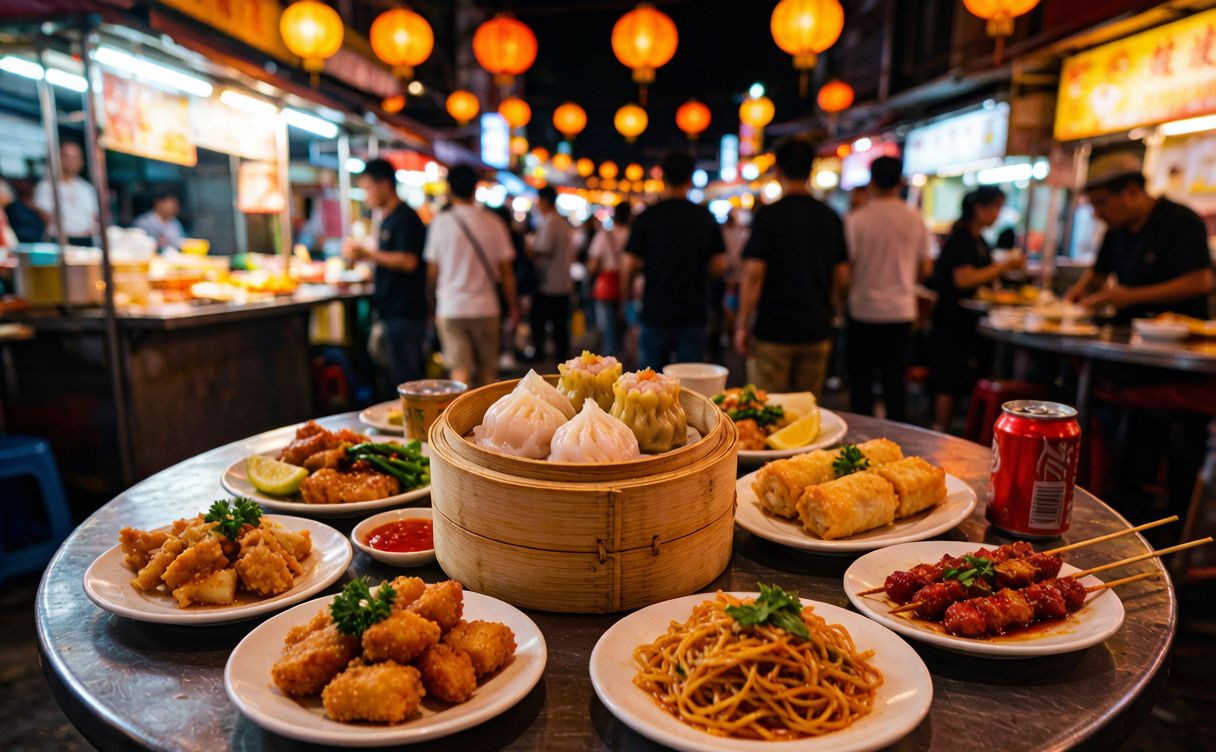
Night markets are the heart of Chinese food culture and the cheapest thrill you will find. Go hungry, go with friends, and go late — the best stalls often open around 6 p.m. and peak after 9. The golden rule is to eat where the locals queue; a long line of residents is the only review system you need. For the full safety rundown before you point at a mystery skewer, read our Street Food in China: Safety Guide.
Ordering Through Apps
Here is the part that surprises people: in most modern Chinese restaurants you do not talk to a waiter to order. You scan a QR code on the table, order and pay through an app, and the food arrives. It is fast, it works even if your Mandarin is zero, and it removes the awkward guessing game. Our How to Order Food in China With Apps walks you through Meituan, Ele.me, and the in-restaurant mini-programs step by step. I cannot recommend learning this early enough — it turns “where do I eat” from a stressor into a superpower.
Food Tours and Cooking Classes
If your trip is short, a guided food tour on day one pays for itself by teaching you what to order for the rest of the week. In Beijing, Chengdu, and Xi’an especially, a good local guide will take you to spots you would never find solo and translate the menu in real time. Cooking classes — dumplings in the north, hotpot broth in Chengdu, dim sum in Guangzhou — are a fantastic half-day and you leave knowing a recipe you can actually recreate.
Vegetarian and Dietary Notes
China is historically not vegetarian-friendly in the way the West expects, but it is far from impossible. Buddhist restaurants (look for 素菜 or 素食) serve surprisingly inventive mock-meat dishes, and almost every city now has international vegetarian and vegan options. The catch is hidden animal products: many “vegetable” dishes are stir-fried in lard or chicken stock, and dim sum often uses pork gelatin. Learn the phrase “我吃素” (wǒ chī sù, “I eat vegetarian”) and confirm “不許用蔥蒜嗎” only if you are strict. For allergies, see the phrasebook in the FAQ. Gluten-free is genuinely hard given the noodle-and-soy-sauce backbone of the cuisine, so plan accordingly.
Sample 7-Day Food Itinerary
This route moves north to south and strings together the best eating in the country. It assumes high-speed trains between cities, which are fast and easy to book once you are set up.
- Day 1–2, Beijing: Peking duck dinner, a hutong breakfast of jianbing (savory crepes) and soy milk, zhajiangmian lunch, and a winter lamb hotpot if the weather cooperates.
- Day 3–4, Xi’an: Fly or train in, then straight to the Muslim Quarter for roujiamo and biangbiang noodles. Spend day four on a morning dumpling feast and an evening of cumin lamb skewers.
- Day 5–6, Chengdu: The hotpot pilgrimage — one classic red-broth session and one yuanyang split pot. Fill the gaps with dan dan noodles, mapo tofu, and a Sichuan opera dinner show with snacks.
- Day 7, Guangzhou (or Shanghai): End south. In Guangzhou, do a proper dim sum breakfast, roast goose lunch, and clay-pot rice dinner. If you prefer Shanghai, swap in soup dumplings and a Jiangnan feast.
Seven days will not cover China’s food — nothing will — but this route gives you four distinct culinary languages in one trip.
FAQ
Is tap water safe to drink in China?
No. Locals boil it, and so should you. Bottled water is everywhere and cheap, and your hotel will usually provide a kettle. Use it for brushing teeth too. I have seen more trips derailed by a careless glass of tap water than by anything else on this list.
Do I need to tip in restaurants?
No. Tipping is not part of Chinese dining culture and adding a tip can confuse the bill. Service is included by default; just pay what the QR code or receipt says. (For guides and drivers, a small tip at the end of a multi-day tour is appreciated but never expected.)
How spicy is Sichuan food, really?
It ranges from “pleasant tingle” to “call the fire department.” The mala numbness is its own sensation, not just heat. Always ask for “微辣” (wēi là, mildly spicy) or “不辣” (bù là, not spicy) if you are unsure, and split pots exist for a reason.
I have a food allergy. How do I communicate it?
Write it down in Chinese before you travel. The key phrases: “我对花生过敏” (I am allergic to peanuts), “我不吃海鲜” (I do not eat seafood), “不要放味精” (no MSG). Show the note to the waiter and confirm. For severe allergies, carry a card explaining the risk clearly — English menus are unreliable on this.
Can I use credit cards at restaurants?
Mostly no. China runs on mobile payment. Set up Alipay or WeChat Pay before you arrive (tourist versions accept foreign cards), and keep some cash as backup for tiny street stalls.
What is a fair daily food budget?
Excellent local food is shockingly affordable. Street food and noodle shops run a few dollars a meal; a sit-down hotpot or duck dinner for two might be $20–40. Even in Shanghai you can eat very well on $15–25 a day if you follow the locals instead of the guidebook restaurants.
For a deeper, independently written overview of how regional Chinese cooking fits together, the Wikipedia entry on Chinese cuisine is a solid reference to read before you go.
Ready to turn this into a real trip? Our China travel guide for first-timers ties food, trains, and visas into one plan.