

If you only have time for one Chinese city on your first trip, the debate usually comes down to two names: Beijing and Shanghai. I’ve guided friends through both, lived the jet lag in each, and lost count of how many times I’ve been asked, “Which one do I actually pick?” This is the article I wish someone had handed me before my first visit in 2015.
Both cities are huge, safe, and wired for tourists. But they feel like different countries. Beijing is the capital of 3,000 years of imperial history. Shanghai is China’s glossy, fast-forward showcase of the future. Below I break down exactly how they compare, where to stay, what to eat, and how to decide — including how to do both if your schedule allows.
Content Preview
- Quick verdict: which city for whom
- Key comparisons at a glance
- History & culture: Beijing
- Modern & cosmopolitan: Shanghai
- Must-see sights in each city
- Food scene in each city
- Where to stay in each city
- Getting around
- Nightlife
- Can you do both? A 7-day Beijing + Shanghai route
- FAQ
Quick Verdict: Which City for Whom
Pick Beijing if your dream trip is about emperors, ancient walls, and standing where dynasties ruled. You want the Forbidden City, the Great Wall, and the kind of history you can feel in the air. It’s the better choice for first-timers who came to China specifically to see “the old China.”
Pick Shanghai if you’re drawn to skylines, design hotels, rooftop bars, and a city that runs at the speed of now. It’s more international, easier to navigate on English signage, and a fantastic base if you also want to day-trip to water towns and Hangzhou.
My honest take after many trips: first-time visitors interested in China’s story should start in Beijing; travelers who want a soft, modern landing with easy comfort should start in Shanghai. Both deserve at least three full days.
Key Comparisons at a Glance
| Factor | Beijing | Shanghai |
|---|---|---|
| Vibe | Imperial, historic, political capital | Modern, cosmopolitan, fast-paced |
| Top sights | Forbidden City, Great Wall, Temple of Heaven | The Bund, Yu Garden, Shanghai Tower |
| Food | Imperial cuisine, Beijing duck, hearty northern fare | Soup dumplings, Shanghainese, global dining |
| Nightlife | Hutong bars, comedy clubs, laid-back | Rooftop bars, clubs, supper street scene |
| Shopping | Silk Market, malls, antiques | Nanjing Road, boutiques, malls |
| Budget | Slightly cheaper outside tourist cores | Slightly pricier, especially for hotels |
| Best time | Apr–May, Sep–Oct | Mar–May, Sep–Nov |
History & Culture: Beijing
Beijing doesn’t whisper its history — it announces it. The city was the seat of Yuan, Ming, and Qing dynasties, and you feel that weight the moment you walk through the Meridian Gate into the Forbidden City. I still remember my first visit: 9,000 rooms of red lacquer and yellow tile, and the strange quiet that falls over the courtyards even with crowds around you.
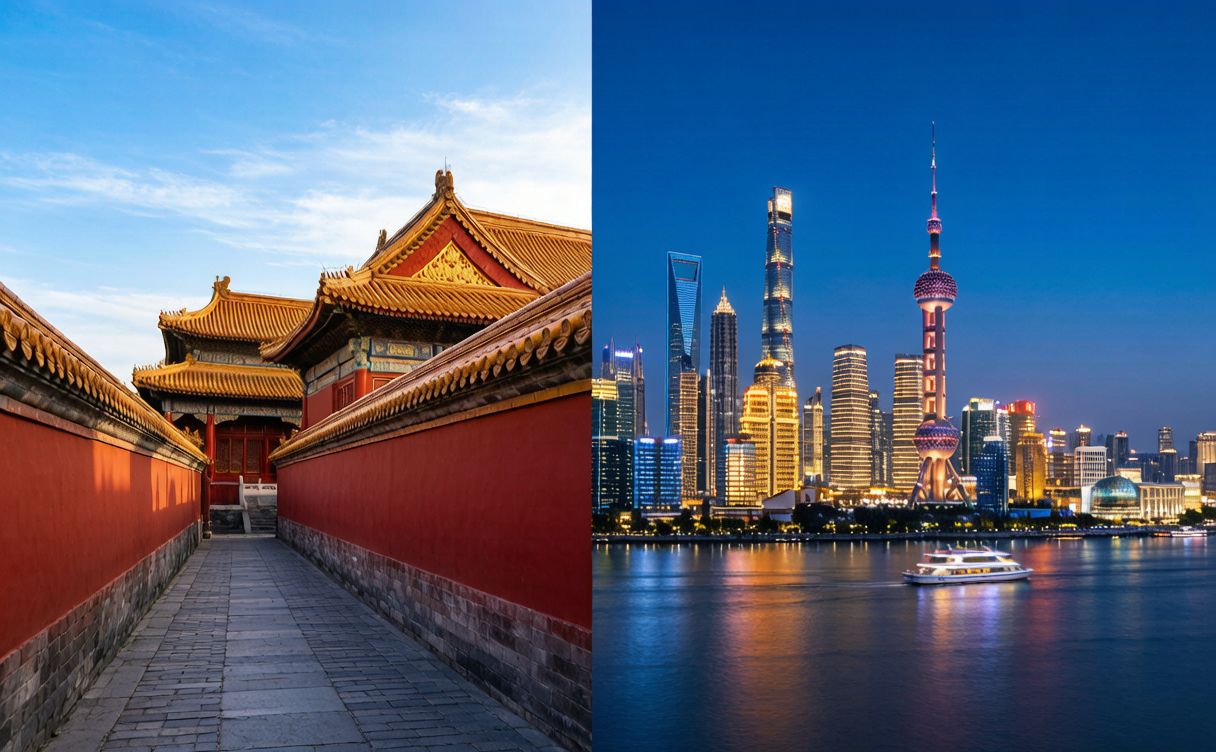
Beyond the palace, Beijing’s soul lives in its hutongs — the alleyway neighborhoods where locals still ride bikes and hang laundry between grey-brick walls. Spend an afternoon in one and you’ll understand the city better than any museum. The Temple of Heaven, Summer Palace, and Lama Temple round out the imperial circuit, and the Great Wall is an easy day trip from the city.
Culturally, Beijing moves at a human pace despite its size. Tea houses, opera, and old-family restaurants give it a depth that newer cities can’t fake. If “seeing China’s roots” is your goal, this is the city.
Modern & Cosmopolitan: Shanghai
Shanghai is what happens when China aims for the future and builds it in glass. The Bund — a row of colonial-era buildings on one bank of the Huangpu River — faces a wall of neon supertall towers in Pudong. Walk across at night and the contrast is genuinely dizzying. It’s my favorite skyline on earth, and I say that having seen a few.
But Shanghai isn’t only shiny. The former French Concession is a grid of tree-lined streets, cafés, and low-rise villas that feel almost European. It’s where the city slows down, where you sip a flat white and forget you’re in Asia’s biggest metropolis. That blend — futuristic waterfront plus walkable leafy neighborhoods — is why many expats and repeat visitors choose Shanghai as their base.
English signage is better here than almost anywhere else in China, and the metro is spotless and intuitive. For a first international trip where comfort matters, Shanghai lowers the friction.
Must-See Sights in Each City
Beijing essentials:
– Forbidden City — book tickets ahead; it’s the single most important stop. Our Forbidden City guide and tickets walks you through the booking steps foreigners actually need.
– Great Wall (Mutianyu or Jinshanling) — skip Badaling if you want photos without shoulder-to-shoulder crowds.
– Temple of Heaven and Summer Palace — calmer, beautiful, and full of local life.
– Hutong walks — Nanluoguxiang is touristy; quieter lanes near the Lama Temple are better.
Shanghai essentials:
– The Bund — go at dusk and stay through the light show. Our Shanghai Bund night-view guide covers the best vantage points.
– Yu Garden — a classical garden in the old town, best visited early.
– Shanghai Tower / Pudong skyline — the observation deck is worth the queue.
– French Concession — wander, don’t rush.
Food Scene in Each City
Beijing food is northern and unapologetic. Peking duck is the headline — crisp skin, thin pancakes, sweet bean sauce — and a proper duck dinner is a rite of passage. Beyond that, try zhajiangmian (bean-paste noodles), hotpot, and the snack stalls of a night market. Portions are generous and flavors are bolder, less sweet than the south.
Shanghai food is subtler and sweater. Xiaolongbao (soup dumplings) from Nanxiang are the icon — burst them carefully. Shanghainese classics like drunken chicken and braised pork shoulder reward slow eating. Because Shanghai is China’s melting pot, you’ll also find excellent Japanese, Italian, and Sichuan food within a few blocks. For a deeper dive, our Chinese food guide to 8 cuisines explains the regional logic.
If you love street food and fearless eating, Beijing wins. If you want variety and refined dining, Shanghai edges ahead.
Where to Stay in Each City
Location matters more than the hotel brand. In Beijing, the Wangfujing / Qianmen area puts you near the Forbidden City and metro lines, while Sanlitun suits travelers who want nightlife and international hotels. In Shanghai, People’s Square / Nanjing Road is central and transit-rich, while the French Concession is ideal for charm and walkability, and Lujiazui puts you in the shadow of the towers.
We’ve mapped neighborhoods, price bands, and specific hotel picks in our where to stay in Beijing and where to stay in Shanghai guides — read those before you book, because the “best” area depends entirely on your itinerary.
Getting Around
Both cities have world-class metros, but they differ in feel. Beijing’s system is enormous and built around ring roads; you’ll do more walking between stations and sights. Shanghai’s metro is denser in the center and English-friendly, and DiDi (the local Uber) works smoothly with an international card if you set it up.
One cross-city tip I give everyone: download a China map app before you land, since Google Maps is unreliable here. Our internet-in-China guide explains how to stay connected. Between Beijing and Shanghai, the high-speed train (about 4.5 hours) beats flying once you factor in airport time — and it’s a scenic, comfortable ride.
Nightlife
Beijing’s nightlife hides in the hutongs: small bars, live music, and a comedy scene that’s grown fast. It’s low-key and social. Shanghai’s is bigger and brighter — rooftop bars overlooking the Bund, late supper streets in Huangpu, and clubs that run till dawn. If nightlife is a priority, Shanghai has more range; if you want cozy and local, Beijing delivers.
Can You Do Both? A 7-Day Beijing + Shanghai Route
Absolutely — and it’s the combo I recommend most to first-timers with a week. You get the history hit and the modern payoff without feeling rushed.
- Days 1–3 (Beijing): Forbidden City + Tiananmen, Temple of Heaven, Great Wall day trip (Mutianyu), hutong dinner.
- Day 4: Morning train to Shanghai (4.5 hrs).
- Days 4–6 (Shanghai): The Bund at night, Yu Garden, French Concession walks, Pudong skyline, Zhujiajiao water town day trip.
- Day 7: Fly out from Shanghai (more international connections) or train onward.
Pair this with our detailed Beijing 3-day itinerary and Shanghai 2-day itinerary for exact timings, or use our broader China 1-week itinerary if you want to fold in a third stop.
FAQ
Which city should I visit first?
If this is your first trip to China and you’re here for the “real China” experience, start in Beijing for the history. If comfort, language ease, and modernity matter more, start in Shanghai. Both work as a first stop.
How many days do I need in each?
Minimum three full days for Beijing (one of those for the Great Wall) and two to three for Shanghai. Anything less and you’ll spend more time in transit than at sights.
Is the language barrier worse in one city?
Shanghai has better English signage and more English-speaking staff in hotels and attractions. Beijing is manageable but you’ll lean harder on translation apps. Either way, download a translator before you arrive.
Can I do a day trip from either city?
Yes. From Beijing: the Great Wall (Mutianyu/Jinshanling) and summer mountain escapes. From Shanghai: Zhujiajiao and Hangzhou water towns are easy half-day or full-day trips.
Which is better for shopping?
Beijing for antiques, pearls, and bargains at the Silk Market. Shanghai for malls, international brands, and boutique fashion in the French Concession. Neither is cheap by regional standards.
Which is cheaper?
Beijing is generally a touch cheaper, especially for food and some hotels. Shanghai’s international polish comes with slightly higher prices, particularly in Pudong and the Concession.
Is it safe to walk around at night?
Both cities are very safe for tourists, including solo travelers. Standard big-city caution applies, but violent crime against visitors is rare. See our China travel safety tips for specifics.
When is the best time to visit?
Beijing shines in spring (Apr–May) and autumn (Sep–Oct). Shanghai is best in spring and autumn too, avoiding the humid summer. Check our best time to visit Beijing and best time to visit Shanghai for month-by-month detail.
External authority: For the UNESCO World Heritage status of the Forbidden City, see the official UNESCO listing.