

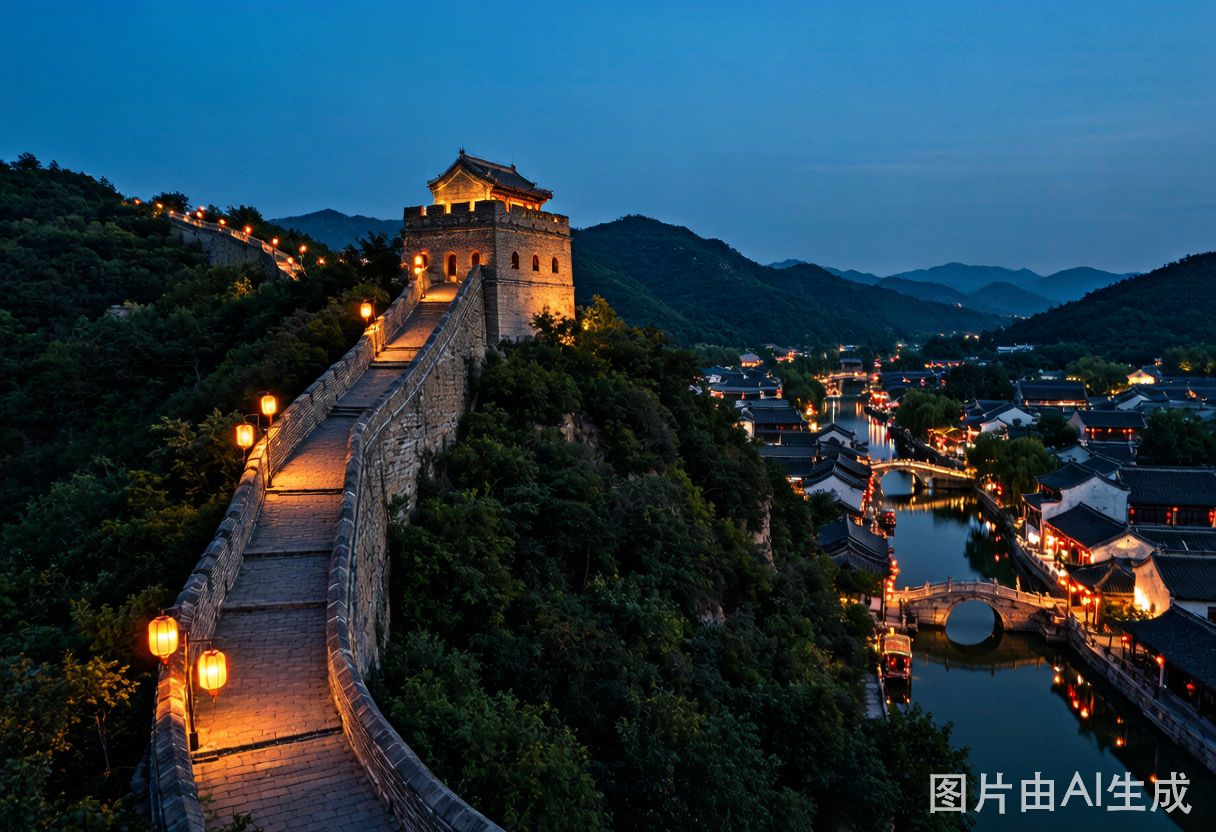
The first time I stood at the foot of the Simatai Great Wall after dark, I genuinely thought I had wandered onto a film set. The wall above me was strung with hundreds of small lanterns, and the stone path climbed into a sky so black it swallowed the mountains on either side. Simatai is the only section of the Great Wall near Beijing officially open to visitors at night, and pairing it with the artificial-but-charming Gubei Water Town at its base is, in my view, the single best evening within a two-hour drive of the capital.
I have now done this trip four times across different seasons, twice solo and twice with skeptical friends who doubted a “lit-up wall” was worth the late bus home. Every one changed their mind by Tower 4. This guide is built from those trips: what to book, how to get there, what the night tour includes, and when to go so you don’t freeze or get soaked.
Why Simatai and Not Mutianyu or Badaling at Night
Most people who come to Beijing hit the Great Wall during daylight on a day trip, and that is a perfectly good plan. But if you want the version of the Wall that shows up on postcards you didn’t know existed, Simatai is the answer. The reason is simple: it is the only restored section with a sanctioned night opening. Badaling and Mutianyu are spectacular, but they close with the sun. My comparison in Mutianyu vs Badaling Great Wall breaks down crowds, cable cars, and hiking difficulty — but neither lets you walk the ramparts under lantern light.
Simatai is also the most “wild” feeling of the restored sections. The gradient is steep, the towers are close together, and the original Ming-dynasty masonry has been treated gently rather than rebuilt into a smooth ramp. At night that rawness reads as drama.
Getting There from Beijing
Simatai sits about 120 km northeast of central Beijing, in Miyun District, right next to Gubei Water Town (Gubei Shuizhen). There is no metro that reaches it, so you have three realistic options.
1. The direct tourist bus. In spring and autumn the water town runs direct shuttle buses from Beijing, often departing from locations like the Dongzhimen area. These are the easiest if you don’t speak Chinese, but the schedule is seasonal and you need to book ahead through the town’s official platform.
2. Public transport, the budget way. Take Beijing Subway Line 2 to Dongzhimen, then the 980 Express bus to Miyun, then a local taxi or the connecting shuttle to Gubei. Doable, but it eats three hours each way and leaves you juggling timing for the night tour. I only recommend it if you are already comfortable navigating Beijing buses.
3. A private car or Didi. This is what I do now. A Didi from central Beijing to Gubei runs roughly 350–500 RMB one way depending on traffic, and you control your return. For two or three people it is barely more expensive than the bus per head, and you won’t be stranded at midnight when the last shuttle has left.
Whichever you choose, plan to arrive in the early afternoon. That gives you time to check in, wander the town, eat, and walk up to the Wall as the light fades — exactly when the magic starts.
If you are building a wider Beijing plan around this, my Beijing 3-Day Itinerary slots this as an overnight on day three, and the Beijing First-Time Travel Guide covers the subway and taxi basics you’ll need to get out here.
The Gubei Water Town Combo
Gubei Water Town is a purpose-built replica of a northern water town, and I’ll be straight with you: it is not ancient. It was constructed in the last decade around a real reservoir and canal system. But “fake” undersells it. The architecture is convincing, the alleys narrow and photogenic, and at night the whole place lights up with red lanterns reflected in the water. Think of it as the gentle, walkable, food-and-beer counterpart to the serious hike above it.
Almost everyone does the combo, because the Wall entrance sits inside the water town. Your ticket flow looks like this:
- Water Town day entry — gets you into the town itself.
- Wall night tour ticket — a separate add-on that lets you ride the cable car (or walk) up after dark and walk the lit section.
- Optional combo passes — sold on the official site and at the gate, bundling town entry, the Wall night ticket, and sometimes the cable car.
I strongly recommend buying the combo online in advance, especially on weekends. The night-tour slots are capped, and I have watched walk-up travelers get turned away on a Saturday in October. Booking the Great Wall Beijing Day Trip style logistics in advance is the same principle that applies here: the popular slots sell out, not the attraction itself.
What the Night Tour Actually Includes
Here is the part that surprises people. The night tour does not open the entire Simatai section. Only a limited stretch — roughly from the base up to Tower 5, sometimes Tower 6 depending on season and staffing — is lit and patrolled after dark. Beyond that the wall is closed and roped off. So manage your expectations: this is a short, guided, lantern-lit stroll with big views, not a midnight conquest of the whole ridge.
What you get:
- A cable car ride up (included in most night tickets) that alone is worth it — the town sparkles below as you rise.
- A lit, paved path between the lower towers with lanterns every few meters.
- Unobstructed views back down over Gubei Water Town’s glowing rooflines and the reservoir.
- A hard stop. Rangers usher people down around 21:30–22:00, and the last cable car is firm. Don’t dawdle at the top.
The photography is the real prize. With no daylight glare and the warm lanterns against a deep-blue sky, even a phone camera produces something frame-worthy. If you want to level up your shots, my guide to the Best Photo Spots on the Great Wall at Sunrise is written for daylight, but the composition tips — leading lines, framing a tower, shooting during the blue hour — apply perfectly here.
Tickets, Pricing, and Practical Booking
Prices shift year to year, so treat these as a planning range rather than gospel. As of my most recent trip:
- Water Town entry: around 140–170 RMB.
- Wall night tour (with cable car): around 160–200 RMB.
- Combo (town + night Wall): often a small discount versus buying separately, roughly 280–340 RMB.
Book through the official Gubei Water Town platform (their WeChat mini-program or website) or a reputable reseller. Bring your passport — Chinese scenic areas tie tickets to ID, and foreigners sometimes get flagged at the gate if the booking name doesn’t match the passport exactly. The Things to Do in Beijing page lists other bookable sights so you can batch your planning.
One more note: the night tour is weather dependent. Heavy rain or strong wind closes the cable car and the lit section. I got caught by a July storm once and was refunded, but it meant a 2 a.m. drive back with no Wall. Check the forecast the morning of, and have a fallback — the water town alone is still a lovely evening.
Best Season to Go
This is the question I get most. My ranking:
- Autumn (late September–early November) is the winner. Cool, clear air, almost no rain, and the lanterns pop against crisp skies. October weekends are busy but worth it.
- Spring (April–May) is excellent too, though watch for occasional sandstorm haze that flattens the views.
- Winter is brutally cold but stunning — snow on the wall, far fewer people, lanterns incredible against white. Dress like you’re mountaineering; I mean it.
- Summer is warm and lush but brings the highest rain risk and the most mosquitoes. The Best Time to Visit Beijing guide gives the month-by-month climate picture.
Avoid Chinese public holidays — the National Day week in early October especially turns the town into a human river. My China Public Holidays crowd calendar (yes, I link the 2025 version because the dates roll forward predictably) is the tool I use to plan around those spikes.
Practical Tips I Wish I’d Known
- Wear real shoes. The lit path is paved but the town’s alleys are slippery stone when wet. I once wore loafers and regretted every step.
- Bring a light jacket even in summer. It drops 8–10 degrees after dark up on the ridge.
- Eat before you go up. The town has decent restaurants, but the Wall itself has nothing.
- Charge your phone. Between the cable car photos and the town, you’ll burn battery fast. A power bank saved my map-reading on trip two.
- Start the climb during blue hour (roughly 30–45 minutes after sunset) for the transition from dusk to full lantern glow — the best of both.
Is It Worth the Trip?
For me, unequivocally yes — but know what you’re buying. This is not a rugged Great Wall adventure; it’s a curated, atmospheric evening that pairs a short, safe, lit walk on genuine Ming masonry with a stroll through a glowing water town. If your image of the Wall is solitude and wilderness, do a daytime hike at Mutianyu or Jinshanling instead. If you want a memory that feels a little like a fairy tale and is easy to pull off as an overnight from Beijing, Simatai at night is hard to beat.
The feedback from readers who’ve done it is consistent: the night tour is the surprise highlight of their Beijing trip. Just book the combo early, pick a clear autumn evening, and let the lanterns do the rest.
For an authoritative rundown of the Wall’s sections and preservation history, the UNESCO World Heritage listing remains the best single reference: Great Wall of China — UNESCO World Heritage Centre.
Planning the rest of your Beijing stay? My [Beijing 3-Day Itinerary](https://www.chinatravelplaces.com/beijing-3-day-itinerary/) folds Simatai into a balanced three days with the Forbidden City, hutongs, and a Great Wall day hike — download the day-by-day plan and stop guessing.
Not sure which Great Wall section is right for you? Read [Mutianyu vs Badaling](https://www.chinatravelplaces.com/mutianyu-vs-badaling-great-wall/) to compare crowds, cable cars, and difficulty, then decide whether your trip wants a daytime hike or this nighttime glow.
Want the lantern-lit photos without the planning headache? Check the [Best Time to Visit Beijing](https://www.chinatravelplaces.com/best-time-to-visit-beijing/) guide for the clearest months, and book your Gubei combo pass at least a week ahead for weekend slots.