

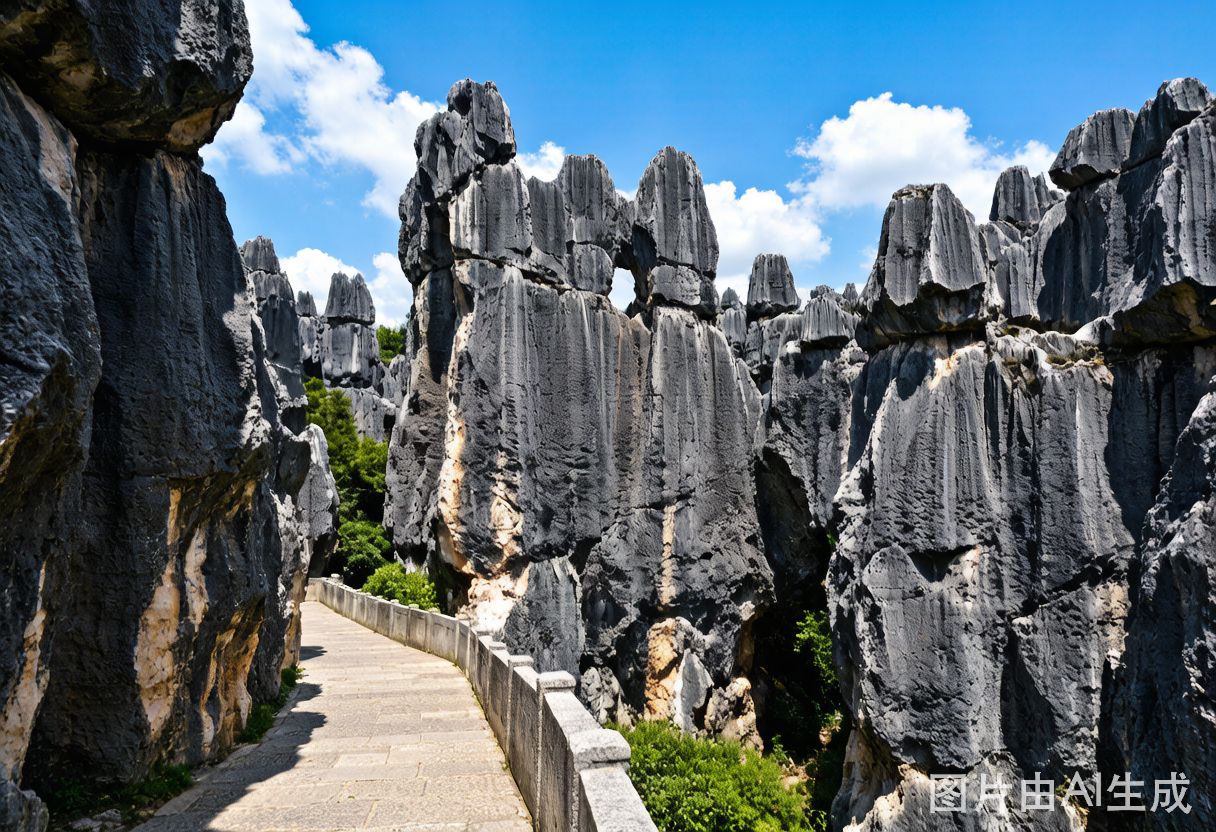
I still remember the first time I stepped off the bus in Shilin and looked up. What I had expected to be a “rock garden” turned out to be a silent, grey city of stone — limestone pillars the height of apartment buildings, leaning at impossible angles, some split down the middle like a cracked eggshell, others worn into shapes locals swear look like swords, camels, or sleeping women. The Yunnan Stone Forest (石林, Shílín) is one of those places that photographs badly and lives in person. If you are basing yourself in Kunming, this is the single easiest and most rewarding day trip in all of Yunnan, and I have sent dozens of friends there with zero regrets.
What the Stone Forest Actually Is
The Stone Forest sits about 90 km southeast of Kunming in Shilin Yi Autonomous County, and it is part of the South China Karst, a UNESCO World Heritage property. The science is simple enough: roughly 270 million years ago this was a shallow sea. Layers of limestone built up, the sea retreated, and acidic rainwater spent the next few hundred million years quietly dissolving the rock along vertical fractures. What is left is a forest of bare limestone columns — some 10 meters tall, some over 30 — separated by narrow, shadowy gullies you can walk through. UNESCO explains the geological story in more detail here: South China Karst – UNESCO World Heritage Centre.
The Yi people, specifically the Sani branch, have lived among these stones for centuries, and to them the forest is home and folklore, not geology. The best-known legend is Ashima (阿诗玛), a Sani girl turned to stone rather than give up the man she loved. You will see her “face” on a pillar and hear the tale from almost every guide. The folklore made the walk feel lived-in rather than merely scenic.
Getting There from Kunming (The Practical Part)
This is the part I care about most, because a confusing transfer can ruin a day. Here is the route I have used and recommend.
By train (fastest, cheapest). Kunming South Railway Station has frequent high-speed trains to Shilin West (石林西) — about 20–35 minutes, roughly ¥35–50. From there, a local bus or taxi (25–30 min, ¥40–60 by Didi) reaches the gate. The train is the move to avoid Kunming traffic; my China high-speed train guide for foreigners walks through 12306 and the station experience.
By direct tourist bus. Kunming’s East Bus Station (东部客运站) runs coaches to Shilin every 30–40 minutes; about 1.5–2 hours and ¥35. Slower than the train but simpler if you stay on the east side.
By tour or private car. Kunming agencies sell day trips bundling transport and a guide; a private car runs ¥400–600. I did this once with my parents who preferred not to navigate transfers, and the zero-stress premium was worth it.
My honest recommendation: take the morning train and arrive before the 9:30 a.m. tour-bus crush for an hour of near-empty paths. Buy your return ticket in advance on busy weekends.
Major Forest vs. Minor Forest vs. Naigu
Most first-timers only see the Major Forest (大石林 / 李子园), and that is a mistake. The ticket usually covers several zones; here is how I split my time.
Major Forest (Da Shilin). This is the postcard area: dense, tall pillars, the Ashima stone, the Sword Peak Pond (剑峰池), and the famous “Stone Forest” inscription carved by a Qing official. The paths climb stone steps and duck through gaps; wear real shoes, not sandals. It is spectacular but gets crowded by late morning. Go here first.
Minor Forest (Xiao Shilin). A short walk from the Major Forest, this open grassland dotted with free-standing pillars has better light and fewer tour groups. I preferred it for just sitting and looking. Sani women in embroidered dress often gather here for photos (tip expected if you ask them to pose).
Naigu Stone Forest (乃古石林). About 20 minutes north by shuttle, Naigu means “black” in Yi, and the rock here is darker, more weathered, and far less visited. If you want the “I had the place to myself” experience, this is it. The loop takes about 90 minutes. I only made it here on my second visit, and I wish I had gone sooner.
There is also a lake area (Lizi Yuanqing) and the nearby “Great Sani Village” performance, but I would treat those as optional. Spend your energy on Major + Minor + Naigu.
A Suggested Route for One Day
If you arrive around 9 a.m. and leave by 5 p.m., here is the loop that worked best for me:
- Enter through the main gate, take the internal shuttle to the Major Forest trailhead (do not walk it — it is far).
- Spend 2–2.5 hours in the Major Forest, climbing to the viewpoints and finding the Ashima stone.
- Walk over to the Minor Forest for 45–60 minutes of open, photo-friendly wandering.
- Grab lunch inside the park (see below) or pack your own.
- Take the shuttle to Naigu Stone Forest for a quieter 90-minute loop.
- Back to the gate, catch your taxi to Shilin West, and the train back to Kunming.
That is a full but relaxed day. If you only have half a day, skip Naigu and do Major + Minor well.
What to Eat
Food inside the park is overpriced and mediocre, so I pack water and snacks. The Sani and broader Yi cuisine is worth trying, and Shilin town just outside the gate has better, cheaper options than the park stalls.
- Stone Forest goat: local pasture-raised goats, lean and charcoal-grilled with a cumin-heavy rub.
- 乳饼 (ru bing): a firm, pan-fried goat-milk cheese, an Yi specialty rare elsewhere in China. Try it once; I liked it more than expected.
- Wild mushrooms (菌): Yunnan is China’s mushroom capital; summer brings fresh wild-fungi hotpots (July–September peak).
- Crossing-the-bridge rice noodles (过桥米线): available everywhere, a safe warming default if unsure.
For a proper meal, walk 10 minutes out of the park gate to the town and pick a busy local spot rather than the obvious tourist restaurant by the entrance.
When to Go
Yunnan sits on a plateau, so the climate is mild, but the Stone Forest has a clear best season. I have been in both the wet and dry months.
- Spring (March–May): my favorite. Warm, flowers blooming, and the stones framed by green.
- Summer (June–August): lush and green, but this is also rainy season — afternoon thunderstorms are common, and the gullies can get slippery. Bring a light rain shell. It is also the busiest time for domestic tourists.
- Autumn (September–November): excellent, cool, clear skies, fewer crowds after the National Day holiday in early October.
- Winter (December–February): cold and dry, occasional frost on the stones, and very few people. If you hate crowds and don’t mind a jacket, this is peaceful.
Whichever season, arrive early. The light is best before 11 a.m., and so is the silence. If you are planning a wider Yunnan or China trip around this, my best time to visit China overview helps you line up regions and seasons.
The Yi / Sani Culture You Should Not Skip
The Stone Forest is not just rocks; it is the cultural heartland of the Sani people. If your schedule allows, time your visit for a local market day (nearby towns hold periodic 赶集 markets) or, better, the Torch Festival (火把节) in late July or early August, when the Sani light bonfires, dance, and wrestle through the night. I attended one and it was the kind of un-touristy evening you remember for years.
Even outside festival time, the Sani embroidery, the call-and-response folk songs, and the Ashima legend give the place a human layer that pure geology lacks. Hire a local guide at the gate (¥80–150) if you want the stories told properly — mine pointed out a dozen “hidden” shapes I would never have noticed.
How It Fits Into a Yunnan Trip
Kunming is the gateway, but the real Yunnan lies further west, and the Stone Forest pairs naturally with the classics. Most travelers spend a night or two in Kunming, hit the Stone Forest as a day trip, then move on to Dali’s lakeside old town and the Naxi lanes of Lijiang. My Dali Yunnan travel guide and Lijiang Old Town travel guide cover those next stops, and the Kunming travel guide has where to stay and eat in the city.
If your interest in karst runs deep, the limestone scenery of Guilin and Yangshuo in Guangxi is the Stone Forest’s southern cousin — same geology, different mood, with river cruises instead of stone gullies. I have done both, and they complement a longer China itinerary. (Note: these peaks are a world apart from the high plateau landscapes of Tibet, China, or Xinjiang, China — different ecosystems, different trips.)
Planning a Yunnan loop? Start by mapping your Kunming base and day trips with our full [Kunming travel guide](https://www.chinatravelplaces.com/kunming-travel-guide/) before you book trains.
Practical Tips I Wish I Knew Earlier
- Tickets: the combined entrance is around ¥130–175 depending on season; buy at the gate or via major Chinese travel apps. The ticket covers the shuttle buses between zones.
- Footwear: stone steps are uneven and can be slick after rain. Closed shoes with grip, not flip-flops.
- Water and sun: little shade in the open Minor Forest and Naigu. Hat, sunscreen, two liters of water in summer.
- Crowds: Chinese public holidays (especially May Day and National Day) turn the Major Forest into a slow shuffle, so plan around the holiday calendar if your dates are flexible.
- Guides: official guides at the gate speak some English; negotiate clearly on price and duration before setting off.
Want the stones to yourself? Travel in winter or on a weekday, and book the earliest Kunming–Shilin train you can — quiet mornings are the secret to this place.
Final Word
The Yunnan Stone Forest is not the most famous sight in China, and that is exactly why I love sending people there. It is an easy, affordable, half-day-or-full-day escape from Kunming that delivers something you cannot see anywhere else on earth — a genuine geological oddity wrapped in Yi folklore and good food. Go early, wear good shoes, leave time for Naigu, and let the Sani stories do the rest. It remains, for me, the most underrated stop on any first trip to Yunnan.
Ready to build the rest of your Yunnan route? Pair the Stone Forest with Dali and Lijiang using our [Lijiang Old Town travel guide](https://www.chinatravelplaces.com/lijiang-old-town-travel-guide/) to plan the next stop.