

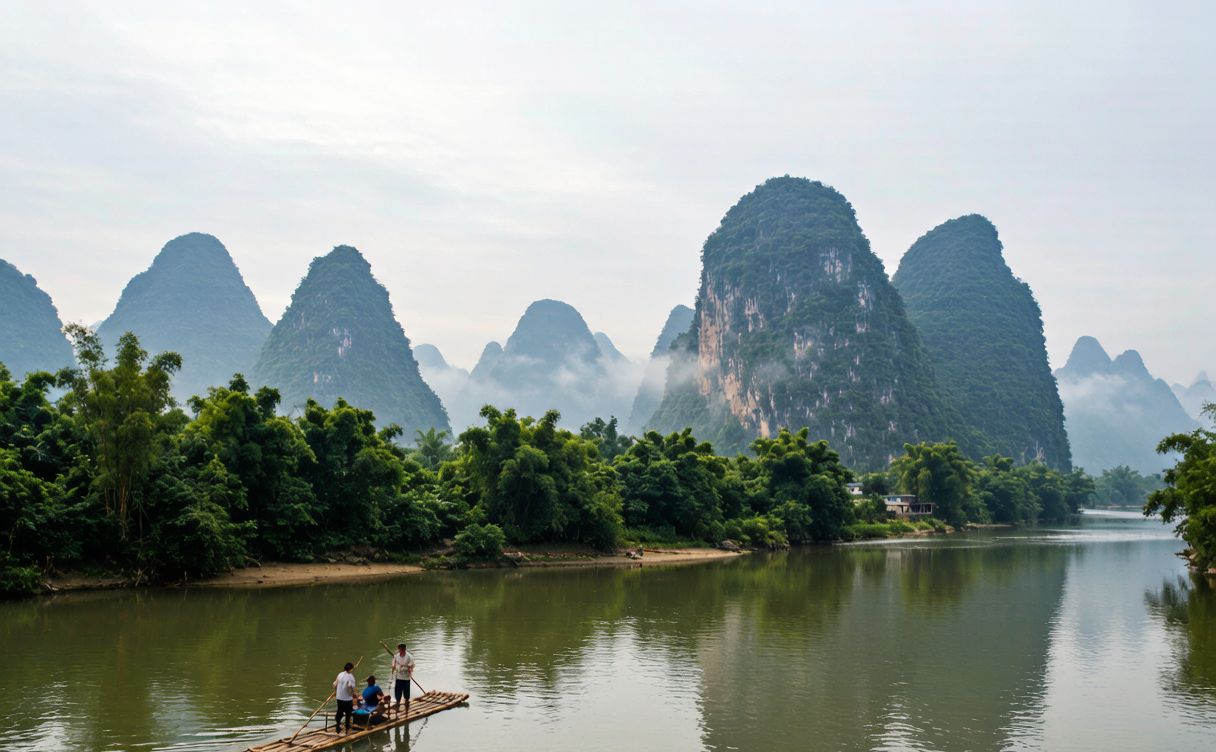
If you have ever seen one of those Chinese landscape paintings with impossibly green hills rising straight out of a misty river, you were probably looking at Guilin and Yangshuo. This corner of Guangxi has been China’s postcard for over a thousand years, and the scenery still earns the hype. The Li River winds between limestone peaks so perfectly shaped they look staged, and the town of Yangshuo — two hours downstream — is where most travelers plant themselves to cycle, climb, and watch the light change on the water. This guide covers how to get there, whether to base in Guilin or Yangshuo, the classic river cruise, and the slower things that make a trip here stick.
At a glance
- Best for: first-time visitors to China, landscape photographers, cyclists, rock climbers
- How long: 3–4 days minimum; add more if you want to climb or just slow down
- Base: Yangshuo for scenery and nightlife, Guilin for transport links and the city itself
- Getting there: high-speed train from major cities; flight into Guilin Liangjiang Airport
- Signature experience: the Li River cruise from Guilin to Yangshuo
- Season: April–October for green hills and water; avoid major holiday weeks
How to get to Guilin and Yangshuo
Guilin sits in the northeast of Guangxi and is well connected by China’s high-speed rail network. Trains from Guangzhou take about two and a half hours, from Shenzhen around three, and from Hong Kong, China you can reach Guilin in roughly four hours with one transfer. Booking is straightforward if you know where to look — our China high-speed train guide for foreigners walks through the app, the ID requirements, and how to collect tickets.
Flying is another option. Guilin Liangjiang International Airport has domestic routes from most big cities and a handful of international flights. From the airport, a bus or taxi gets you into Guilin city in about 40 minutes, and from there it’s another shuttle or train to Yangshuo.
Once you’re in the region, local transport is easy. Buses and the Guilin–Yangshuo expressway connect the two, and the river cruise itself is the most scenic transfer you’ll ever take.
Guilin vs Yangshuo: where to base
This is the first decision most people face, and it shapes the whole trip.
Stay in Yangshuo if…
You came for the landscape and want to be in it. West Street (Xi Jie) in Yangshuo town is touristy but lively, packed with cafés, climbing outfitters, and bars. Within a short bike ride you reach rice fields, river bends, and quiet villages. Most travelers who love Yangshuo end up extending their stay.
Stay in Guilin if…
You want a proper city with museums, the Reed Flute Cave, and easier airport and train access. Guilin is a fine base for a night, but the dramatic scenery is mostly downstream. Many people spend one night in Guilin, then cruise to Yangshuo and stay there.
My usual advice: sleep in Yangshuo, treat Guilin as a transit and half-day stop. You’ll spend more time looking at hills and less time in traffic.
The Li River cruise: Guilin to Yangshuo
The cruise is the reason most foreigners come, and it delivers. Boats leave from Zhujiang Pier, about 40 minutes from Guilin, and take roughly four hours to reach Yangshuo, passing the famous formations — Nine Horse Fresco Hill, Yellow Cloth Shoal (the hill on the old 20-yuan note), and the clusters of peaks that define the region.
There are a few ways to do it:
- Large cruise boat: air-conditioned, buffet lunch, commentary. Comfortable and social, around 300–400 yuan. This is what most tour packages use.
- Small private boat: faster, fewer people, more flexible photo stops, but pricier and bookable mainly through agents.
- Bamboo raft (upstream section): short hops near Yangshuo on the tributaries — thrilling but not the full Guilin–Yangshuo run.
Bring something warm; the upper deck gets windy even in spring. And charge your camera the night before — the views don’t let up.
If you want the deep version with timings, ticket types, and where each boat actually docks, see our dedicated Li River Guilin cruise guide.
Cycling the Yangshuo countryside
Rent a bike in Yangshuo and you’ll understand the place fast. The flat roads along the Yulong River and around the village of Gaotian are pancake-flat and traffic-light, looping past paddies, old stone bridges, and peaks that change color with the light. A half-day loop covers the essentials; a full day lets you reach the quieter south.
E-bikes are everywhere and remove any worry about the heat. Most guesthouses rent both, and plenty of cafés double as repair stops. The Moon Hill climb and the path to the Silver Cave are popular targets, but honestly the joy is in the unnamed stretches between them.
Rock climbing around Yangshuo
Yangshuo is one of Asia’s best-known climbing destinations, with hundreds of routes on the limestone. The crag at White Mountain and the routes near Wine Bottle Mountain are classics, spanning beginner slabs to serious overhangs. Several outfitters in town run daily courses, rent gear, and bolt new lines every season.
You don’t need experience to try it — a half-day intro with a certified guide gets most people up a real route by lunch. The views from the anchors are a different kind of reward from the riverbank.
Impression Sanjie Liu and Yangshuo nights
The open-air show Impression Sanjie Liu, directed by Zhang Yimou, stages hundreds of performers on a natural stage of river and hills. Lights, mist, and moving boats turn the landscape itself into the set. It’s touristy and a little cheesy, but on a clear night it’s genuinely moving — and a good contrast to the quiet mornings.
Back in town, West Street fills with food stalls, live music, and the kind of easy social scene that makes solo travelers stay longer than planned. For broader context on staying safe and sane while traveling in China, our China travel safety tips cover the basics.
When to go and what to pack
Spring (April–May) and autumn (September–October) are the sweet spots: green hills, manageable heat, and good river levels. Summer is lush but hot and humid, with afternoon storms. Winter is cold and sometimes socked in with low cloud, which can actually look magical on the river — just don’t expect long views.
Avoid the first week of May (Labor Day) and the first week of October (National Day). Trains sell out and the riverboats are packed. For a region-by-region take on timing across the country, see the best time to visit China.
Pack light, breathable layers, a rain shell, and solid walking shoes. Sunscreen matters more than you’d think on the water.
A few practical notes
Money and connectivity are easier than many expect. Alipay and WeChat Pay cover almost everything in Yangshuo, and a local SIM or eSIM keeps maps working in the countryside. If Guangxi is your first stop, our things to know before visiting China rounds up the small rules that save headaches.
Guangxi food deserves its own attention: rice noodles (Guilin mifen), beer fish (pijiu yu) in Yangshuo, and the sour-sweet pickles sold from roadside stalls. It’s lighter and more herbal than the heavy northern cooking, and a good reset after days of city food.
Planning more of China
Guilin pairs naturally with Guangzhou to the south or Zhangjiajie to the north, and it’s an easy add-on to a first-timer’s route. If you’re building a longer trip, our China travel guide for first-timers links the regions together without overloading your schedule.
Guilin and Yangshuo reward the traveler who slows down. Take the cruise, then stay a few extra days to ride the back roads and watch the same hills in different light. That’s the trip people remember.
Written by Karl. For current train times, visa rules, and seasonal conditions, always confirm with official sources before you fly — start with the Guilin Tourism Administration for up-to-date regional information.