

Spanning the Linxi River in the green hills of Sanjiang County, the Chengyang Wind-Rain Bridge is one of the most celebrated wooden structures in southern China. Built by the Dong ethnic minority without a single iron nail, this covered bridge blends practical river crossing with breathtaking craftsmanship and living cultural tradition. For travelers exploring Guangxi, China, it is an unmissable stop that connects you to centuries of Dong engineering and village life.
The bridge is also known as the Chengyang Yongji Bridge or simply as the dong minority bridge that has come to symbolize Dong architecture across the region. Unlike the stone arches of Europe or the steel spans of modern cities, the Chengyang Wind-Rain Bridge is made almost entirely of timber, pieced together with interlocking joints so precise that the structure has survived more than a century of wind, rain, and seasonal floods. That is exactly why it earned the poetic name “wind-rain bridge” — a sheltered place where locals rest, greet neighbors, and watch the river flow, protected from the elements.
Discover more handcrafted China travel guides to plan your perfect southern adventure.
A Brief History of the Chengyang Bridge
The Chengyang bridge we see today dates back to the early 20th century, with its main construction completed in 1916 under the collective effort of five nearby Dong villages. The Dong people have a long tradition of building communal structures — drum towers, wind-rain bridges, and villages laid out around shared space — and the bridge was conceived as both a functional crossing and a gift to the community.
Local legend says the design was inspired by the vision of a skilled carpenter who studied the way a rice bird’s nest is woven without bindings. Whether or not the story is literally true, it captures the spirit of Dong building: structures that appear delicate yet stand for generations. The bridge has been restored several times, always using traditional methods so that the original joinery logic remains intact.
During the 20th century, the chengyang bridge guangxi region became a quiet symbol of ethnic minority craftsmanship. Today it is protected as a key cultural relic and draws visitors from across China and the world who want to see a wooden bridge that refuses to rust, rot, or fall.
The Architecture of a Living Masterpiece
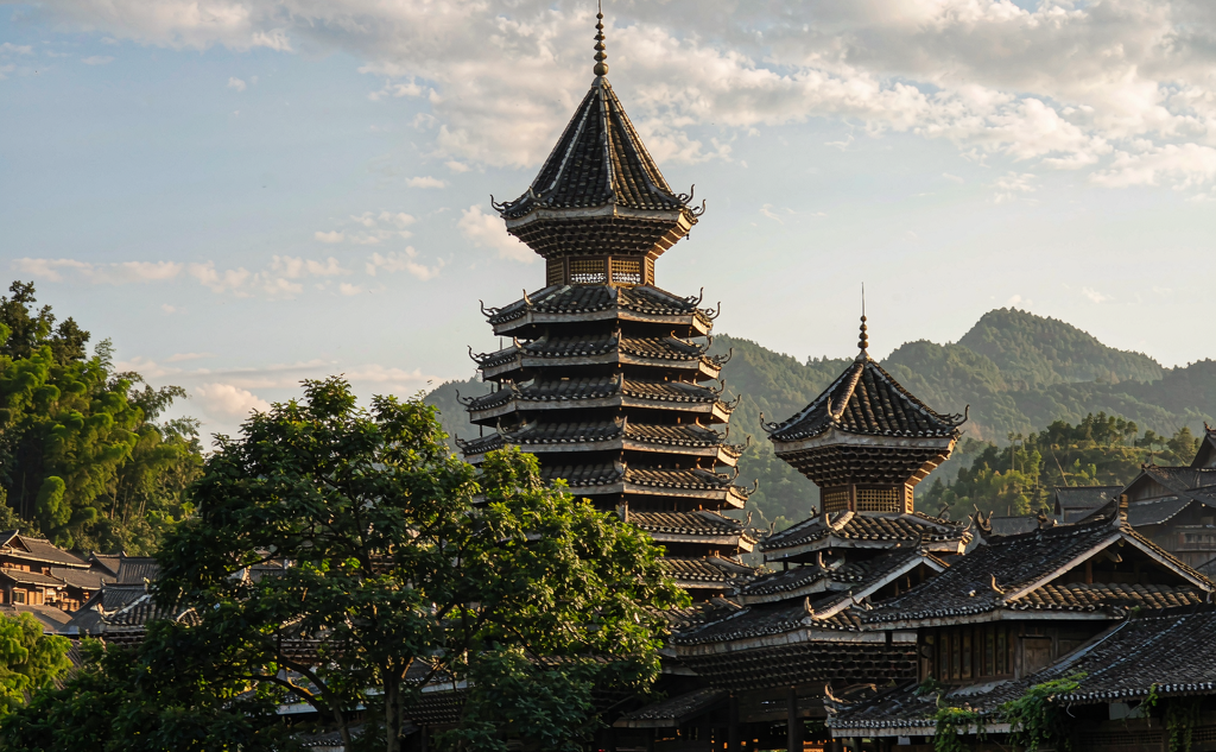
What makes the Chengyang Wind-Rain Bridge extraordinary is not its length — about 64 meters in total — but its form. The bridge deck is covered by a series of pavilions and verandas, creating a roofed corridor that feels more like a temple than a crossing. Five tower-like pavilions rise from the deck at intervals, each with multiple tiers of upturned eaves that echo the silhouette of a Dong drum tower.
No-Nail Joinery
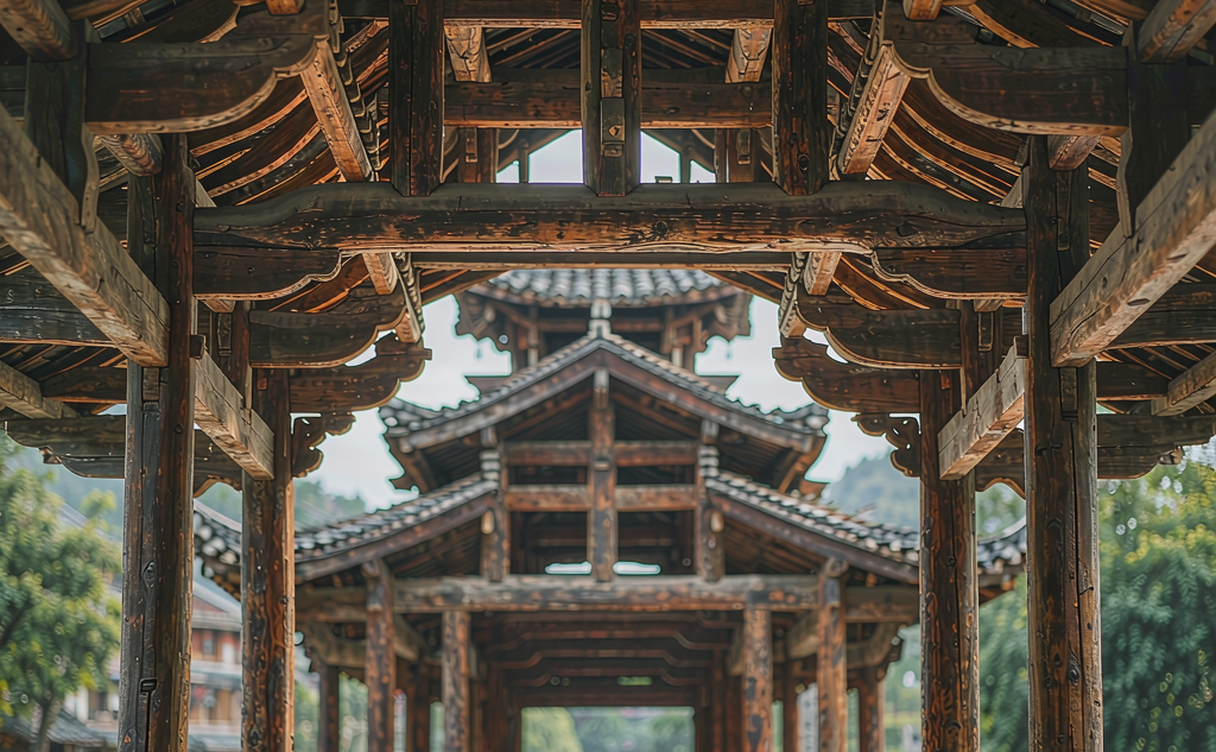
The defining feature of any dong minority bridge is the absence of nails. Master carpenters used mortise-and-tenon joints, wedge locks, and carefully calculated angles to hold the timber together. The central span uses a bracket-arch method, where layers of wood cantilever outward and meet in the middle without support columns in the riverbed. This keeps the waterway clear for boats and reduces flood damage.
Walking beneath the bridge, you can see the intricate lattice of beams. None of it is decorative alone — every joint distributes weight and flexes slightly with temperature and humidity, a passive engineering wisdom that modern architects still study. The chengyang wind-rain bridge is essentially a textbook of pre-industrial structural intelligence.
Pavilions and Drum Towers
The five pavilions are not identical. The largest sits at the center and resembles a drum tower, the social heart of a Dong village where elders meet and festivals are announced. Smaller pavilions mark the ends and midpoints, each with its own roof shape. Inside, the corridor is lined with benches, and the rafters are sometimes painted with simple geometric patterns in red and green.
This marriage of bridge and tower is unique to the Dong. In the surrounding villages you will find stand-alone drum towers that share the same carpentry language, making the chengyang bridge guangxi area a perfect open-air museum of Dong design.
How to Get There
Reaching the Chengyang Wind-Rain Bridge is straightforward once you are in Guangxi, China. Most travelers use Guilin as a base before heading deeper into the province, then continue to Sanjiang, the county seat closest to the bridge.
From Guilin
The most comfortable route is the high-speed train from Guilin to Sanjiang. The journey takes roughly one and a half to two hours, and Sanjiang South Railway Station is the main arrival point. From the station you can hire a taxi or take a local bus toward Chengyang village; the final stretch is about 20 kilometers and offers views of terraced fields and Dong settlements.
If you prefer a guided route, consider pairing this stop with a broader plan such as our Guangxi 7-day itinerary, which links Guilin, the rice terraces, and Sanjiang into one smooth loop.
From Sanjiang
Once in Sanjiang, the bridge is an easy half-day trip. Local buses labeled for Chengyang depart regularly from the county town, and a private car gives you the freedom to also visit nearby villages afterward. Many visitors combine the bridge with the Sanjiang Guangxi travel guide route, which covers the county’s drum towers and the famous Chengyang scenic area in one go.
Best Photo Spots
Photographing the Chengyang Wind-Rain Bridge rewards patience and the right angle. The most iconic shot is from the small footbridge or riverbank just upstream, where the pavilions mirror in calm water. Arrive before 9 a.m. to catch soft light and few crowds.
A second excellent vantage point is the hill path behind Chengyang village, which gives a sweeping overview of the roof tiers against the valley. At sunset the wooden eaves glow warm orange, and the silhouette of the dong minority bridge stands out beautifully against the hills.
For detail shots, walk the covered corridor itself. The lattice joints, the worn benches, and the red-painted patterns make intimate compositions that tell the story of daily use. If you visit during a festival, dancers in traditional dress on the deck create unforgettable frames.
Nearby Dong Villages
The bridge is only the beginning. The Chengyang scenic area includes several connected Dong villages — Ma’an, Pingzhai, Yanzhai, and others — where you can step inside real drum towers and see how the carpentry traditions live on. Each village has its own tower and a communal square where elders play lusheng reed pipes in the evenings.
If you want to go deeper into Dong culture beyond Guangxi, the Guizhou Zhaoxing Dong village guide describes the largest Dong settlement in neighboring Guizhou, with its famed five drum towers. Travelers interested in the wider minority landscape of the region might also enjoy the Guizhou Xijiang Miao village guide, which shows how the Miao people build their hillside stilt houses just a few hours north.
Browse our full collection of China travel guides to find more hidden ethnic-minority gems.
When to Visit
The best seasons for the Chengyang Wind-Rain Bridge are spring (March to May) and autumn (September to November). Spring brings green terraces and comfortable temperatures, while autumn offers clear skies and golden rice fields that frame the bridge perfectly.
Summer is lush but humid and prone to afternoon rain — ironically appropriate for a wind-rain bridge, though photography can be challenging. Winter is quiet and cold, with few tourists, which some visitors prefer for undisturbed exploration. If you time your trip to a local Dong festival, such as the lunar new year celebrations or harvest events, you will see the bridge at its most alive.
Practical Tips for Travelers
- Wear comfortable shoes; the bridge corridor and village paths are wooden and uneven in places.
- Bring small cash for local snacks, handicrafts, and village entry fees, as card payment is not always available.
- Hire a local guide at the scenic area to learn the stories behind each pavilion and the meaning of the drum-tower carvings.
- Combine your visit with the [Guilin Longji rice terraces guide](https://www.chinatravelplaces.com/guilin-longji-rice-terraces-guide/) for a classic Guangxi, China, highland-and-river experience, or add the [Guilin Elephant Trunk Hill guide](https://www.chinatravelplaces.com/guilin-elephant-trunk-hill-guide/) if you start your journey in the city of Guilin.
The Chengyang bridge is more than a photo opportunity. It is a working piece of social infrastructure, a place where the rhythm of Dong life continues exactly as it has for a hundred years. Sitting on a worn bench as mist lifts off the river, you understand why the chengyang wind-rain bridge has become a symbol of intangible cultural heritage worth protecting.
For deeper background on the cultural context, the Dong people overview on Wikipedia provides a useful external reference on their history, language, and architectural traditions.
Why the Chengyang Bridge Matters
In an age of concrete and steel, the chengyang bridge guangxi stands as proof that sustainable, beautiful infrastructure can be built from local materials and community knowledge. The Dong did not need industrial machinery to create something that has outlasted many modern structures. They needed skill, cooperation, and respect for the river.
Whether you are a photography lover, a history buff, or a curious traveler chasing authentic culture, the Chengyang Wind-Rain Bridge rewards every kind of visitor. Plan a half day at minimum, stay for a night in a Dong village if you can, and let the quiet wisdom of the dong minority bridge reshape how you think about travel in southern China.
Explore more China travel guides and start building your personalized Guangxi adventure today.