

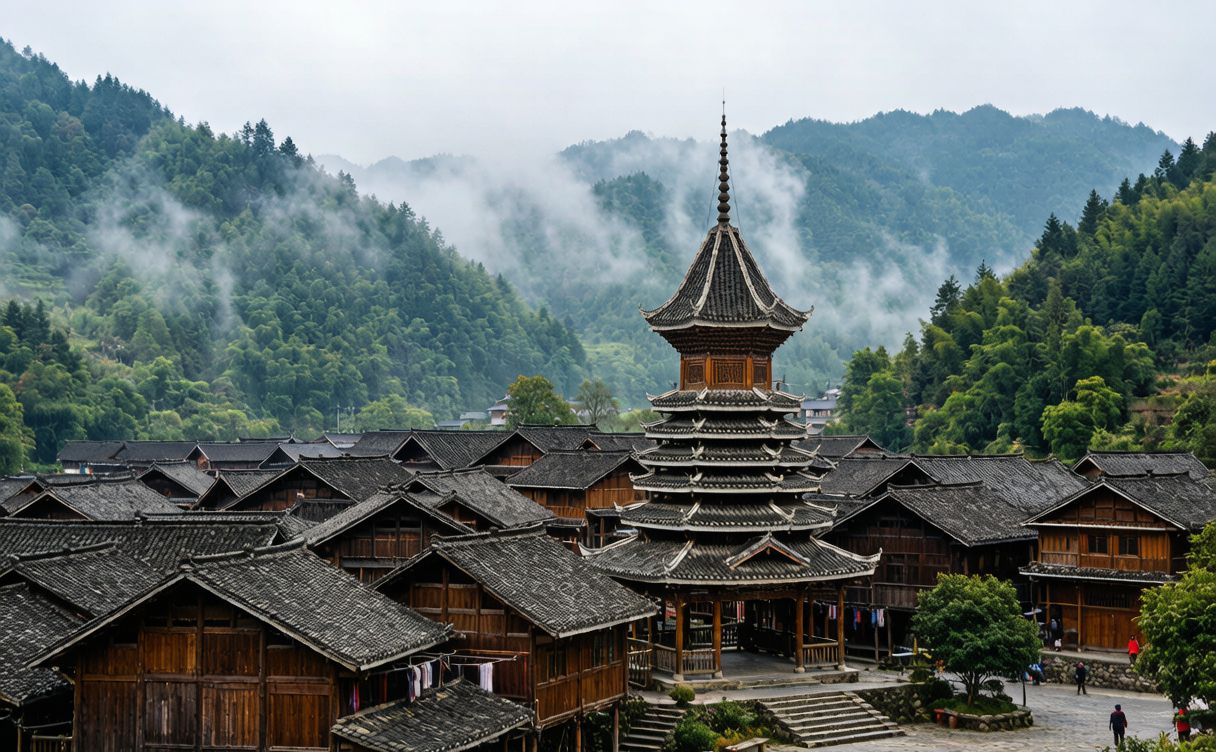
I still remember the first time I stepped off the bus in Zhaoxing Dong Village. The narrow stone lane opened suddenly into a bowl-shaped valley, and there it was — a cluster of wooden towers rising above a sea of dark-tiled rooftops, smoke drifting lazily from kitchen chimneys, and the sound of a lusheng flute echoing off the surrounding hills. No grand gates, no ticket booth visible at first, just life carrying on exactly as it has for hundreds of years. That is the quiet magic of Zhaoxing: it is not a museum dressed up to look like a village, but a working village that happens to be one of the largest and most beautiful settlements of the Dong people in all of China.
Getting There
Getting to Zhaoxing is easier than most travelers expect, though the journey itself is half the pleasure. I flew into Guiyang, the capital of Guizhou, then boarded a high-speed train heading south. The station you want is Congjiang (从江站), which sits roughly twenty minutes from the village entrance by taxi or the local shuttle bus. From the platform, the first thing I noticed was how the hills rolled endlessly toward the horizon, stitched with terraced fields the color of fresh jade.
If you are already touring the province, Zhaoxing pairs wonderfully with other highlights. I had come from Guizhou Xijiang Miao Village the week before, and the contrast between Miao and Dong cultures stayed with me — different costumes, different music, different architecture, yet the same deep respect for ancestors and the land. You can also reach Congjiang from Guilin or Kaili, and the final road from the station winds through rice paddies that are worth the window seat on their own. From Guiyang, budget about three to four hours including the transfer. Once inside the village, everything is walkable, and the lanes are far too narrow for cars anyway, so a comfortable pair of shoes becomes your best companion.
What to See
Zhaoxing is laid out along a single stream that runs the full length of the settlement, divided into five distinct neighborhoods named after the five Dong clans: Ren (仁), Yi (义), Li (礼), Zhi (智), and Xin (信). Each neighborhood has its own drum tower and its own wind-and-rain bridge, and moving between them on foot is the surest way to feel the pulse of daily life.
I spent my first afternoon doing almost nothing and enjoying every minute of it. Old women sat spinning indigo thread into tight coils, children splashed in the shallow stream, and roosters announced themselves from unexpected rooftops. Near the far end of the village, a small museum explains Dong construction methods and the famous Grand Song (大歌), a multi-part choral tradition performed without a conductor or written score. In the evenings, locals gather to sing it — not for tourist tips, but because the song genuinely belongs to the village and to the season. Watching a circle of singers, voices interlocking in perfect harmony under a string of paper lanterns, was the moment Zhaoxing stopped feeling like a destination and started feeling like a home I had briefly been invited into.
Drum Towers & Bridges
The drum towers are the reason I made this trip, and they did not disappoint. Five of them stand here, each a remarkable feat of joinery. They are built entirely of wood, stacked with tier upon tier of soaring eaves, crowned by a slender spire, and anchored at the center by a great drum that was historically beaten to summon the community in times of need. What stopped me in my tracks was learning that not a single nail holds them together — Dong carpenters lock the entire structure with mortise and tenon joints, a craft passed from master to apprentice across countless generations. Standing beneath the tallest tower, I tilted my head back until my neck ached, watching the curving roofs slice cleanly against the open sky.
The wind-and-rain bridges (风雨桥) are just as moving. These covered bridges offer shelter to travelers and a cool, shaded bench on the hottest afternoons. I lingered on one for nearly an hour, watching the water slip beneath the plank floor while an old man carved a wooden toy horse for his grandson, unhurried and content. Together, the towers and bridges form a kind of open-air architecture gallery — and unlike many restored heritage sites, every one of these structures is still used by the community each and every day. If you enjoy this kind of living riverside heritage, the Fenghuang Ancient Town Guide captures another town that breathes the same gentle spirit.
Tips
A handful of things I wish someone had told me before I arrived. First, and most important, stay overnight. The day-trippers thin out by late afternoon, and the village quietly transforms — lanterns glow amber, the air turns cool, and the evening performances begin. I booked a wooden guesthouse right above the stream, and falling asleep to the sound of running water below my window was genuinely unforgettable.
Second, dress for Guizhou’s moods. Rain arrives fast and without much warning, and the stone paths turn slick within minutes, so a light rain jacket and shoes with real grip saved me more than once. Third, carry some small cash; a few of the food stalls and the tiny tofu shops do not take cards or phone payments reliably. Fourth, always ask before photographing someone up close — a smile and a small gesture goes a very long way, and most villagers are happy to pose once they understand. Finally, eat locally: the sour fish hotpot and the sticky glutinous rice tasted like nothing I have found anywhere else, and the steam-corn cakes sold from baskets at dawn became my daily ritual.
Best Time
I visited in late spring, when the terraces glowed with fresh green rice shoots, and it was glorious. Yet every season here makes its own argument. April through June brings lush, emerald fields and comfortably mild temperatures, while September and October paint the same terraces gold at harvest. Winter is cold and wonderfully quiet, with occasional frost feathering the rooftops and almost no crowds — a favorite of photographers who come for the stillness.
I would avoid the very peak of Golden Week in early October if your schedule allows, since the narrow lanes can get genuinely packed. The shoulder months of May and September struck me as ideal: good light, gentle weather, and enough local activity to feel the place alive without the crush. If you are shaping a wider Guizhou route, the power of Guizhou Huangguoshu Waterfall makes a thrilling natural counterpoint to Zhaoxing’s human-scale calm, and the two sit comfortably on the same itinerary.
Good to Know
Zhaoxing lies within Liping County in southeastern Guizhou, close to the borders with Guangxi and Hunan, which makes it an easy add-on if you are also exploring the region. Entry to the village requires a ticket that in peak season also covers the evening performances; off-season it is both cheaper and noticeably quieter. The Dong language is still spoken widely here, though younger vendors usually manage Mandarin and often a little basic English. Mobile signal is decent but not flawless, so I downloaded my maps and translation apps before leaving the city. Above all, remember this is a home first and a destination second — tread gently, buy from the local makers, and the village will quietly offer you its best self in return.
For official regional travel information, see Guizhou Tourism.