

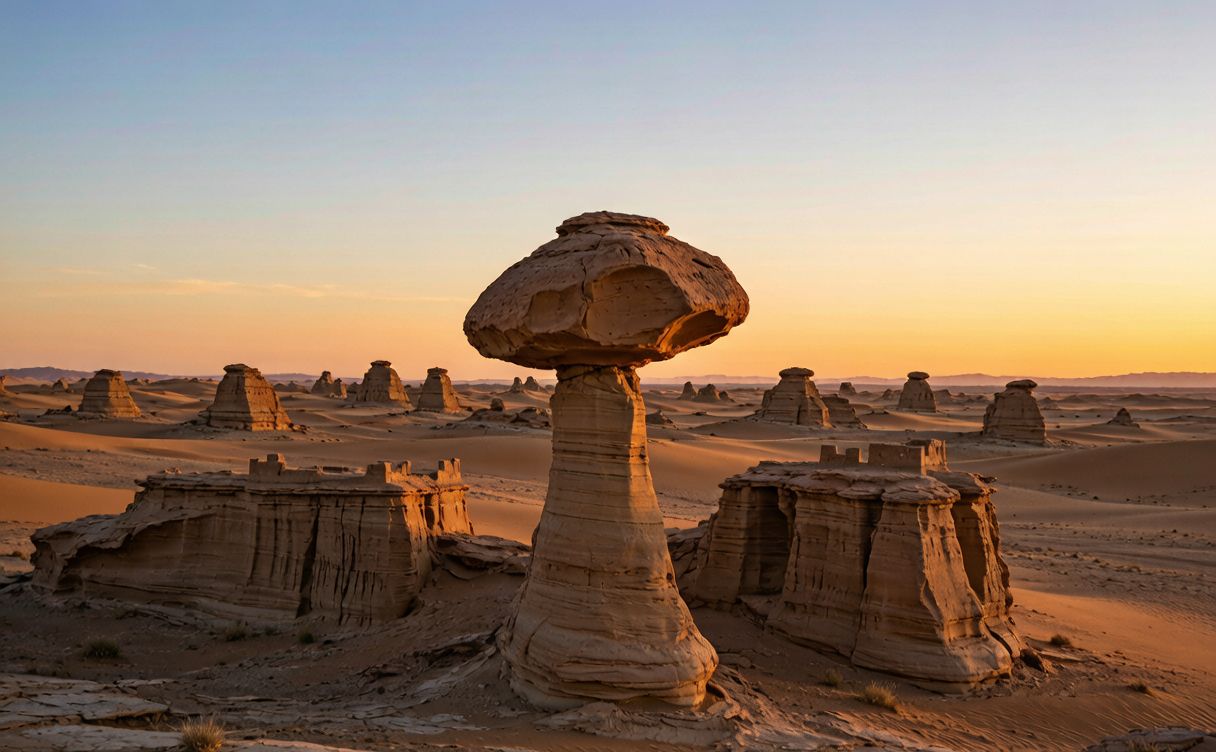
I almost skipped Ghost City. On my first road trip through Xinjiang, China, I had Turpan’s flames and Kashgar’s old town on the list, and the “Devil City” near Urho sounded like one of those roadside attractions you wave at from the bus window. I was wrong. The afternoon I finally turned off the highway and stepped into the Yardang landform, the wind hit me like a held breath let go — and the desert in front of me was not sand at all, but a city of stone that had been sculpted by weather for a million years. This is the Ghost City (魔鬼城) of Karamay, one of the strangest and most photogenic places I have ever stood.
Getting There (via Karamay, Xinjiang, China)
Most travelers reach the Ghost City through Karamay, Xinjiang, China, a city built on oil and wind. I flew into Urumqi first, then took the comfortable high-speed rail west to Karamay, which drops you in a clean, modern town far removed from the desert postcard in your head. From Karamay it is roughly a 100-kilometer drive north to the Urho district and the scenic area entrance. I rented a car with a driver for the day — worth every yuan, because the surrounding Gobi is hypnotic and you will want to stop for photos that have no name.
If you prefer public transport, buses run from Karamay to Urho, and from there a taxi or arranged shuttle covers the final stretch to the gate. The scenic area itself is large, and walking the full loop under the midday sun is punishing, so most visitors take the park’s sightseeing shuttle, which loops past the best formations with short stops at each viewpoint. Give yourself at least three hours from Karamay and plan to be there for the late afternoon.
The drive itself is part of the fun. The road climbs out of Karamay and into open Gobi where the only landmarks are distant rigs and the long shadows of clouds. I remember my driver pointing at a flat horizon and saying, “Soon you will see the city.” He meant the stone one. When the first reddish ridges appeared, low and weird against the plain, I understood why locals once called this place haunted.
What to See
The Ghost City is a Yardang landform — a terrain shaped when soft rock is eroded by wind carrying sand, leaving harder caps balanced on thinner stems. The result looks engineered: castles, gateways, ships, and beasts frozen mid-stride. I am not usually one for “that rock looks like a camel” tourism, but here the resemblance is uncanny. There is a formation locals call the “Sphinx,” another that reads as a fortress wall, and a cluster that genuinely looks like a ruined metropolis seen from above.
My favorite was an isolated mushroom rock, a wide cap resting on a narrow neck, standing alone like a monument placed by someone who never came back. The park marks many of these with names, but I liked inventing my own — a sleeping elephant, a kneeling giant, a ship’s prow cutting into the wind. Because the stone is layered in reds, ochres, and grays, the same rock shifts color as the light moves, so the “city” you photograph at four o’clock is not the city you see at seven.
Birdwatchers should know the area is also a habitat for raptors, and in spring the Gobi blooms with low scrub and the occasional flower. I was there in late summer and saw more lizards than birds, but the silence was the real attraction — a wind-scoured quiet broken only by the eerie whistle that gives the place its devil’s name. Stand still long enough and the wind sounds like voices.
Sunset & Photography
Come for the formations, stay for the light. The single best reason to time your visit for late afternoon is the sunset, when the low sun rakes across the Yardang ridges and turns the whole desert the color of embers. I arrived around five, walked the eastern loop while the light was still bright and harsh, then found a low ridge to sit on as the shadows lengthened. By seven the stone was glowing.
For photography, bring a wide lens for the vastness and a longer lens to compress the castle shapes against the sky. A polarizer helps cut the glare. The golden hour here is long and forgiving, but blue hour is the secret: after the sun drops, the afterglow holds the ridges in deep purple while the sky goes orange. I shot handheld and on a small tripod, and the tripod won every time.
One tip I learned the hard way: the wind picks up exactly as the sun goes down, and it carries fine grit. I shielded my camera with my body and kept lens cloths handy. The wind also makes the “singing” sound at its loudest near dusk, which is either atmospheric or unsettling depending on your mood — I found it thrilling.
Tips
- Go late. Midday sun flattens the shapes and bakes you; afternoon-to-sunset is when the place earns its name.
- Carry water and a hat even in cooler months. The Gobi gives no shade, and the shuttle stops are short.
- Wear closed shoes. The ground is loose gravel and the wind builds mini-dunes you sink into.
- Protect your camera. A scarf over the lens between shots saved mine from the dust.
- Hire the shuttle or a driver. Walking the full circuit in heat is not worth the effort when the wind is free.
- Charge everything. There is little shade or seating, and you will be outside longer than planned.
I also suggest not rushing the quiet. After the last shuttle leaves a viewpoint, the place empties, and for ten minutes I had a whole stone cathedral to myself. That is the memory I keep.
Best Time
The best window to visit Xinjiang, China for the Ghost City is late spring through early autumn, roughly May to October, when roads are clear and days are long. Summer brings the most reliable blue skies but also the strongest midday heat, so plan around it. I went in August and the evenings were perfect; the daytime was fierce. Spring and early autumn are gentler and the light is just as good, with fewer crowds.
Winters are brutally cold and the Gobi wind cuts hard, but the landform under snow is a different kind of surreal — worth it only if you are already in Karamay and dressed for it. Whenever you go, check the wind forecast; a calm day is far more pleasant than a sandblasting.
If you are building a regional route, pair this stop with the Flaming Mountains and the Karez wells to the southeast, or fold it into a longer northern Xinjiang loop. Either way, the Ghost City works best as a half-day anchored by Karamay.
Good to Know
The scenic area has an entrance fee and a separate shuttle charge; both are posted at the gate and change by season, so confirm on arrival. Facilities are basic — a visitor center, restrooms, and a small shop — but no real restaurants inside, so eat in Karamay or Urho before you come. Signal can be spotty once you leave the city, so download your maps and any translation help in advance.
The nearest proper base is Karamay, with good hotels and food, while Urumqi to the east is the regional hub for flights and trains. I based myself in Karamay for two nights and used it to explore both the Ghost City and the wider northern Gobi. For official, up-to-date travel information on the region, see the Xinjiang Culture and Tourism Department.