

Xunpu village sits on a narrow finger of land in Fengze District, where Quanzhou Bay opens into the estuary, and it looks like nowhere else in Fujian. The lane walls of Xunpu village are built from oyster shells, thick grey curling slabs stacked into a curved plaster that no other coastal village in China uses. Above them hang racks of dried fish. Almost every woman you pass has a ring of garden flowers pinned around her bun, which is why travel writers started calling Xunpu the flower hairpin village. This Xunpu village guide covers the shell houses, the Xunpu flower hairpin photo experience, the Xunpu seafood breakfast street, the sunrise over the bay, and how to get to Xunpu village from Quanzhou or Xiamen.
Why the shell houses of Xunpu village are made of oyster shells
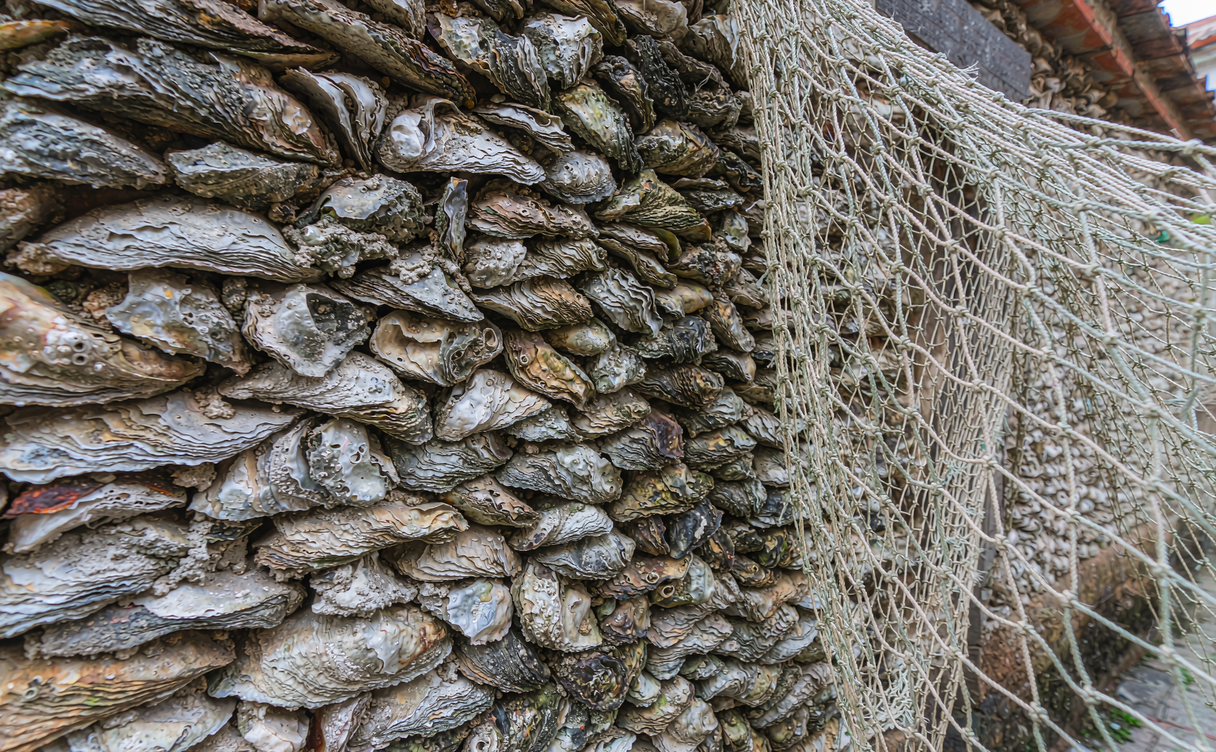
The Xunpu shell houses have a practical explanation, and a story attached to them.
Start with the practical part. Xunpu village faces the open bay, and the wind off the water carries salt. On this exposed stretch of Fujian, salt-laden air eats ordinary lime render and brickwork quickly, and the summer monsoon can tear a light wall apart. Oyster shell is the one material available here that resists both: it is hard, it does not soak up seawater, it breathes rather than blisters, and a village of fishing families had millions of the things lying on the tideline. Shells were also cheap. In a community that lived on what the sea gave, the refuse of the oyster beds became the wall of the house. The curved shape of each shell, laid in rows with the convex side out, gives the wall extra strength against the wind, so you can read the typhoon logic in the facade without being told about it.
The story is older and stranger. Local tradition holds that the first shells came back on ships belonging to the Arab merchants who settled in Quanzhou during the Song and Yuan periods, the community the chroniclers called the “Gin” People. Sailors used oyster shell as ballast, filling the hold on the return leg after the cargo had been sold, and rather than throw it overboard they hauled it inland and it went into the walls. Whether or not every shell really travelled that far, the version tells you something true about the place: this was a port village, fed by trade that reached across the Indian Ocean, and the material of its houses is literally the leftovers of that trade.
Walk the lanes of Xunpu village and you will notice the mixed palette. A Xunpu shell house is rarely only shell. Red brick from the kilns up the coast, white stone blocks cut flat, and shell, layered in bands; some facades are almost entirely shell, others use it only for the ground floor and the gable. Inside, the plan is the ordinary Fujian fishing house: a small courtyard, a stone trough, and a low kitchen at the front where the oysters are steamed.
Build Xunpu village into a longer Fujian loop rather than a one-day dash, and check the distances, train times and suggested sequencing in our Quanzhou travel guide before you book anything.
The flower hairpin of the Xunpu women
The Xunpu women are among the three traditional fishing communities of Fujian, and their dress is the most photographed in the province. The centre of it is the flower hairpin, a circular arrangement of blossoms worn around a hair bun at the back of the head: jasmine, gardenia, chrysanthemum, rose and other seasonal flowers strung on fine wire or bamboo into a ring, the more the better, sometimes several rings stacked. Underneath goes a strip of cloth and a comb; over it, in warm weather, a light headscarf.
Two details are worth knowing before you go. First, the flowers are not decoration for a festival: older women in the village keep the ring up year-round, re-stringing it daily, and it marks a fishing household rather than an occasion. Second, the style had a second life far beyond the water, after the actress wearing a full flower hairpin appeared on national television during the Dragon Boat Festival in 2023 brought visitors to Quanzhou in much larger numbers. The local nickname travels with the style: the flower hairpin village, and it is what most first-time visitors come for now.
Practically, this means you do not have to be a costume fan to take part. Several households and small studios in Xunpu village rent a flower hairpin set for a few hours: a basket of flowers, a comb, a scarf and the help of someone who does this every morning, and you walk out into the same lanes where the shell walls and drying racks make the backdrop. Expect a queue at midday on weekends and public holidays; go early, bring your own camera, and settle the arrangement before the flowers go on: how long you keep them, whether photos are included, and whether the price covers the set alone or the styling too. Rentals are simple and inexpensive, but nobody in the lane will thank you for unpicking another visitor’s session to get a clear shot.
Breakfast on the Xunpu seafood breakfast street
The other reason to come early is the food, and the best hour is the first one.
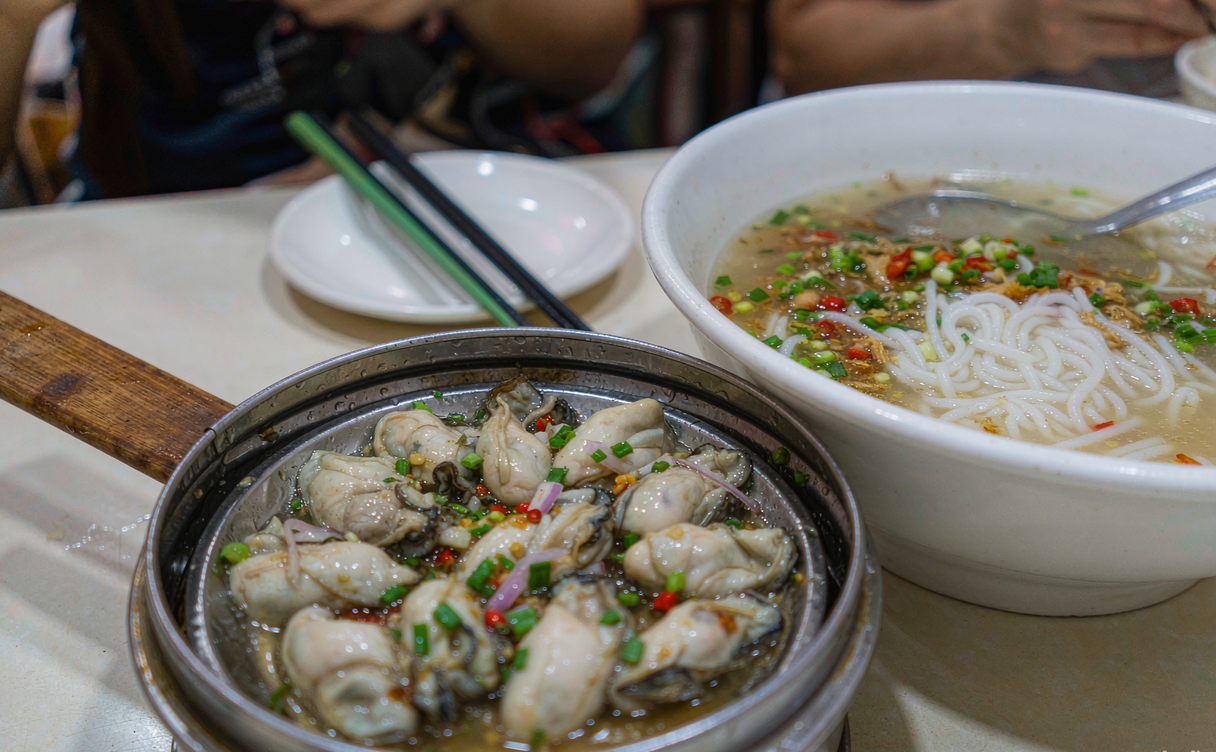
Xunpu village still runs as a working fishing port. Boats come in near dawn, the oysters are opened by hand, and the lanes fill with the smell of them. Along the small clusters of stalls that serve the village and the port side there is a breakfast circuit worth following: oyster noodle soup, where the broth is poured over fresh oysters and a thick hand-pulled noodle; oyster omelette, the Fujian version of the dish, fluffy and soft-centred, with the flat shell of the oyster still visible; and a pot of congee, rice cooked down with shrimp, fish or a spoon of the day’s catch. Steamed oysters come straight from the husk with a dip of garlic and soy, which is the plainest and best way to eat them.
If you want a colder, stranger track, look for the little curbside bowls of translucent jelly made from a sand worm, served with chilli and garlic, a Quanzhou speciality rather than a Xunpu one, but sold in the same lanes. The whole Fujian coastal pantry is explained in our Fujian min cuisine guide, which is the place to read if you want to know what you are ordering.
Turn the breakfast stall into the reason for a morning stop, then find where the rest of the province eats in our Fujian min cuisine guide.
Sea god, parades and the pace of the village
Xunpu village is a fishing village first, and its calendar still runs on the sea. The bay is watched over by Mazu, the goddess of the sea whom you will see at temples along the whole Fujian coast: a small altar near the shore, incense at the dock, and on her birthday a procession through the lanes with banners, drums and the flower hairpins of the women who walk in it. If your dates overlap, ask in the village rather than planning around it, since the timing follows the lunar calendar and the lane is the best seat in town.
The shoreline deserves an hour on its own. A low wooden walkway runs out along the rocks and the boat moorings on the seaward side, close enough to the water that you hear the hulls knocking, with the mudflats of the estuary beyond and container cranes on the far shore to remind you which port this belongs to. Come for sunrise: the light comes up across the water, the gulls come in with the boats, and the whole bay goes from grey to gold in about twenty minutes. Early is also quiet: the lanes fill only later, and the flower hairpin queues have not formed.
How to get to Xunpu village
Xunpu village stands around ten kilometers east of central Quanzhou, and both the bus and the taxi are easy.
From Quanzhou, most travellers start at Quanzhou Railway Station in the west of the city or Quanzhou East in the east, then take a taxi or a rideshare direct to the village, which is the simplest option with a camera bag and a flower hairpin in your hair; alternatively pick up one of the local bus routes towards the coastal villages and change near the port. Allow half an hour in normal traffic. From Xiamen, drive across the bay bridge, about an hour by road, and long-distance coaches between the two cities drop you in central Quanzhou where the same taxis apply. Our Xiamen travel guide covers the crossing if you start there.
Driving is straightforward and the signage is good, but the last kilometer into Xunpu village is a single-lane village road with stalls on both sides, so tell your driver you want the drop-off nearest the lane entrance rather than the far end.
Best time to visit Xunpu village
The best time to visit Xunpu village is autumn and early winter, October through December, when the typhoon season is over, the sky over the bay is clear and the light on the shell walls is warm. Spring, roughly March to May, is second best and the flowers for the hairpin are at their fullest. July to September is hot, humid and the most likely window for a storm, so if you must come then watch the forecast and plan the coastal walk for early morning.
Two practical notes. Mornings beat afternoons in every season: the seafood comes in at dawn, the lanes are empty before ten, and the shell walls photograph better in raking light. And avoid the May Day and October National Day holidays if you dislike crowds, because the flower hairpin rental stalls run serious queues and the single village road backs up for kilometers.
A half day, or a full one
Give Xunpu village at least three hours. That is enough for a shell-house walk, a flower hairpin session, a bowl of oyster noodles and the wooden walkway at the edge of the water, with time left over for a cold drink afterwards.
Those who stay longer get the place at its best again once the day-trippers have gone. The sorting sheds quieten, the drying racks go out along the lanes again, and the older women string their flower rings in the same doorway for the fortieth year running.
Where Xunpu fits in a Fujian trip
Quanzhou is a UNESCO World Heritage city, the Song-Yuan emporium that Arabic sources called Zayton, and the UNESCO World Heritage Centre listing for Quanzhou is a good introduction to the port that produced this village. It pairs naturally with the old town: the lanes and the Mazu temples, the mosque, the bridges out to the bay, all within a short ride.
Most itineraries then run north or south. North brings Putian and the Meizhou island temples of the sea goddess, the same goddess whose altar stands at the end of Xunpu’s own lanes, and then Fuzhou’s three lanes and seven alleys, the old commercial spine of the province and a contrast with the fishing village in every direction. South puts you back on the Xiamen side of the bay. Whatever order you choose, the widest picture of the coast is in our best things to do in China.
Add a morning in Xunpu village to your Fujian route and check how the village links to the rest of the coast in our best things to do in China list.