

Most ten-day plans in this corner of southwest China pick one province and refuse to leave it. That is a mistake, and we have made it ourselves more than once. Yunnan has the postcard lakes, the minority textiles, and the altitude. Guizhou has the best-preserved wooden villages in the country, the largest Miao settlement in Asia, and a food culture that turns up on almost no other itinerary we write. Put the two together as one loop and you get two entirely different Chinas sitting about three hours apart by train.
The provincial entry on Yunnan is a useful calibration of scale. This province borders Myanmar, Laos and Vietnam, and its ground climbs from tropical river valleys to the snow ridges above Lijiang. Guizhou, immediately east, is the only province in China with no true plain — every metre of it is hill, and that single fact explains most of what follows.
How this Yunnan Guizhou itinerary is built
We design the route as a one-way loop, north to south, with international-style flights in and out of Kunming or Lijiang rather than an open-jaw ticket that forces you backwards. Ten days is the sweet spot. Twelve lets you add Tiger Leaping Gorge properly; eight starts to feel like a sprint, and the plateau punishes tired travellers more than people expect.
Total driving is modest for such varied country. Kunming to Dali by high-speed rail is roughly 2 hours. Dali to Lijiang is about 1 hour 40. The return leg to Kunming is 3.5 to 5 hours depending on the train you catch, and Kunming to Guiyang on the new coastal-connecting line is around 2 hours. You are not spending your trip aboard trains — we budget under 7 hours of rail across the whole ten days.
Because the altitudes run 1,900 m in Kunming, 2,090 m in Dali, about 2,400 m in Lijiang, and 1,100 m in Guiyang, we deliberately keep the first two nights flat-ish and easy. Nobody wants a altitude headache on day two.
Days 1–2: Kunming and the Stone Forest
Kunming is the natural door. It is a provincial capital with two and a half million people, a mild year-round climate, and none of the friction of Beijing or Shanghai. Day one we keep almost empty: a walk through the old town around Jinma Biji Fang, dinner on Potato Street — 蒸饵丝 (steamed rice noodles, ¥12–¥18), 汽锅鸡 (steam-pot chicken, ¥68–¥90 for one), and the small 野生菌 hotpots that appear in July and August only.
Day two is the Stone Forest (石林), the karst labyrinth 78 kilometres southeast of the city. The buses leave from the southern coach station and take about 90 minutes; a private car is ¥350–¥500 round trip and saves you the terminal shuffle. Entry is ¥130 and the big sites are inside a 2-kilometre loop with electric carts at ¥25. Budget five hours. The rock is grey, the planting is dense, and the place photographs far better in the two hours after the gates open than at midday when three hundred school groups share it with you.
Fly into Kunming a day early and spend that morning at the Stone Forest before your real itinerary begins — you will want the first full day in Dali, not in a coach station.
Days 3–4: Dali, where the loop feels slow
The early train out of Kunming puts you in Dali Old Town before lunch. We like the southbound afternoon services better anyway, so try Day 3 morning, arrive 10:30, drop bags, and lose the rest of the day to 洋人街 (Foreigners’ Street) and the ramparts.
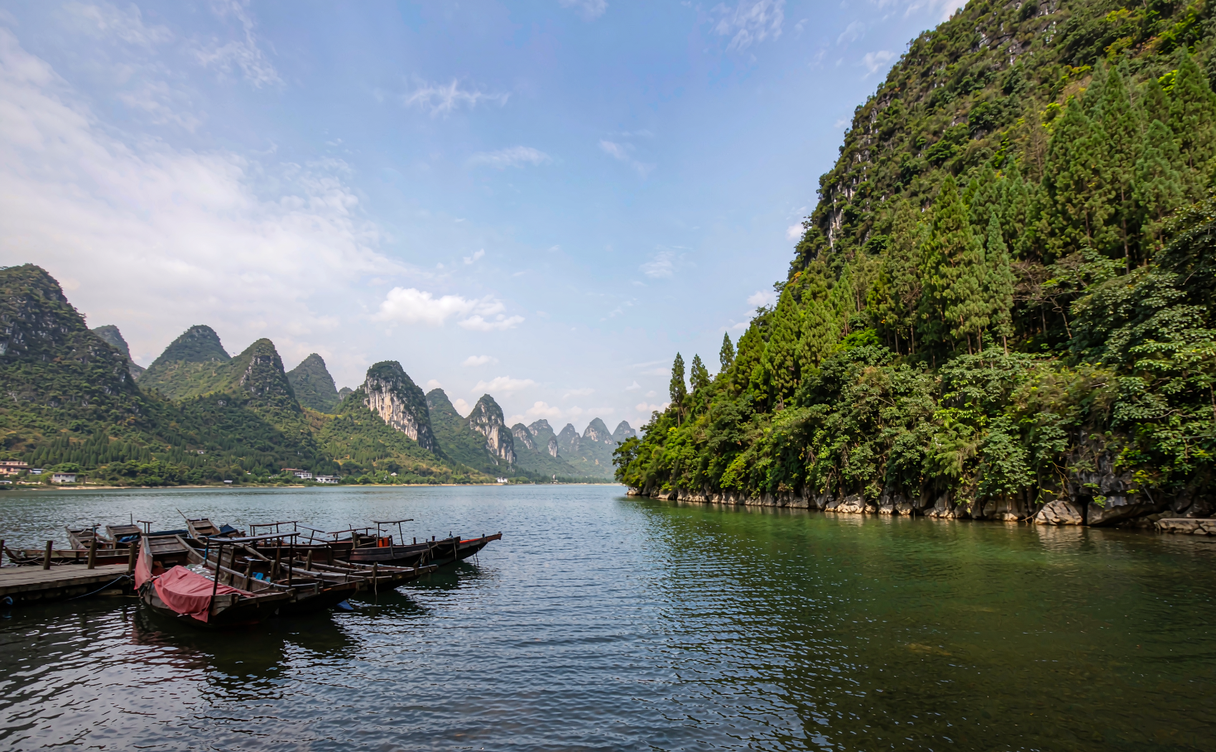
Dali is the one stop on this Yunnan Guizhou route where doing nothing is the correct plan. The town sits on the western shore of Erhai Lake, a 40-kilometre-wide almond of water ringed by rice fields and low hills, with the Cangshan range behind it. Rent a bicycle — ¥20–¥40 a day — and ride the eastern shore to Shuanglang or Xizhou, both about 12 kilometres out. The northbound stretch past 喜洲 (Xizhou) has the old courtyards and the best price-per-yuan lunch on the lake: a 白族 (Bai) homestay 生皮 dish or a plate of 乳扇 (camel’s-milk cheese, ¥15) grilled over embers.
Keep Day 4 for the same lake. Two days is our minimum and three is better if you are travelling with anyone who does not mountain-bike at altitude.
Days 5–6: Lijiang and the snow mountain above it
The Dali–Lijiang high-speed line opened in 2018 and now runs roughly every 40 minutes from ¥80. It takes 1 hour 40 and drops you north of the old town, a ¥15 taxi ride away.
Lijiang Old Town is a UNESCO World Heritage site for exactly the reason people grumble about it: it is a living Naxi town with a true water system, and the cobbles carry thousands of visitors a day. We suggest arriving, getting lost on purpose in the 四方街 grid, and finding a courtyard restaurant with 腊排骨火锅 (cured-pork hotpot, ¥110–¥160 for two) before the light goes. Evening Naxi pipe music in 丽江客栈 squares is roughly ¥30 and genuinely worth it.
Day 6 is either Jade Dragon Snow Mountain (玉龙雪山), a 40-minute drive north where a cable car climbs to 4,506 m and the entry plus shuttle plus cable car runs ¥280–¥340 per person depending on the season, or Tiger Leaping Gorge (虎跳峡), two hours east and the single best full-day hike in the province. Pick one. We send hikers to Tiger Leaping; we send anyone who wants photographs and a warm hotel to Jade Dragon.
Day 7: The long, easy transfer back
This is the least glamorous day and the one we get asked about most, so we will be blunt: Lijiang is 500 kilometres southeast of Guiyang and there is no train that does it in a day worth having. You have two real options.
The first is a morning high-speed train back to Kunming (3.5–5 hours, ¥150–¥220), an afternoon of nothing, and an overnight in Kunming so Day 8’s Guiyang leg starts at 8 a.m. The second is a 1-hour 20-minute flight from Lijiang to Guiyang, roughly ¥700–¥1,400 booked domestically, which deletes a whole day of rail and leaves you in Guizhou by early afternoon.
Fly it if you are short on time or travelling with anyone who gets restless on trains. Take the rail if the point of the trip is watching the landscape change.
Days 8–9: Guizhou, the half nobody expects
Guiyang is not a pretty city, and we would rather say so than pretend. It is a hot, humid, functional provincial capital of four and a half million people with broad avenues and some of the best cheap eating in the country. Stay in the 甲秀楼 district near the river; mid-range rooms run ¥260–¥420 and business hotels reach ¥600.
Day 8 afternoon: Qianling Mountain Park with its macaque troops and the golden temple on the ridge, then the Jiaxiu Tower at dusk. Dinner is 丝娃娃 (silk baby cabbage rolls, ¥25–¥40 for a plate) and 酸汤鱼 (sour-soup fish, ¥60–¥90) — a rice-wine soured broth that Guizhouans consider their own invention and that no other province makes.
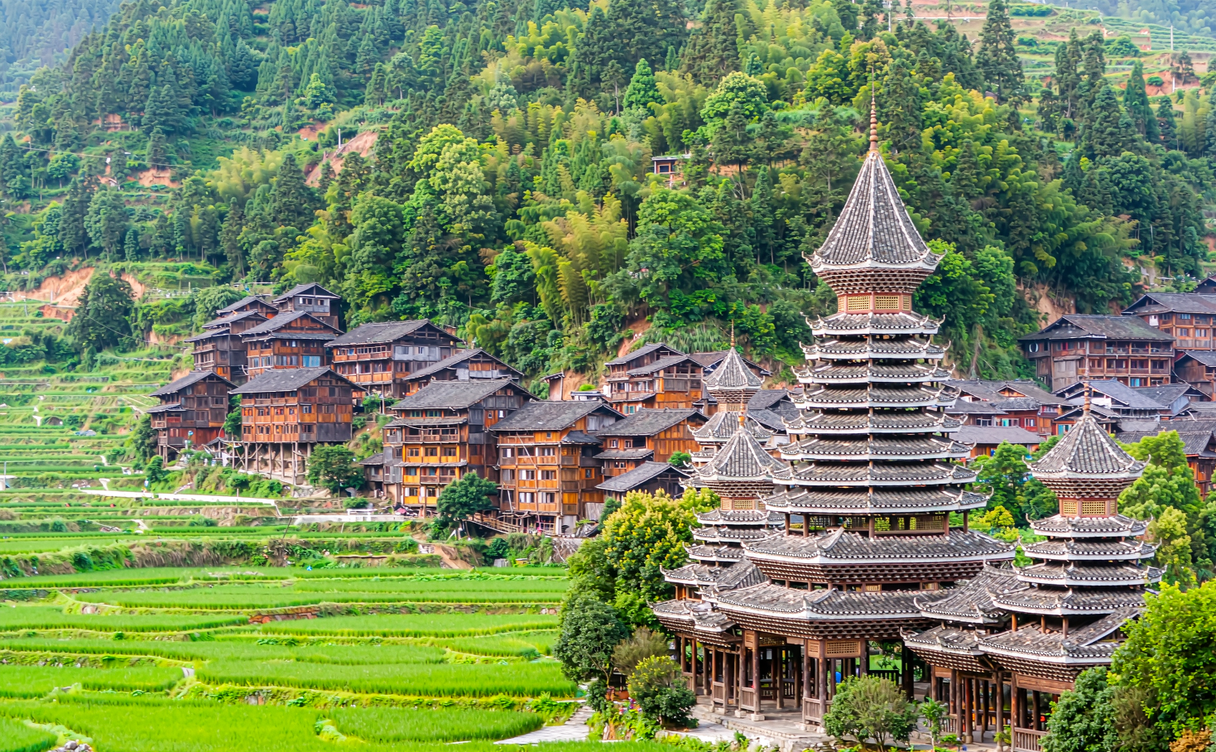
Day 9 is the big one: Xijiang Miao Village (西江千户苗寨) in Leishan county, around 3 hours by road from Guiyang (charter a car for ¥600–¥800; the buses exist but take 4 and change twice). It is the largest Miao settlement on earth — over a thousand wooden stilt houses spilling up a valley wall. Entry is ¥100 including the shuttle. Skip the 4 p.m. tour-bus arrivals. Either leave at 7 a.m. or, better, stay the night: after 8 p.m. the valley is yours and the light on the timber is extraordinary.
Where the route works, and where it does not
Two honest caveats. First, the Kunming–Dali–Lijiang leg is heavily domestic-touristed in July, August and the first week of October; book the trains a week ahead and book the Lijiang old-town rooms a month ahead. Second, Guizhou’s weather is genuinely changeable — we carry rain shells every day between June and September even when the morning is clear.
For the rail specifics — passport-number booking windows, which station is which, how second class compares — our China high-speed train guide for foreigners covers the mechanics properly.
Best time to run this route
March to May and late September to mid-November. In April the fields are working, the lakes are calm, and Kunming is about 18°C while Lijiang morning is 8°C. October is the most beautiful and the most crowded; book everything. July and August give you 野生菌 fungi in Kunming and water in the gorge, at the cost of queues. December to February brings clear skies over Erhai and almost nobody, but high passes can close after snow.
If the regional seasons are still confusing, our best time to visit China walkthrough maps the whole country month by month.
Planning the rest around it
Our advice for anyone building a full month: give the Yunnan leg six days, the Guizhou leg three, and leave one empty day somewhere in the middle. Our Yunnan ten-day itinerary breaks the Yunnan half down day by day if you want more detail than this summary, and our Guizhou seven-day itinerary does the same for the eastern province — both are the routes we actually recommend extending with, not alternatives to this one.
Book the Kunming–Dali and Dali–Lijiang trains as soon as your dates are firm, then lock the Xijiang village guesthouse for the night — the valley empties after nine and it is the best sleep of the trip.
What we would change if we had ten days again
Drop Kunming’s second day and add one in Xijiang. Keep the Dali lake days no matter what anyone tells you about seeing more. And do not try to fit Shanghai into this trip. The whole point of a Yunnan Guizhou route is that it stays small, high, and green — the opposite of most first trips to China.
If you are still weighing this against a single-province holiday, pair it with our China travel guide for first-timers to sort out payments, eSIMs and how much luggage you actually need at 2,400 m.