

Step off the train in Yanji and the first thing you notice is the signage: every shopfront, street sign and bus stop carries Korean script above the Chinese. This is the capital of the Yanbian Korean Autonomous Prefecture in eastern Jilin province, home to the largest ethnic Korean community in China, and it feels genuinely distinct from anywhere else in the country. This Yanji travel guide covers the cold-noodle joints and barbecue smoke, the hanbok photo studios that made the city a domestic-travel sensation, and the practicalities of using Yanji as your launchpad for Changbai Mountain and its crater lake. It is a compact, cheap, extremely well-fed city — and still largely unknown to foreign visitors.
Why Visit Yanji
Yanji rewards travellers who care about food and cultural texture more than monuments. There is no ancient walled city here and no famous pagoda. What there is: some of the best regional cooking in northeast China, a bilingual street culture you will not find elsewhere, prices roughly a third of Shanghai’s, and easy access to Changbaishan, one of China’s most spectacular volcanic landscapes.
Best Time to Visit Yanji
The best time to visit Yanji is June through early October. Summer runs 22–27°C by day and drops to a comfortable 16–18°C at night — a real relief compared with the humidity of eastern China. July and August bring the heaviest rain, so pack a shell.
Mid-September to early October is the standout window. The city sits at 14–20°C, the air turns dry and clear, and the birch and larch forests on Changbai Mountain blaze orange and gold — also when Heaven Lake is least likely to be fogged in. Book accommodation early.
Winter is severe: January averages −6°C by day and −17°C at night, with lows near −25°C. Changbaishan’s ski resorts open December to March and Yanji hotel rates fall sharply. Spring (April–May) is windy and brown. For coordinating a northeast trip, see our best time to visit China guide.
How to Get There
Yanji has both an airport and a high-speed rail station, which is unusual for a city of this size. Yanji Chaoyangchuan International Airport (YNJ) sits about 5 km from the centre — a ¥20 taxi ride. Yanji West Station (延吉西站) handles bullet trains on the Changchun–Hunchun line.
| From | Option | Time | Approx. Cost |
|—|—|—|—|
| Changchun | High-speed train to Yanji West | 2–2.5 hr | ¥150 (US$21) |
| Shenyang | High-speed train (via Changchun) | 4–4.5 hr | ¥290 (US$41) |
| Harbin | High-speed train (via Changchun) | 3.5–4 hr | ¥240 (US$34) |
| Beijing | Direct flight to YNJ | ~2 hr | ¥700–1,400 (US$99–197) |
| Shanghai | Direct flight to YNJ | ~2.5 hr | ¥900–1,700 (US$127–239) |
| Yanji | HSR to Baihe (Changbaishan) via Dunhua | 2.5–3 hr | ¥120 (US$17) |
| Yanji | Tourist coach to Erdaobaihe | 3.5–4 hr | ¥90 (US$13) |
How to get to Yanji most cheaply depends on where you start: from anywhere in Jilin or Liaoning the train wins easily, while from southern China flying is the only sensible option. Foreign passports work at all ticket gates — our China high-speed train guide for foreigners walks through booking and station procedure, and you can check live timetables on the official China Railway 12306 English site.
Things to Do in Yanji
The Chinese Korean Folk Village
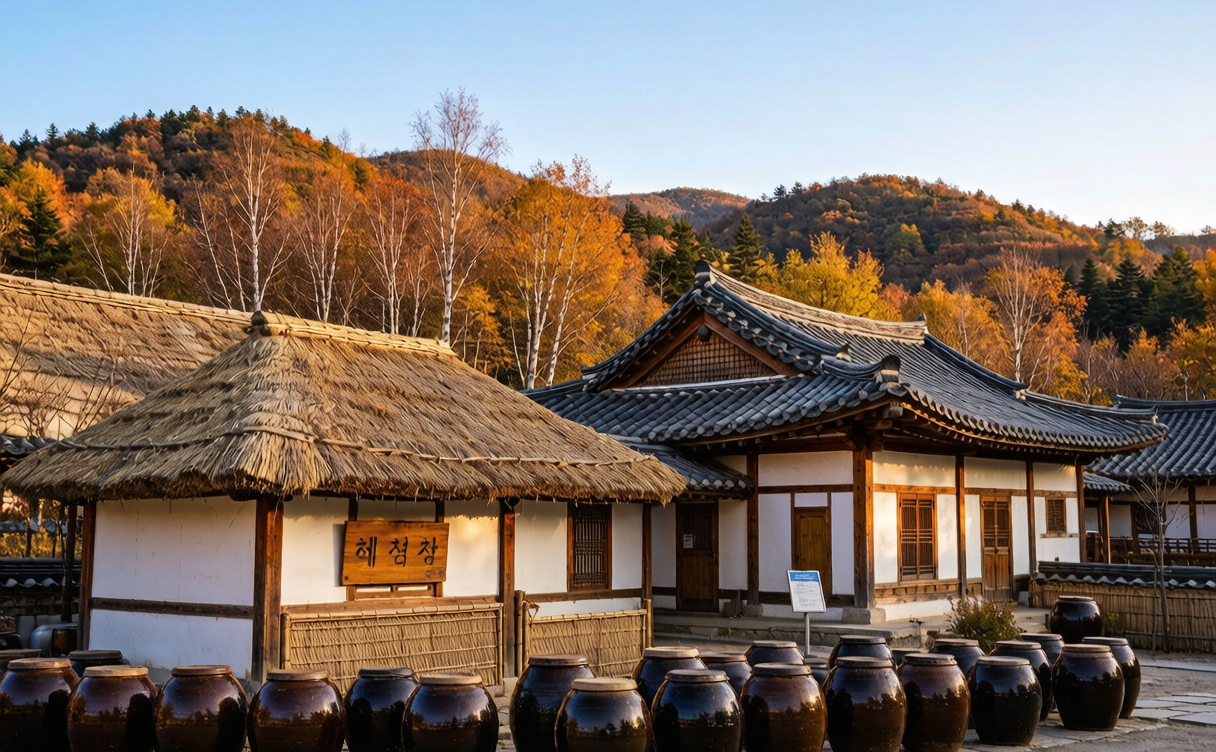
The most photographed spot in the city. This reconstructed village of thatched and tile-roofed houses has become a hanbok photography phenomenon: studios along the approach rent full traditional outfits with hair and makeup for ¥100–300 (US$14–42). Even without the costume it is a pleasant, free stroll, and the exhibits explain Korean-Chinese settlement history in Yanbian.
Buerhatong River at night
The Buerhatong River splits Yanji in two, and after dark the bridges, riverbanks and hillside apartment blocks light up in a synchronised display. Walk the north bank promenade from around 19:30. It is free, and it is where locals actually spend their evenings.
Xishi Market
Yanji’s west market is a serious food hall: barrels of kimchi and pickled radish, trays of dried pollock, mountains of rice cakes, sesame oil pressed on site. Come hungry and buy vacuum-packed kimchi to take away. Mornings are best.
Yanbian Museum
A well-curated, free museum covering the migration of Korean communities into northeast China, traditional dress, farming implements and revolutionary history. Bring your passport for entry; English labelling is partial but the objects speak for themselves. Allow 90 minutes.
Maoershan National Forest Park
A 15-minute drive north of the centre, this hill offers a 40-minute walk up to a viewing platform over the whole valley. Popular at sunset with locals; free.
Changbai Mountain (Changbaishan)
The reason many travellers come this far east. Changbaishan is a dormant volcano crowned by Heaven Lake (Tianchi), a caldera lake ringed by sixteen peaks and, on a clear day, one of the most startling sights in China. The North Slope is the most developed entrance, taking in Changbai Waterfall, hot springs where vendors boil eggs in the ground, and the Underground Forest. Reckon on ¥190–320 (US$27–45) for entry plus shuttle. Base yourself in Erdaobaihe town for a full day on the mountain — weather changes fast and an early start matters.
What to Eat in Yanji
This is the real reason to visit.
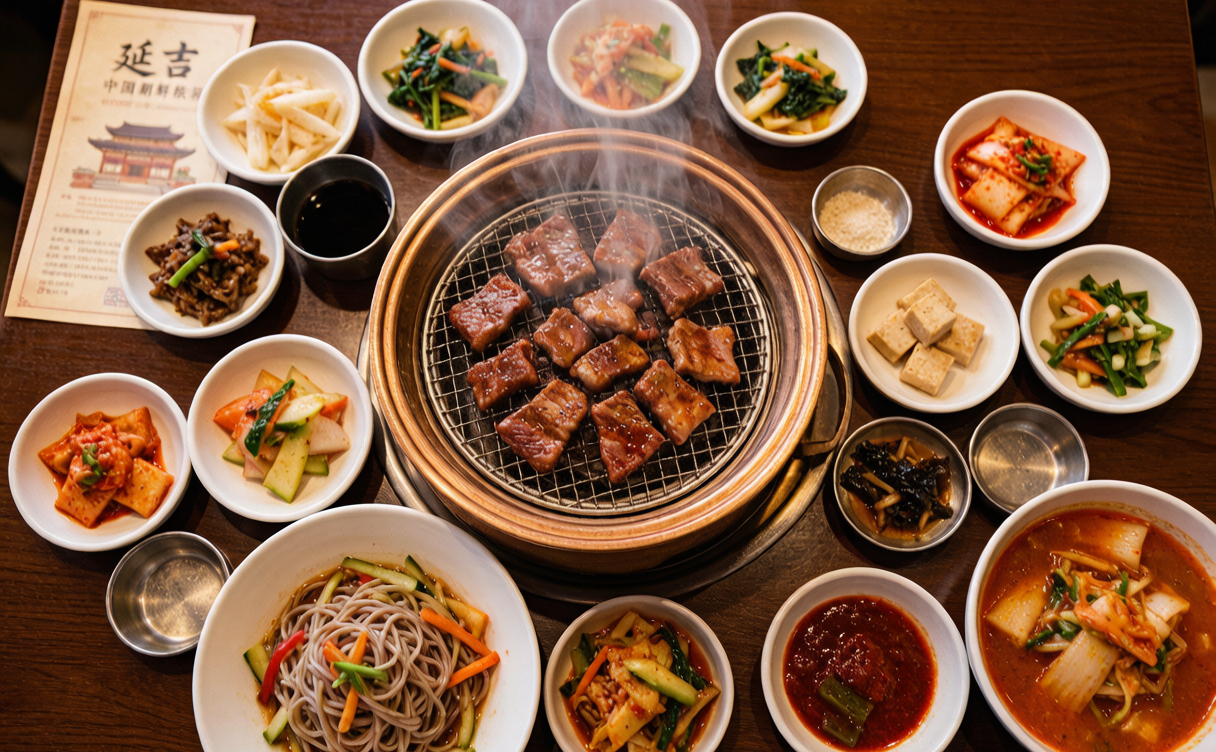
- Yanji cold noodles (냉면 / 延吉冷面) — chewy buckwheat noodles in an icy, faintly sweet-sour beef broth with sliced pear, cucumber, half a boiled egg and a slick of chilli paste. Eaten year-round, including in January. Around ¥18–30.
- Yanji barbecue — charcoal grills sunk into the table, thin beef, marinated pork belly, ox tongue and offal, wrapped in lettuce with garlic and ssamjang. Expect ¥60–120 per person with beer.
- Stone-pot bibimbap (石锅拌饭) — served scorching so the rice crusts at the bottom. ¥25–40.
- Dried pollock salad (明太鱼) — shredded, chilli-dressed, addictive with rice wine.
- Rice cakes (打糕) — pounded glutinous rice dusted with soybean powder, sold by weight in the markets.
- Sundae-style rice sausage (米肠) and soybean paste stew (大酱汤) — cheap, filling, everywhere.
- Makgeolli (米酒) — cloudy rice wine, served cold in metal bowls.
One practical note: a few traditional Yanbian restaurants serve dog meat, which many foreign visitors prefer to avoid. It is almost always clearly listed and rarely appears in barbecue or noodle shops. To steer clear, choose places advertising 冷面 (cold noodles), 烤肉 (barbecue) or 拌饭 (bibimbap) on the sign. Vegetarian options are limited, but kimchi pancakes, tofu stew and meat-free bibimbap are widely available.
Where to Stay
City centre (Renmin Road / Xishi Market area) — the best all-round choice. Business hotels and boutique properties run ¥220–450 (US$31–63) per night, with clean budget chains at ¥130–200 (US$18–28). Everything is walkable and the night food streets are on your doorstep.
Near Yanji West Station — newer mid-range hotels at ¥180–320 (US$25–45), convenient for an early train to Changbaishan but a 15-minute ride from the good restaurants.
Erdaobaihe (Changbaishan base town) — worth one night if you are climbing the mountain. Guesthouses ¥180–300 (US$25–42); resort-style hotels near the hot springs ¥600–1,400 (US$85–197). Rates spike during the autumn foliage window and Spring Festival.
Sample Itinerary: Three Days
Day 1 — Yanji city
- 09:30 Xishi Market for breakfast rice cakes and a walk through the food halls
- 11:30 Yanbian Museum
- 13:30 Cold noodles for lunch
- 15:00 Chinese Korean Folk Village, with optional hanbok shoot
- 19:00 Barbecue dinner, then the riverside light display
Day 2 — Changbai Mountain
- 06:30 Early train or coach to Erdaobaihe
- 10:00 North Slope shuttle up to Heaven Lake
- 12:30 Changbai Waterfall and the hot spring boiling pools
- 15:00 Underground Forest boardwalk
- 18:00 Overnight in Erdaobaihe, or return to Yanji
Day 3 — Slow morning
- 08:30 Maoershan viewpoint walk
- 11:00 Shopping for kimchi, dried seafood and ginseng products
- 14:00 Late lunch of bibimbap and soybean stew before your train or flight
Practical Tips
- Payment: Alipay and WeChat Pay are universal and both accept international cards. Carry ¥200–300 for market stalls.
- Language: Mandarin and Korean are both official here; English is rare, so a translation app is essential. Menus often carry photos.
- Tickets: Changbaishan entry is capped in peak season — reserve via the official scenic-area WeChat mini-programme a day or two ahead.
- Hours: markets 06:00–15:00, restaurants late, museums typically 09:00–16:30 and closed Mondays.
- Clothing: even in July, bring a warm layer for the Changbaishan summit, where wind chill can feel close to freezing.
- Documents: parts of the wider prefecture sit near international frontiers. Stick to signposted tourist areas and carry your passport.
FAQ
How many days do I need in Yanji?
Two days covers the city comfortably. Add one or two more if you are visiting Changbai Mountain, which really deserves an overnight in Erdaobaihe rather than a punishing round trip.
Is Yanji worth visiting for foreign travellers?
Yes, if you enjoy food-led travel and want somewhere with a distinct regional identity. It is not a monument destination — but if you want three great meals a day, low prices and easy access to a volcano, it delivers.
Can I visit Changbai Mountain from Yanji in one day?
It is possible with a 06:00 start and a chartered car, but tight: the mountain is 3.5–4 hours away by road and summer shuttle queues add an hour. One night in Erdaobaihe is far less stressful.
Is Yanji suitable for families?
Very. Distances are short, food is mild by Chinese standards, the folk village and riverside parks work well with children, and hotel costs are low. Our China family travel guide has more on travelling in the northeast with kids.
Do people speak Korean in Yanji?
Widely, yes — Korean is co-official in the prefecture, signage is bilingual, and many residents are fluent in both languages. Korean-speaking visitors will find Yanji unusually easy to navigate.
Written by Karl, last updated August 4, 2026.