

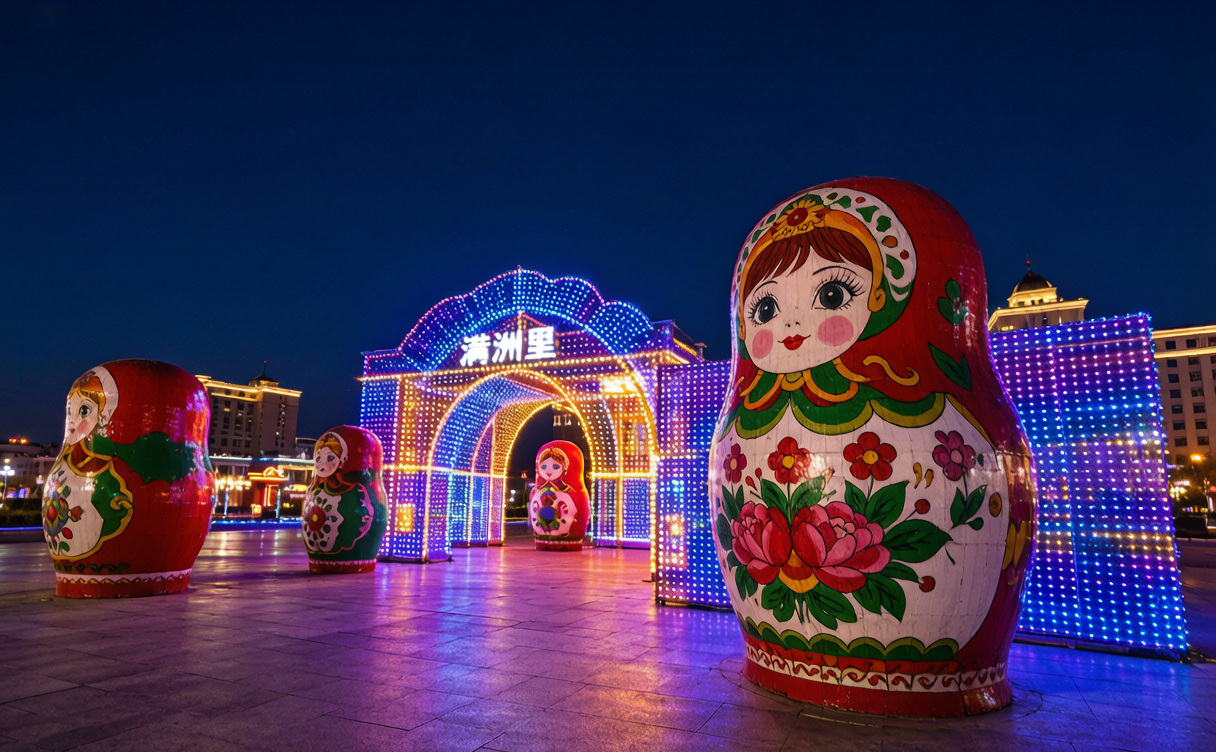
There is nowhere else in China quite like Manzhouli. Pastel façades with onion domes line the main street, shop signs run in Chinese, Russian and Mongolian, and a 30-metre matryoshka doll stands at the edge of town like a lighthouse. This is China’s largest land port of entry with Russia, tucked into the far northwestern corner of the Inner Mongolia Autonomous Region, where the Hulunbuir grasslands roll away in every direction. This Manzhouli travel guide explains when to come, how to get here without an epic train journey, what the Russian-influenced architecture is really about, and how to combine the city with Hulun Lake and the grasslands. Be warned: winter here is genuinely extreme.
Why Visit Manzhouli
Three things justify the effort. First, the architecture: Manzhouli grew up around the Chinese Eastern Railway a century ago and has leaned into a Russian-Baroque aesthetic ever since — much of it recent, all of it photogenic once the downtown is floodlit. Second, the setting: this is the western gateway to Hulunbuir, arguably China’s finest grassland, and to Hulun Lake. Third, the culture: Mongolian herding traditions, Russian trade and Han Chinese commerce overlap in the food, the signage and the shops.
Best Time to Visit Manzhouli
The best time to visit Manzhouli is late June to late August, when the grasslands are green, wildflowers are out, and daytime temperatures sit at a pleasant 22–26°C with nights cooling to 10–14°C. July is the peak month for grassland tourism and the naadam festivals held around Hulunbuir; book yurt camps well ahead.
September is underrated: the birch forests east of here turn gold, crowds thin, and days hold at 14–18°C, though nights fall close to freezing by month’s end. May and early June are green but windy and unpredictable.
Winter (December–February) is the other reason people come — and it is serious. January averages −18°C by day and −28°C at night, with cold snaps below −35°C. In exchange you get ice sculptures at the Manzhouli Ice and Snow Festival, frozen Hulun Lake, snow-covered grassland, reindeer encounters and near-empty hotels at half price. Only attempt it with proper Arctic-grade clothing. Our best time to visit China guide puts these extremes in national context.
How to Get There
Manzhouli has no high-speed rail — this is one corner of China where flying or an overnight sleeper is still the norm. The city has its own small airport, Manzhouli Xijiao (NZH), about 9 km out, while the regional hub is Hulunbuir Hailar Airport (HLD), roughly 200 km east.
| From | Option | Time | Approx. Cost |
|—|—|—|—|
| Beijing | Direct flight to NZH | ~2.5 hr | ¥900–1,900 (US$127–268) |
| Hohhot | Flight to NZH | ~2.5 hr | ¥800–1,500 (US$113–211) |
| Harbin | Overnight sleeper train | 11–13 hr | ¥180–330 (US$25–46) |
| Harbin | Flight (often via Hailar) | 1.5–3 hr | ¥600–1,300 (US$85–183) |
| Hailar | Train to Manzhouli | 2.5–3 hr | ¥30–60 (US$4–8) |
| Hailar | Long-distance bus or shared car | ~3 hr | ¥60–100 (US$8–14) |
| Manzhouli | Taxi/Didi to Hulun Lake | ~50 min | ¥120–180 (US$17–25) |
How to get to Manzhouli most efficiently: fly to Hailar (more flights, cheaper fares), then take the train or a shared car west. If you are already in Heilongjiang, the Harbin sleeper is atmospheric and saves a hotel night. Within the city, everything downtown is walkable and taxis rarely top ¥15.
Things to Do in Manzhouli
Matryoshka Doll Square
The city’s emblem and the first stop for almost everyone. The main doll stands about 30 metres tall — reportedly the largest anywhere — surrounded by hundreds of smaller painted dolls, fountains, a hotel in the same style and a small amusement park. Unabashedly kitsch and enormously fun, especially at dusk. The square is free; rides and interior attractions cost ¥60–150 (US$8–21). Allow two hours.
Downtown and the Russian trade streets
Walk Zhongsu Jinjie (“China–Russia Golden Street”) and the surrounding blocks in the evening. Colonnades, spires, pastel plasterwork and neon combine into something between St Petersburg and a film set. Shops sell Russian chocolate, honey, amber, nesting dolls, felt boots and fur hats; bargaining is expected and the quality is variable, so inspect before you buy.
The National Gate scenic area
Nine kilometres northwest of town, the Guomen scenic area marks the rail crossing point and holds an observation building, boundary markers and an exhibition on the history of the frontier railway. From the upper deck you can look out over the tracks that carry freight between the two countries. Entry is around ¥80 (US$11). Bring your passport — it is required for entry, and photography is restricted in some directions, so follow the posted signs.
Hulun Lake (Dalai Lake)
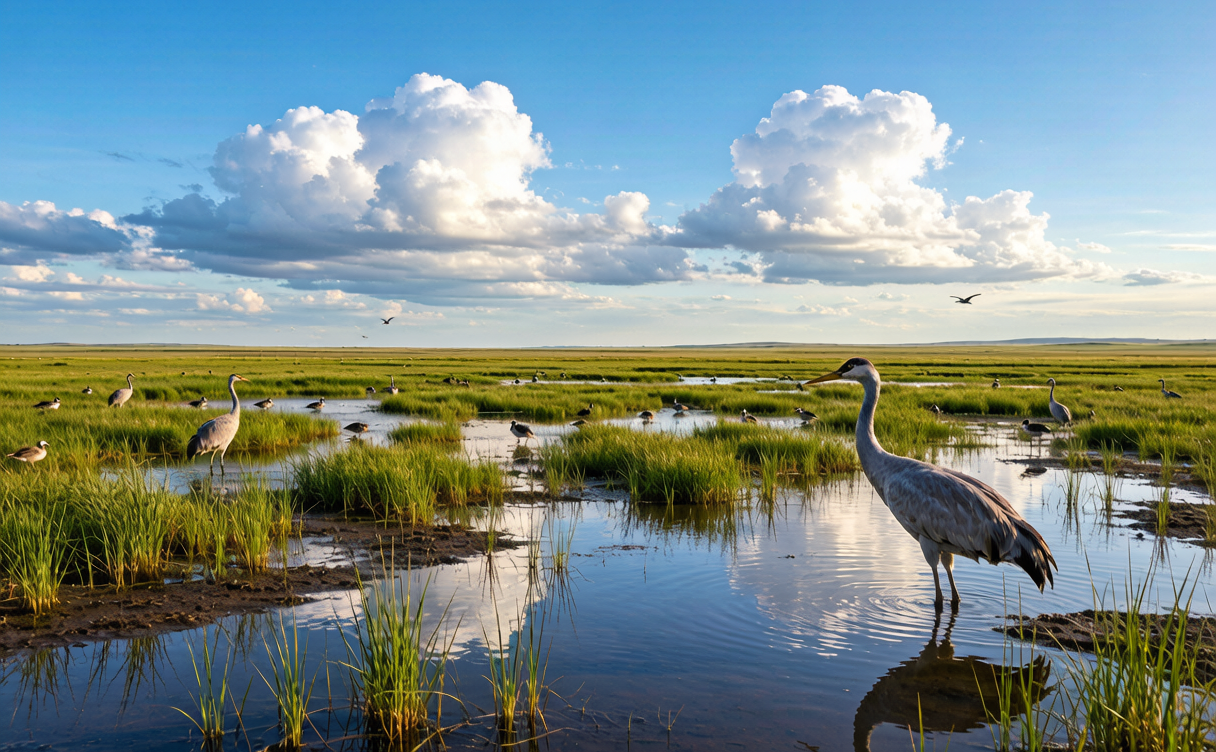
About 40 km south, Hulun Lake is a vast, shallow, faintly saline expanse that feels more like an inland sea, especially when the wind gets up. Summer visits mean beach-style shorelines, birdwatching (cranes, swans and gulls pass through on migration), sunset over open water and lakeside restaurants serving whole-fish banquets. In winter it freezes solid and hosts ice-fishing demonstrations. There is no entry fee to most shoreline areas, though some managed sections charge ¥30–50.
Grassland camps and Mongolian culture
From June to September, ger (yurt) camps operate on the grassland within an hour of the city. A typical programme covers horse riding, archery, a milk-tea welcome and an evening lamb roast with singing — ¥200–500 (US$28–70) per person with a meal. Choose smaller family-run camps over the coach-tour operations if you want something less staged.
Winter ice and snow
From late December the city builds an ice town of carved blocks, illuminated from within, alongside snow slides, snowmobiles and horse-drawn sleighs. Tickets run ¥100–200 (US$14–28). Reindeer, brought from the Ewenki herding communities further north, appear at several sites.
What to Eat
Manzhouli’s menus split three ways, and you should try all of them.
Mongolian. Hand-grabbed mutton (手把肉) — boiled on the bone, eaten with a knife and salt — is the staple. Roast whole lamb is the celebration dish, ordered in advance for a group. Salty milk tea with fried millet and dried curd (奶豆腐) appear at breakfast, and copper-pot mutton hotpot is superb in winter.
Russian-influenced. Borscht (苏波汤), a dense beetroot-and-beef soup; dalieba, big round sourdough loaves; smoked sausage; and kvass, the mildly fermented bread drink, on tap in summer.
Lake and grassland. Hulun Lake whitefish and carp appear in the quanyuyan whole-fish banquet. Local blueberries turn up as juice, jam and wine from July onward.
Expect ¥40–80 (US$6–11) per person for a solid local meal, ¥150–250 for a lamb roast.
Where to Stay
Downtown (Zhongsu Jinjie area) — the practical choice. Mid-range business hotels ¥220–450 (US$31–63) per night; budget chains ¥130–200 (US$18–28). You are walking distance from restaurants and the illuminated streets.
Matryoshka Square area — themed resort hotels in the Russian-Baroque style, ¥400–900 (US$56–127), higher in July and August. Good for families, less convenient for evening dining.
Grassland ger camps — ¥250–600 (US$35–85) per night in summer. Facilities range from shared washblocks to surprisingly comfortable en-suite gers. Closed roughly October to May.
Winter rates fall 30–50% across all tiers except during the Ice and Snow Festival opening weekend and Spring Festival.
Sample Itinerary: Three Days
Day 1 — City
- 11:00 Arrive, check in downtown
- 13:00 Russian-style lunch: borscht and sourdough
- 15:00 Walk the trade streets and Russian art shops
- 17:30 Matryoshka Doll Square for sunset and the light show
- 20:00 Mutton hotpot dinner
Day 2 — Lake and grassland
- 08:30 Chartered car south to Hulun Lake
- 10:00 Shoreline walk and birdwatching
- 12:30 Whole-fish lunch at a lakeside restaurant
- 15:00 Grassland camp: horse riding and archery
- 18:30 Lamb roast and evening singing; return to town or stay in a ger
Day 3 — Border and departure
- 09:00 National Gate scenic area (passport required)
- 11:30 Souvenir shopping — amber, chocolate, felt boots
- 13:30 Late lunch, then transfer to the airport or the Hailar train
Practical Tips
- Passport: carry it everywhere. This is a border city, hotels register foreign guests carefully, and the National Gate area requires ID. Confirm entry rules in advance via the National Immigration Administration.
- Payment: Alipay and WeChat Pay work everywhere, including market stalls. Some Russian-goods shops prefer cash; keep ¥300–500 on hand.
- Language: Mandarin dominates; Russian is the second language of commerce. English is very limited. A translation app with offline Chinese is essential.
- Hours: shops open late (10:00) and close late (22:00) in summer; winter hours shorten considerably.
- Clothing: even in July, grassland evenings fall to single digits. Winter demands insulated boots, a parka rated below −30°C, face covering and glove liners — several downtown shops sell them.
- Getting around: distances are large and public transport thin. A chartered car with driver costs ¥600–900 (US$85–127) per day.
FAQ
How many days do you need in Manzhouli?
Two full days covers the city, Hulun Lake and a grassland afternoon. Three is better if you want an overnight in a ger camp or a day trip east toward Erguna’s wetlands and birch forests.
Can foreigners visit Manzhouli freely?
Yes. Manzhouli is a normal open city for tourism and no special permit is required to visit. You simply need your passport for hotel registration and for entry to the border-area attractions.
Is Manzhouli worth visiting in winter?
Only if you actively want extreme cold and ice scenery. The ice festival, frozen lake and snowbound grassland are spectacular, but −30°C is not a novelty for long. Bring genuine polar-grade gear or stay in summer.
Is there high-speed rail to Manzhouli?
Not yet. Conventional trains connect Manzhouli with Hailar, Qiqihar and Harbin, and flights handle longer distances. Some travellers reach Hailar by air and continue by rail. Our China travel guide for first-timers explains how to mix flights, sleeper trains and bullet trains on a single itinerary.
What souvenirs are worth buying?
Russian chocolate and honey, amber jewellery (check authenticity), felt boots and fur hats, Mongolian milk curd and blueberry wine. Prices on the main tourist street are inflated — walk a block back for better rates.
Written by Karl, last updated August 4, 2026.