

For a thousand years Yangzhou was one of the richest cities in China, a salt-trade capital where the Grand Canal meets the Yangtze. Poets wrote about its moonlit bridges; merchants built scholar gardens to prove their taste; chefs refined Huaiyang cuisine into one of China’s four great culinary traditions. Today it is a relaxed, green Jiangsu city that most foreign visitors skip between Nanjing and Suzhou — which is exactly why it is worth two days. This Yangzhou travel guide covers Slender West Lake in blossom season, the Grand Canal heritage sites, the classical gardens, and the morning-tea ritual locals treat as a civic duty.
Why Visit Yangzhou
Yangzhou offers the Jiangnan experience — canals, gardens, teahouses, humpbacked bridges — with fewer crowds and lower prices than Suzhou or Hangzhou. It is also a genuine food destination: UNESCO named it a City of Gastronomy in 2019, and the local breakfast culture alone justifies the trip. Add the Grand Canal, inscribed as a World Heritage site in 2014 with Yangzhou as lead city of the nomination — see the UNESCO World Heritage listing for the Grand Canal.
Best Time to Visit Yangzhou
Late March to late April is the classic window. Willows along Slender West Lake come into leaf, peach and cherry blossom open, and the city’s emblematic qionghua flowers bloom in April. Temperatures sit at 12–20°C. The old line about Yangzhou being at its best “in the third lunar month” holds up.
September to November is the quieter alternative: 15–24°C, dry, with osmanthus scent through the gardens in late September and lower hotel rates.
Summer (June–August) is hot and sticky at 27–33°C with July highs above 35°C; gardens are lush but sightseeing is draining. Winter (December–February) runs 0–8°C and damp, with occasional snow on the Five-Pavilion Bridge and the year’s lowest prices. Avoid the first week of October and the Qingming weekend. Our best time to visit China guide sets these seasons against the rest of the country.
How to Get There
Yangzhou sits on the north bank of the Yangtze, about 100 km from Nanjing. The high-speed station is Yangzhou East (扬州东站), roughly 15 km east of the centre; the older Yangzhou Station in the west handles conventional services. The nearest major airport is Nanjing Lukou (NKG); the small Yangzhou Taizhou (YTY) airport has limited domestic routes.
| From | Option | Time | Approx. Cost |
|—|—|—|—|
| Nanjing South | High-speed train to Yangzhou East | 50–70 min | ¥55 (US$8) |
| Nanjing Lukou Airport | Direct airport coach | ~1.5 hr | ¥100 (US$14) |
| Shanghai Hongqiao | High-speed train (change at Nanjing) | 2.5–3.5 hr | ¥210 (US$30) |
| Suzhou | High-speed train via Nanjing or Zhenjiang | 2–2.5 hr | ¥140 (US$20) |
| Beijing South | High-speed train (change at Nanjing South) | 5–6 hr | ¥560 (US$79) |
| Zhenjiang | Bus across the Yangtze bridge | ~50 min | ¥25 (US$4) |
| Yangzhou East Station | Bus 32 or Didi to old town | 30–40 min | ¥2–45 (US$0.30–6) |
Getting around is easy: the city is flat, buses cost ¥2, Didi rides across town run ¥12–25, and shared bikes are everywhere. Slender West Lake to Dongguan Street is a pleasant 25-minute walk.
Things to Do in Yangzhou
Slender West Lake (Shouxihu)
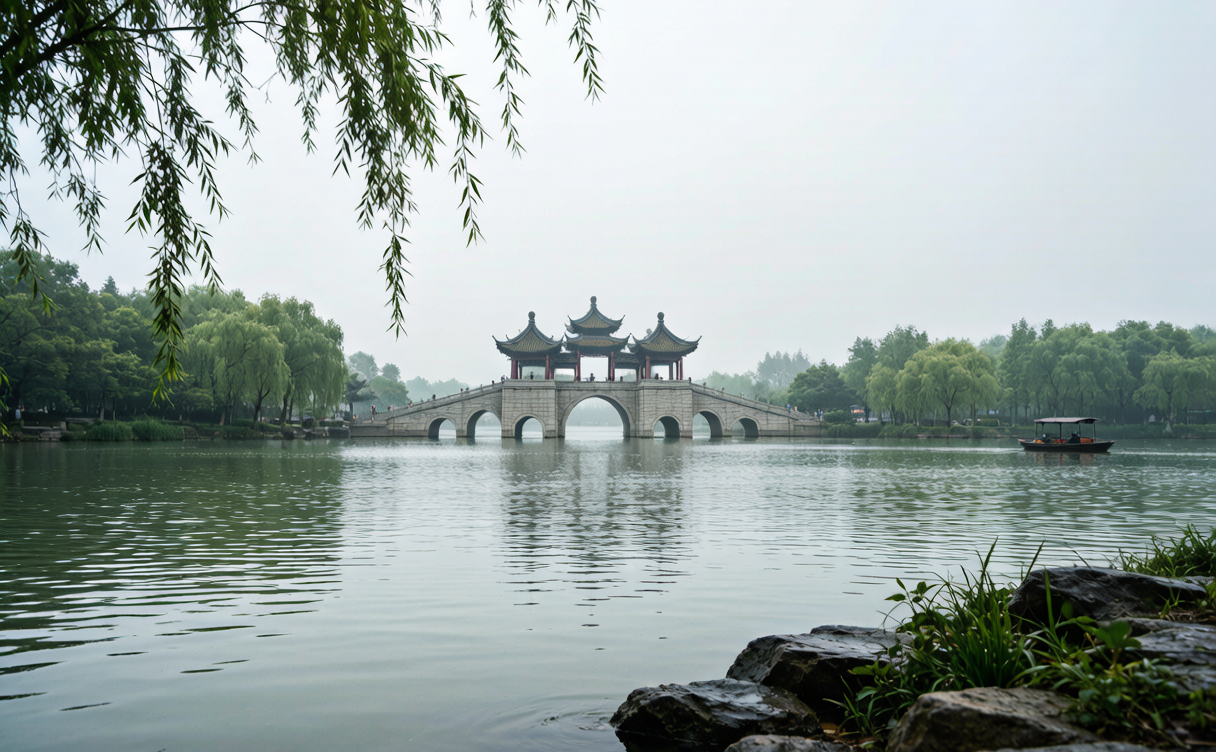
Not a lake so much as a narrow, sinuous stretch of former canal landscaped over centuries into a sequence of set-piece views. The Five-Pavilion Bridge (Wuting Bridge), yellow-tiled pavilions on a white stone base, is the city’s signature image; the White Pagoda nearby is a Qing-era echo of the one in Beijing’s Beihai Park. Look also for the Twenty-Four Bridge, named in a famous Tang poem.
Allow three hours. Entry is about ¥100 (US$14) in peak season and ¥60 (US$8) off-peak; boats cost ¥40–80 extra. Enter at the south gate before 09:00, when the light is soft and the tour groups have not arrived.
Ge Garden and He Garden
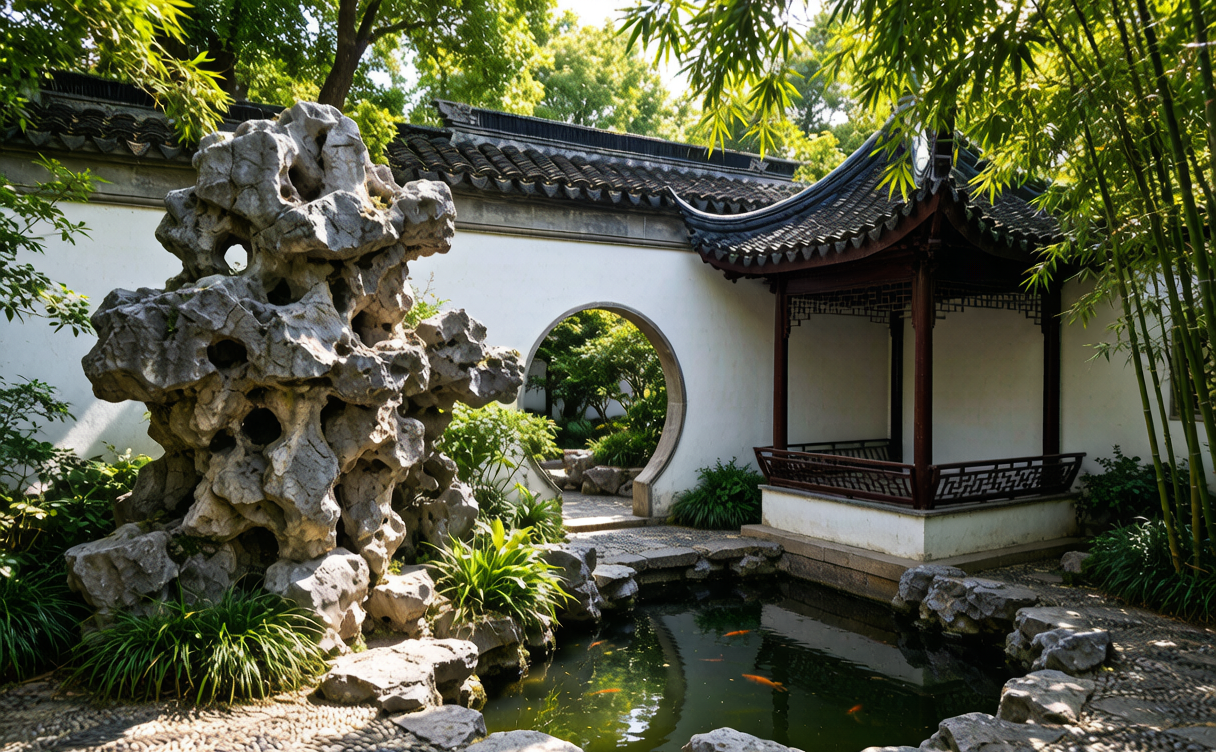
Two of the finest private gardens in China outside Suzhou, and far less crowded. Ge Garden (个园) was built by a salt merchant around bamboo and four rockeries representing the seasons — spring bamboo shoots, summer grey stone, autumn ochre rock, winter white pebble like snow. He Garden (何园), late Qing, is more architectural, famous for a raised double corridor that circles the whole complex. Each costs around ¥45 (US$6) and takes 60–90 minutes.
Daming Temple
Daming Temple occupies a hill north of the lake and dates to the fifth century. Its main draw is the Tang-style memorial hall to the monk Jianzhen, who left from here in the eighth century and, after five failed attempts, reached Japan to found a great temple in Nara. The nine-storey Qiling Pagoda gives the best panorama in the city. Entry around ¥45 (US$6).
Dongguan Street and the Grand Canal
Dongguan Street is the restored spine of the old merchant quarter: stone paving, lantern-hung shopfronts, snack vendors, and the Dongguan Ancient Ferry wharf where the street meets the canal. Touristy but well done, and the side lanes north are quiet and genuine.
The China Grand Canal Museum at Sanwan is outstanding — large, modern and immersive, covering 2,500 years of engineering. Entry is free but requires advance reservation through its WeChat mini-programme. Evening canal cruises depart from Dongguan and Sanwan wharves for ¥80–120 (US$11–17).
What to Eat: Morning Tea and Huaiyang Cuisine
Yangzhou’s food culture is the highlight for many visitors, and it starts early. Morning tea (早茶) is not a quick coffee but a leisurely two-hour sit-down that locals do several times a week; the historic teahouses near Slender West Lake and along the canal fill from 06:30. Order green tea plus a spread of small dishes:
- Crab-roe soup dumplings (蟹黄汤包) — served with a straw; sip the broth first, then eat the skin. Autumn is peak season.
- Three-diced buns (三丁包) — soft steamed buns filled with diced chicken, pork and bamboo shoot.
- Dazhu gansi (大煮干丝) — pressed tofu sliced into hair-fine threads and simmered in a rich chicken and ham broth. The knife work is the point.
- Thousand-layer oil cake (千层油糕) — sweet, translucent, faintly chewy.
- Jade shaomai (翡翠烧卖) — green vegetable filling in a thin wrapper.
Expect ¥50–120 (US$7–17) per person at a well-known teahouse; neighbourhood places do it for half that.
At lunch and dinner, go for Huaiyang classics: lion’s-head meatballs (狮子头) in clear broth; Wensi tofu soup, in which a block of silken tofu is cut into thousands of threads; and sweet-and-sour mandarin fish. And yes — Yangzhou fried rice is from here. The real version is restrained and precise: shrimp, ham, egg, bamboo shoot, peas, each grain separate. Yangzhou also keeps alive the “three knives” trades — cooking, barbering and pedicure — and a traditional bathhouse session with back-scrub and foot treatment (¥80–200) is a very local afternoon.
Where to Stay
Slender West Lake / Shita area — the most scenic base, walkable to the lake and Daming Temple. Four-star hotels ¥400–750 (US$56–106) per night; heritage-style boutique properties ¥600–1,200 (US$85–169).
Old town / Dongguan Street — courtyard guesthouses and small boutique hotels at ¥280–550 (US$39–77), inside the atmospheric lanes with morning tea on your doorstep. My pick for a first visit.
Near Yangzhou East Station — modern chain hotels at ¥160–300 (US$23–42), good value but a 30-minute ride from the sights.
Rates rise 40–60% during the April blossom peak and the October holiday.
Sample Itinerary: Two Days in Yangzhou
Day 1
- 07:00 Morning tea — soup dumplings, gansi, green tea
- 09:00 Slender West Lake from the south gate
- 12:30 Light lunch, then Daming Temple and Qiling Pagoda
- 15:30 Ge Garden
- 18:00 Dongguan Street, then a night cruise on the Grand Canal
Day 2
- 08:00 A quieter neighbourhood morning tea
- 09:30 China Grand Canal Museum at Sanwan (book ahead)
- 12:30 Huaiyang lunch: lion’s head, Wensi tofu, Yangzhou fried rice
- 14:30 He Garden and the Wenchang Pavilion area
- 16:30 Traditional bathhouse or a canal-side teahouse
- 19:00 Dinner, then the evening train onward
Practical Tips
- Tickets: buy Slender West Lake entry at the gate with your passport or via the scenic-area mini-programme. The Grand Canal Museum is free but reservation-only — book 2–7 days ahead.
- Combination passes: multi-attraction tickets covering the lake, both gardens and Daming Temple save roughly 20–25%.
- Hours: gardens typically 07:30–17:30; Slender West Lake opens 06:30 in peak season; museums close Mondays.
- Payment: Alipay and WeChat Pay everywhere, both accepting foreign cards. Keep ¥100–200 cash for small teahouses.
- Language: English signage is decent at major sites but rare in restaurants. Photo menus are common.
- Pace: Yangzhou rewards slowness. Two days is right; three lets you add an unplanned canal-side morning.
FAQ
How many days do I need in Yangzhou?
Two full days covers Slender West Lake, both major gardens, Daming Temple, Dongguan Street and the Grand Canal Museum at a comfortable pace. One day means skipping either the gardens or the museum.
Can I visit Yangzhou as a day trip from Nanjing or Shanghai?
From Nanjing, easily — under an hour each way by high-speed train. From Shanghai it is a long day at 2.5–3.5 hours each way, and you would see little beyond the lake. Staying overnight is much better, not least because morning tea is the local highlight.
Is Slender West Lake worth the entrance fee?
Yes, particularly in spring and autumn. It is a designed landscape, and the sequence of bridges, pavilions and framed views is the point. Go early, and take the boat if you are short on walking energy.
When is the best time to see blossom in Yangzhou?
Late March through mid-April for peach and cherry blossom, with the local qionghua flowers peaking in April. Timing shifts a week or two each year depending on the winter.
What is Yangzhou morning tea and how do I order it?
A slow sit-down breakfast of tea plus steamed and baked small dishes. Order a pot of green tea per person, then point at three or four items — soup dumplings, three-diced buns, gansi and an oil cake make a classic set for two.
Written by Karl, last updated August 4, 2026.