

Tucked into the hilly border where Henan meets Shanxi, Wangwu Mountain, Henan, is one of China’s oldest Taoist sacred peaks and the quiet hero of a famous fable. This is the mountain the “Foolish Old Man” (Yugong) vowed to move in the parable every Chinese child learns, and for Taoists it ranks as the “first of the Ten Grottoes,” the top blessed site in the religion’s cosmology. Most foreign travelers rush between Luoyang and the Shaolin Temple and never hear of it, which is exactly why we like it. We’ve sent travelers here for a slow day of temples, forests, and gorges, and they come back surprised that such a significant holy mountain gets so few visitors.
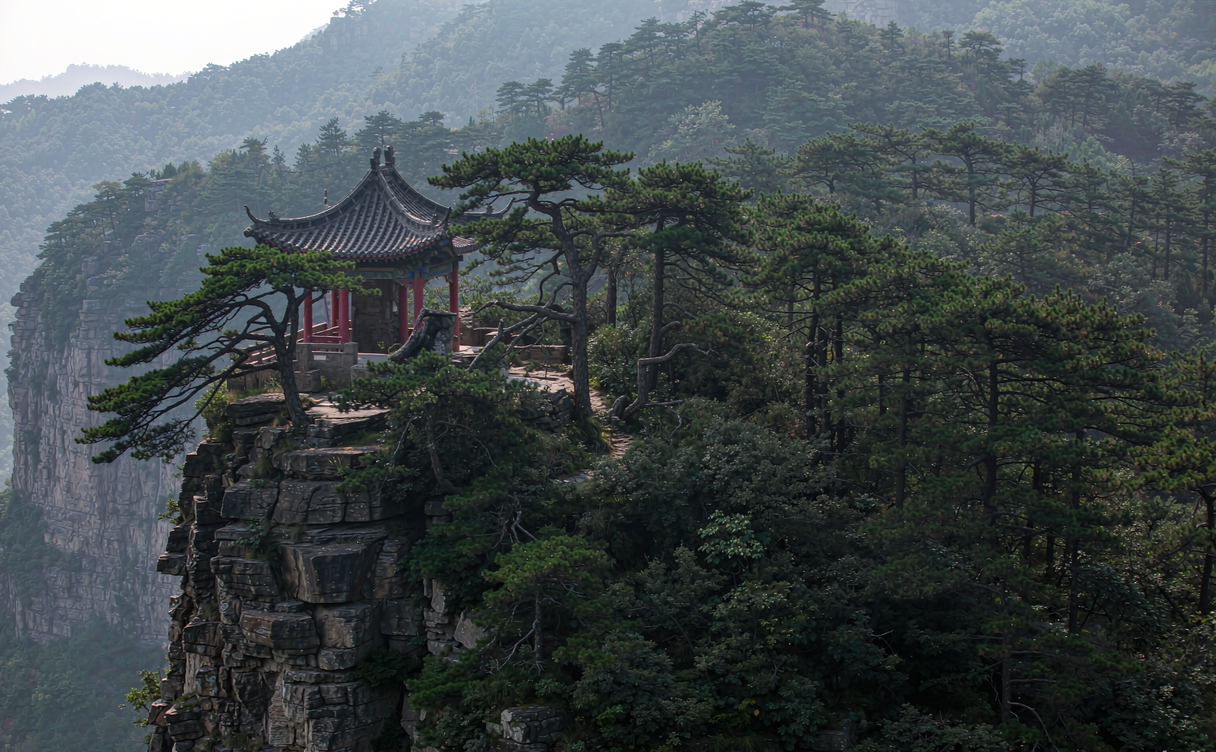
The Wangwu Mountain taoist heritage runs deep. The Tang emperor raised the Yangtai Palace (Sun Terrace Palace) here, and the Tang sage Sima Chengzhen practiced and taught on the peak, drawing emperors to the site. The mountain’s main summit, Tiantan Peak (Sky Altar Peak), rises to about 1,715 meters and was once used for celestial sacrifices. Below the temples, the rock is a mix of limestone gorge and primeval forest, part of the Wangwushan-Daimeishan UNESCO Global Geopark, so the scenery carries real geological weight as well as spiritual meaning. The combination of working temples and protected gorges makes Wangwu unusual: you can burn incense at a thousand-year-old hall in the morning and hike a wild ravine by noon.
Things to do at Wangwu Mountain
The first things to do at Wangwu Mountain are the temple visits. Start at Yangtai Palace, where the carved doors and the old cypress planted, legend says, by Sima Chengzhen still stand; allow an hour to walk the courtyards and read the stone steles. Then take the cable car or the old stone path toward Tiantan Peak, where on a clear day you can see across the plain toward the Taihang range that the Foolish Old Man also wanted to move. Mid-mountain, a network of gorge trails follows the Wangwu stream past pools and small falls; the section near the “Purple微” ravine is the most photogenic and the least crowded.
A slower, family-friendly option is the base village, where you can watch Taoist musicians rehearse and try a cup of mountain herbal tea for about ¥10 ($1.50 USD). Our guides like to end the day at the cliff overlook above the gorge for the late light. On our last visit in mid-October, the forest was turning and a Taoist ceremony was underway at Yangtai Palace, drums echoing down the valley; the travelers with us said it was the most atmospheric moment of their Henan trip. We’ve sent both pilgrims and hikers, and the cable car plus temple path means non-trekkers still see the best views.
Best time to visit Wangwu Mountain
The best time to visit Wangwu Mountain is April to May, when the wildflowers and new leaves soften the gorges and the weather is mild, and again in September to October, when the maple and oak forest turns red and gold and the skies are clear for the peak view. Summer is cool and green, a decent escape from Henan’s heat, though afternoons can bring rain. Winter brings snow on the upper slopes and very few services, so we usually advise against it unless you want solitude. For a broad seasonal plan, our best time to visit China guide maps the months by region.
How to get to Wangwu Mountain
Understanding how to get to Wangwu Mountain starts with Jiyuan, the small city at the mountain’s foot. High-speed trains reach Jiyuan from Zhengzhou in about 1.5 to 2 hours and from Luoyang in roughly an hour; from Jiyuan station a taxi to the scenic gate is 30 to 40 minutes and costs about ¥60 to ¥90 (around $8 to $13 USD). Some travelers drive from Luoyang as a day trip, about 1.5 hours each way. We often book a private car from either base city for the flexibility to stop at village temples. Our China high-speed train guide for foreigners explains how to buy those Henan rail tickets and read the station boards.
Costs and the surrounding Henan plan
Admission is about ¥80 per adult, with the Tiantan cable car extra at roughly ¥60 round trip (total around $20 USD). Children under 1.2 meters enter free. Wangwu Mountain Jiyuan sits between two major hubs, so it works as a day trip from either. Our Luoyang travel guide covers the Longmen Grottoes and Shaolin side trips, while the Zhengzhou base handles the provincial capital. For travelers collecting protected landscapes, a national parks overview places Wangwu inside the country’s geopark network.
Food and a Henan angle
The Wangwu foothills eat plain, hearty Henan food. A bowl of huimian (braised wheat noodles) with lamb runs about ¥18 to ¥28 ($2.50 to $4 USD), and a breakfast bowl of hulatang, the peppery spicy soup, is ¥8 to ¥12 ($1 to $1.50 USD). We send every food-curious traveler to Henan Yu cuisine guides before they come so they can order beyond the hotel buffet and find the real street stalls.
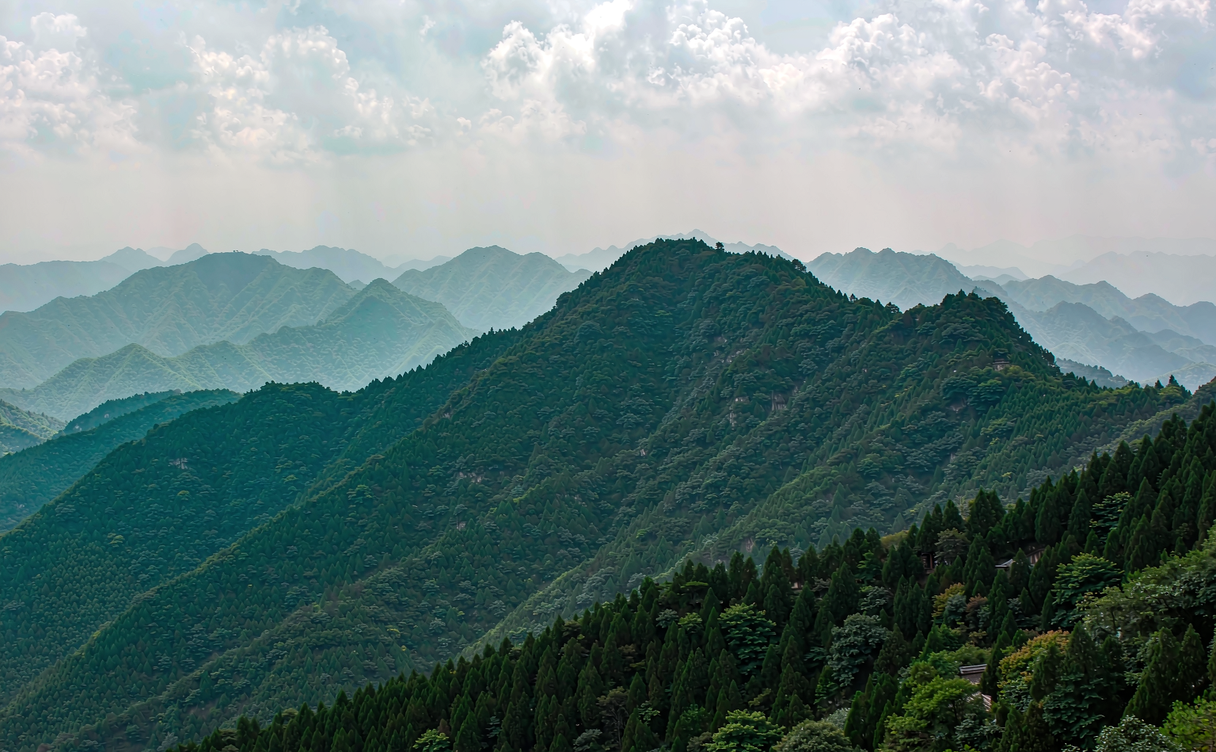
The Wangwu story begins with a fable every Chinese child knows. An old man called Yugong, frustrated that the Wangwu and Taihang mountains blocked his village’s light, vowed to dig them away with his family, answering ridicule with the line that later generations would finish the work. Mao later reused the tale as a metaphor for persistence, which is why signs about it appear at the gate. Standing on Tiantan Peak, you understand the grip the mountain had on the imagination: two ranges once framed the horizon and the plain below. The peak also marks the start of the Wangwushan-Daimeishan geopark, whose limestone gorges continue west into Henan and give the whole border region its rugged character. A good day plan is the 9 a.m. train to Jiyuan, the palace and gorge until mid-afternoon, and the cliff overlook for the closing light before the return train. We tell travelers to wear proper shoes for the gorge, because the stone path is uneven and slick after rain, and to bring a light layer even in summer, since the peak stays cooler than the city.
Why we keep sending travelers here
On our last visit the morning mist lifted off Tiantan Peak just as a temple bell sounded, and the whole group stopped talking to listen; those are the moments we travel for. The Wangwu Mountain Henan peak is a Taoist icon, and the Wangwu Mountain Jiyuan base makes a calm day trip. The best things to do at Wangwu Mountain are the palace and the gorge, and the best time to visit Wangwu Mountain is autumn. Figuring out how to get to Wangwu Mountain from Luoyang is straightforward by train. We’ve sent travelers there as a calm day between the busy Luoyang grottoes and Zhengzhou, and it consistently rates as the most peaceful stop because the crowds are thin and the setting is sacred. A comfortable plan is to take the 9 a.m. train to Jiyuan, reach the gate by late morning, tour the palaces and gorge until mid-afternoon, and return to the city for dinner. The Wangwu Mountain Henan experience rewards travelers who like their history with a little altitude and a lot of quiet.
The mountain’s global geological value is recognized by the UNESCO Global Geoparks network, which lists Wangwushan-Daimeishan as a protected geopark.