

Most foreigners who come to Anhui go straight up Yellow Mountain and leave, missing the broad green water that sits at its northern foot. That water is Taiping Lake — a long, narrow reservoir so calm and so lined with wooded islets that locals call it “Huangshan’s Emerald.” We’ve sent travelers here as a recovery day after the steep climbs of Huangshan, and the contrast is perfect: after two days of granite peaks and crowds, the lake feels like a deep exhale. This Taiping Lake Huangshan Anhui guide covers what the lake actually offers, how to get there, and how to build it into an Anhui route.
The reservoir was created in the 1970s when a dam was built across the Gantang River to generate power and control flooding. What resulted was a 90-square-kilometer lake with roughly 80 kilometers of winding shoreline and dozens of small green islands — a landscape that, from a boat, looks more like a flooded forest than a typical Chinese reservoir.
Why visit, and what the lake is like
Taiping Lake sits in Huangshan City (the prefecture that also holds Yellow Mountain), between the Yellow Mountain massif to the south and the sacred peak of Jiuhua Mountain to the north. It is the watery hinge of what Anhui tourism calls the “Huangshan–Taiping Lake–Jiuhua” golden line. In our experience, it works in three ways: as a post-Huangshan rest stop, as a kayaking and boating destination in its own right, or as a scenic break on a road trip between Hangzhou and the mountains.
The water is clearest in spring and autumn, when low sun turns the surface into a mirror for the surrounding hills. Unlike the busy West Lake in Hangzhou, Taiping is spread out and quiet — you can go an hour on a boat and see only a fisherman and a heron.
Because the lake was formed by flooding a river valley, the old villages and hills that once lined the banks now poke out as islands and peninsulas, which is exactly what gives the shoreline its maze-like, exploratory feel. Local life continues on the water: fishing boats head out at first light, and the small settlements on the larger islands keep kitchen gardens and tea plots much as they did before the dam. For travelers coming from the dense cities of the east, that combination — big open water plus a slow village rhythm — is the lake’s real selling point, and it’s why we often build a full night here rather than a rushed half-day stop between mountain hikes.
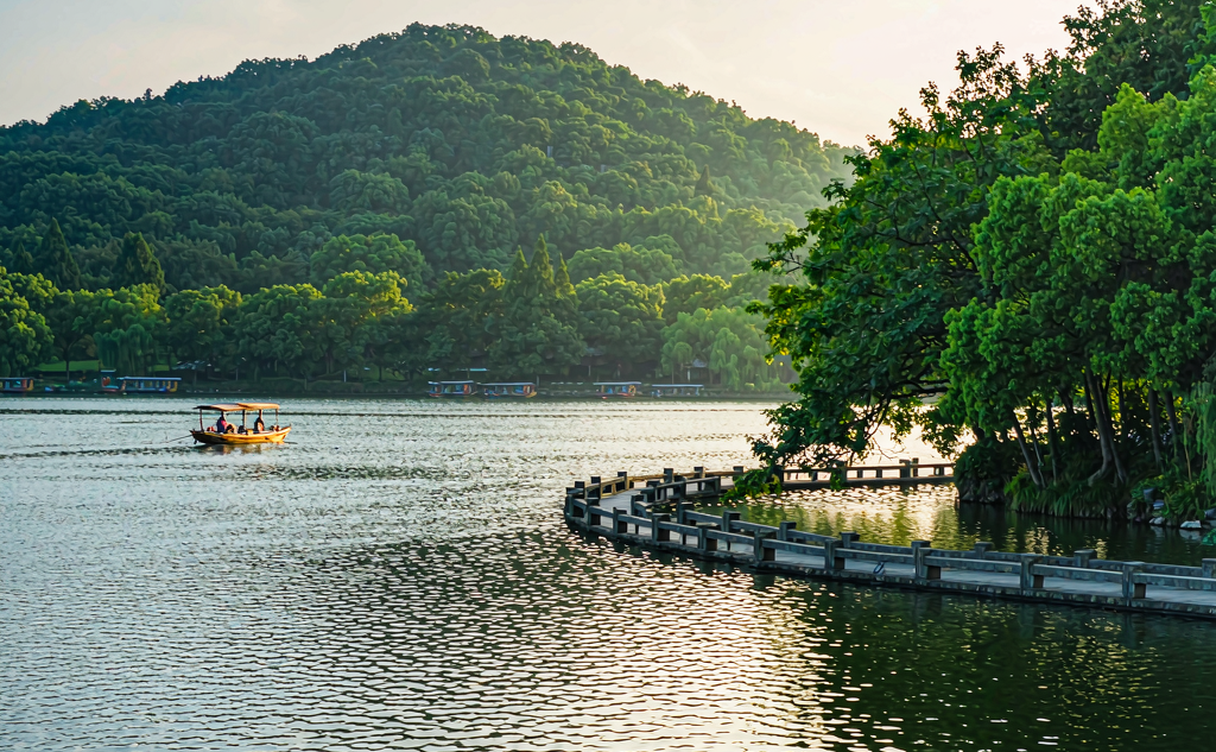
Taiping Lake boat cruise and things to do
The signature experience is a Taiping Lake boat cruise. Tour boats leave from the main wharf and loop past the larger islands; private and chartered boats can be arranged through lakeside hotels if you want a slower, customizable route. Things to do at Taiping Lake include:
- Sightseeing cruise. A standard tour boat runs roughly 2–3 hours and stops at one or two islets with walking paths and viewpoints. Expect to pay in the range of 100–150 RMB for a seat on a scheduled cruise, more for a private charter.
- Kayaking and paddle boats. Several resorts rent kayaks andSUP boards; early morning is glassy and ideal. We’ve had travelers paddle out to a small wooded islet and barely see another soul.
- Lakeside cycling and walking. Paved paths along parts of the shore make for easy, flat biking — a nice change after Huangshan’s stairs.
- Hot-spring resorts. The Taiping Lake area is known for hot-spring hotels where you can soak with a lake view, especially good in cooler months.
- Fishing and village visits. Some islets have small settlements and tea terraces; a few operators offer fishing or farmhouse lunches.
For Taiping Lake resorts, the lakeshore has a mix of larger resort hotels (some with hot springs and private beaches) and smaller family-run lakeside guesthouses. Prices swing with the season: budget 300–600 RMB for a comfortable lakeside room in shoulder season, and considerably more for a branded resort on a holiday weekend. Booking through your hotel for boat trips usually gets you a better rate than the public wharf.
Two islands are worth knowing by name. The larger developed islet has a walking loop, a viewpoint pagoda, and a small tea house where you can sit over a cup of the local Huangshan maofeng with a lake panorama. A second, quieter island is favored by kayakers and has a short forest trail to a cliff-edge lookout. Operators at the wharf can route a private boat to both if you charter for half a day, which we recommend over the standard group circuit if your schedule allows.
Food around the lake is its own reason to stop. The reservoir is rich in freshwater fish — the local steamed or sour-cabbage-poached fish is a simple, excellent lunch — and the surrounding hills produce tea and chestnuts. Several lakeside resorts run their own restaurants using the day’s lake catch; we tell travelers to eat at the water’s edge rather than along the highway, where quality drops. A relaxed lakeside lunch is, for many visitors, the memory that outlasts the boat ride itself, and it’s a good excuse to slow the pace after the rigors of Yellow Mountain.
Getting there and a Taiping Lake to Huangshan trip
Location and access. The lake is about 1.5–2 hours by road from the Yellow Mountain scenic area (Tangkou) and around 2–2.5 hours from Huangshan City center (Tunxi). High-speed trains run to Huangshan North railway station from Hangzhou, Shanghai, and Nanjing; from there you continue by bus or private car. If you’re driving the classic eastern route, the Hangzhou travel guide is your natural starting point, about 3.5–4 hours south.
A Taiping Lake to Huangshan trip. The most popular pairing is two days on Yellow Mountain followed by a night at the lake. We suggest: climb Huangshan, descend to Tangkou, transfer north to Taiping Lake for an afternoon cruise and a hot-spring evening, then continue to Yellow Mountain base towns or onward to Jiuhua. The lake also connects neatly to the Huizhou ancient villages (Hongcun, Xidi) if you want culture with your scenery.
Side trips. North of the lake, the Xuancheng region offers ink-stone workshops and river towns, while to the east the Anji bamboo hills and Huzhou canals extend the lake-and-mountain theme into Zhejiang. If you’d rather end your trip in a big city with good hotels, our Hangzhou hotel guide helps you close the loop in comfort.
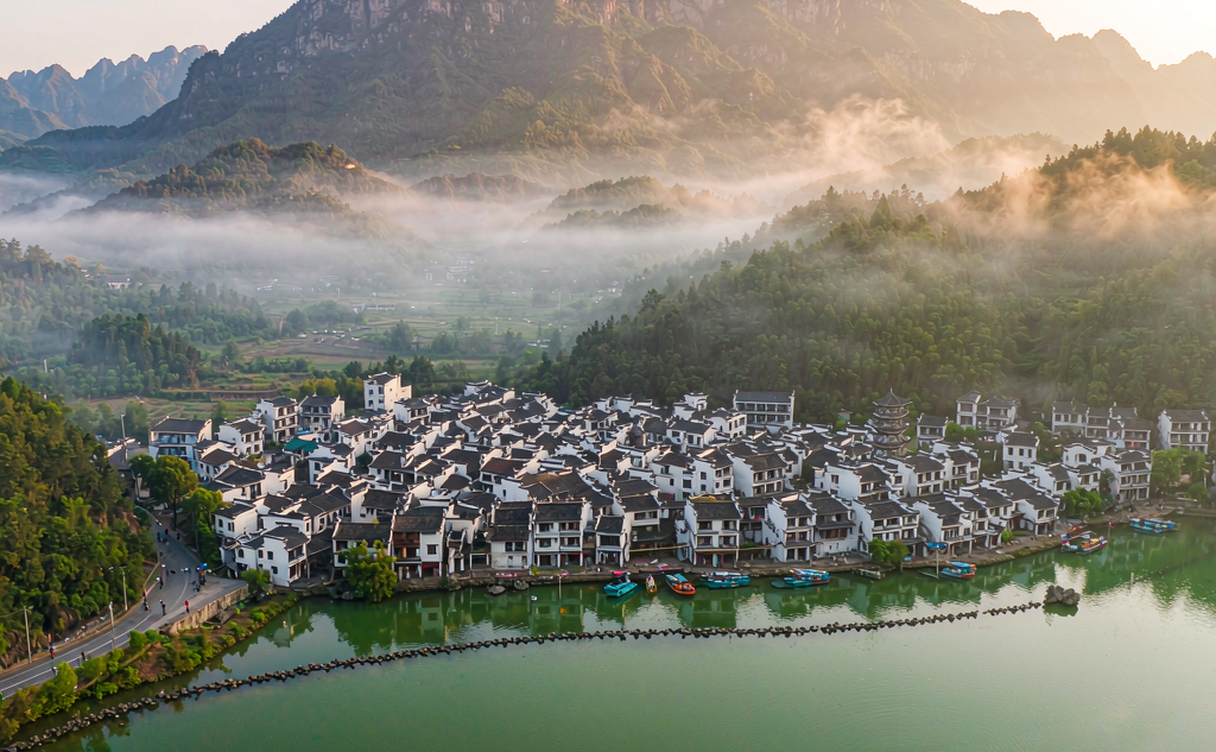
Best time to visit Taiping Lake
The best time to visit Taiping Lake is April–May and September–November. Spring brings fresh green terraces and mild weather; autumn gives clear water, comfortable temperatures, and the best light for photography. Summer (June–August) is lush but hot and prone to heavy rain and the occasional typhoon edge-effect, so watch the forecast. Winter is quiet and cheap, though some boat services run less frequently.
A practical note: the lake’s appeal is weather-dependent. On a grey, rainy day it’s pleasant but flat; on a still, sunny morning it’s genuinely stunning. We tell travelers to keep one flexible day so they can put the lake on the best-weather window of their trip.
For background on the broader mountain-and-lake region, the overview at Wikipedia’s Taiping Lake page summarizes how the reservoir was formed and what surrounds it.
Recover from the peaks with water instead of stone — read our Yellow Mountain guide to plan a Huangshan-and-lake route that paces the climbs.
Want a lakeside room with a hot spring after the hike? Book the right base using our Hangzhou hotel guide and we’ll point you to resorts that fit the route.
Extend the lake-and-mountain theme into Zhejiang with our Anji travel guide for bamboo hills and quiet reservoirs south of Taiping Lake.