

Serious travelers to Shanxi eventually hear the same piece of folklore: for most of the 20th century, experts believed not a single wooden hall from China’s Tang dynasty (618–907) had survived. Then, in 1937, the architect Liang Sicheng and his wife Lin Huiyin found one tucked against a hillside in the mountains of northeastern Shanxi. That building is the East Hall of Foguang Temple, and standing beneath its eaves today is as close as you can get to walking inside a Tang dynasty room. This Foguang Temple Shanxi guide explains why the temple is a pilgrimage site for architecture fans, how to reach it, and how to pair it with nearby Mount Wutai.
In our experience, Foguang is the single most rewarding “difficult to reach” site in the province. The main Wutai Shan monastic town draws the crowds; Foguang sits quietly an hour’s drive away and receives a fraction of the visitors, which only adds to the sense that you’ve discovered something.
Foguang Temple history
Foguang Temple (佛光寺, “Temple of Buddha Light”) was first recorded in the 6th century, but the building that makes it world-famous — the East Hall (东大殿) — was constructed in 857 AD, late in the Tang dynasty, during the Dazhong reign. Its survival is extraordinary: of all the wooden architecture China produced across a thousand years, only a tiny handful of Tang-period halls remain standing, and the East Hall is the largest and most complete of them.
The Foguang Temple history took a modern turn in 1937. Liang Sicheng, often called the father of Chinese architectural history, had been hunting for a genuine Tang structure for years and had nearly given up. Using a Tang dynasty mural in a cave at Dunhuang as a clue, he and Lin Huiyin traveled to the remote site and confirmed the date by reading an inscription on a beam inside the hall. Liang later called it “the first treasure of Chinese architecture,” and the phrase has stuck among travelers and scholars alike.
What makes the find even richer is that the East Hall is a complete Tang ensemble: not just the frame, but Tang dynasty clay sculptures, Tang murals on the walls, and a Tang inscription — four pieces of evidence from the same 9th-century moment, all in one room.
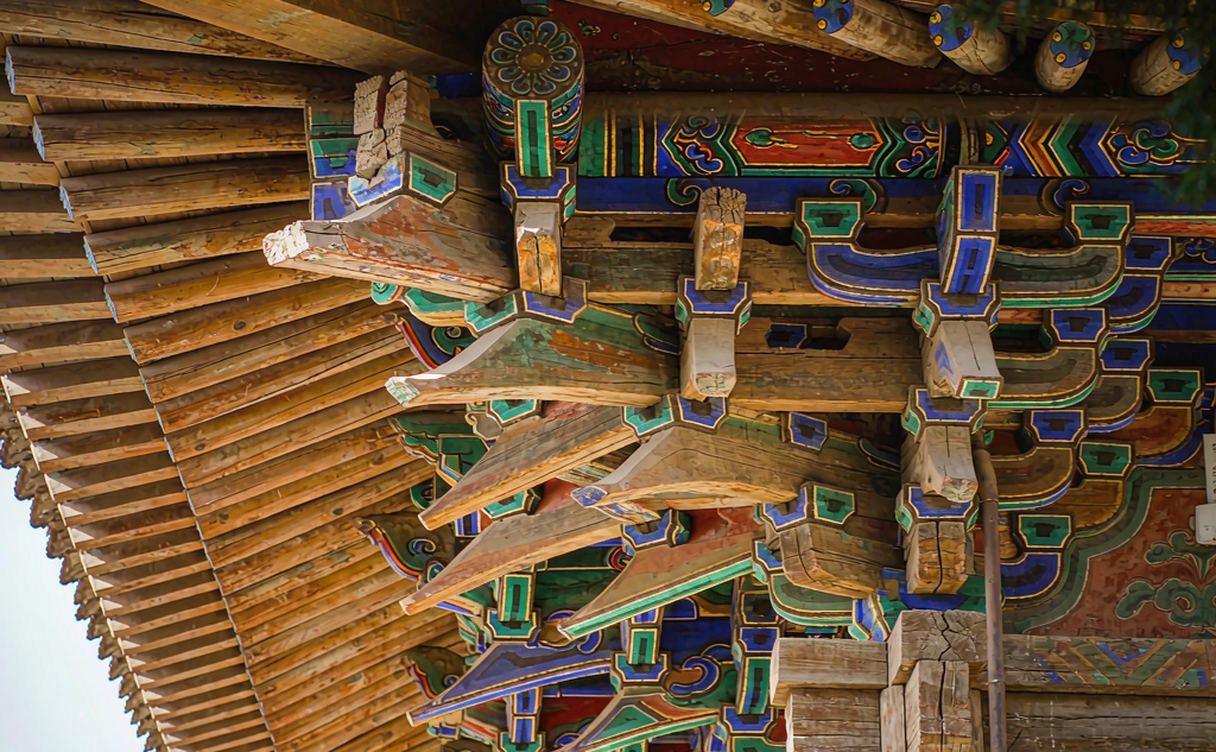
Foguang Temple Tang architecture
The East Hall is built on a stone platform and spans seven bays, with a deep, sweeping roof carried on bracket sets (dougong) so large they’re nearly half the height of the columns. That proportion — bold, heavy, and confident — is the visual signature of Tang architecture, and you won’t see it done this way anywhere later. Step inside and look up: the beams, the bracket arms, and the unpainted structure are exactly as the builders left them more than 1,150 years ago.
Highlights of the Foguang Temple Tang architecture include:
- The bracket sets. The dougong are oversized and functional, spreading the roof’s weight without the need for interior columns. This is the kind of engineering that lets the hall feel open and vast inside.
- The sculpture group. Behind the altar stand a cluster of Tang dynasty clay figures — a central Buddha flanked by bodhisattvas and arhats — arranged exactly as they were placed in 857.
- The murals. Faint Tang murals survive on the walls behind the statues, among the oldest Buddhist wall paintings still in situ in China.
- The small stone pagoda outside. Near the temple stands an early stone pagoda, a quiet reminder that the site was sacred long before the present hall was raised.
Things to do at Foguang Temple are simple but profound: walk the platform, study the brackets up close, sit in the cool shade of the eaves, and let the age of the wood sink in. Photography is allowed in the courtyard; the interior rules are stricter, so follow the staff’s guidance.
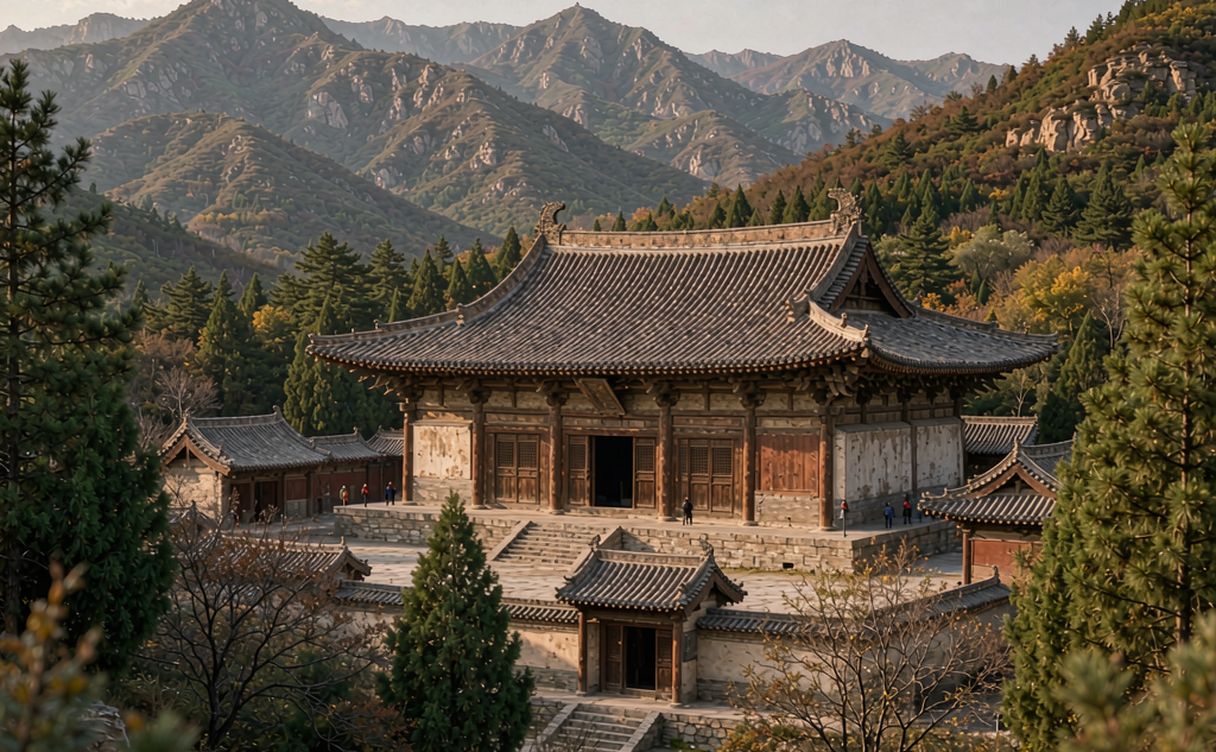
The story of how the hall was found is almost as compelling as the building itself. Liang Sicheng had been told by a foreign scholar that no Tang wooden structure survived in China, and he was determined to prove otherwise. The clue came from a 9th-century mural in the Dunhuang caves that depicted a hall with a specific layout; matching that description against old records, he traveled to this remote hillside in 1937 and confirmed the date from an inscription high on a beam. Lin Huiyin, climbing a ladder in the gloom, read the characters that settled the question. For travelers today, knowing that backstory makes standing inside the hall feel like finishing someone else’s decades-long search.
If you have a full day on the mountain, the even older Nanchan Temple — another Tang wooden hall, smaller and simpler — lies a short drive away and pairs perfectly with Foguang for a two-Tang-day that few foreign visitors manage. Both are quiet, both are remote, and together they let you compare two slightly different moments of the same short-lived golden age of Chinese carpentry. We recommend a private car for this combo, since public transport between the two is sparse.
Getting there and a Foguang to Wutai Mountain trip
Location. Foguang Temple lies on the southern flank of the Mount Wutai area in Wutai County, about an hour by car southwest of the main monastic town of Taihuai. It is inside the wider Mount Wutai region, so you’ll generally approach it as a side trip from Wutai Shan rather than as a standalone stop.
Transport. Public buses to Foguang are infrequent, so in our experience the easiest way is a private car or driver from Taihuai (roughly 60–90 minutes), from Datong (about 2.5–3 hours), or from Taiyuan (around 2.5 hours). If you’re already touring Shanxi by car, it fits naturally between Datong and the Wutai area.
Tickets and hours. The temple charges a modest separate entrance fee, typically around 10–20 RMB, on top of any Mount Wutai area entry. Hours are roughly 8:00–17:30 in season; confirm locally as mountain sites shift with daylight. Because visitor numbers are capped and the site is remote, you rarely wait in line.
Crowds. Compared with the busy Taihuai monasteries, Foguang is peaceful almost year-round. A Foguang to Wutai Mountain trip works best as a morning at the hall followed by an afternoon among the better-known Taihuai temples such as Xiantong and Tayuan.
Best time to visit Foguang
The best time to visit Foguang is late spring through early autumn (May–October), when mountain roads are clear and the hillside is green. Summer (June–August) is the most comfortable for the high elevation but also the busiest for Wutai Shan overall; we suggest visiting Foguang on a weekday to keep it tranquil. Winter is cold and some access is limited by snow, but the bare trees and snow-dusted eaves make for unforgettable photographs if you’re prepared.
For the broader region, Foguang is the architectural crown of a rich loop. The sacred peaks of Mount Wutai are the natural base, while the Yungang Grottoes and the Pingyao ancient town complete a classic Shanxi circuit. If you’d rather sleep near the north end of that route, our Datong hotel guide has you covered.
Mount Wutai, including Foguang Temple, is inscribed on the UNESCO World Heritage list; the official description at UNESCO’s Mount Wutai page explains its cultural significance.
Make Foguang the centerpiece of your mountain trip — plan the approach with our Mount Wutai guide and we’ll help you time the drive and the quiet hours.
Pair your Tang dynasty hall with northern Shanxi’s Buddhist carving — see both on our Yungang Grottoes guide for a single unforgettable route.
Want a driver-based Shanxi circuit that reaches the remote temples? Start from the north with our Datong travel guide and build outward to Foguang.