

Standing in the center of Henan Province, Songshan Mountain has watched over Chinese civilization for more than two thousand years. We’ve taken travelers there who arrived expecting just another hill and left stunned by how much history is packed onto one massif. This is the Central Sacred Mountain (中岳) of China’s Five Great Mountains, and it is also the cradle of Shaolin kung fu. A proper Songshan Mountain Henan guide has to cover both the geology and the temples, because you cannot really separate them here.
Songshan is actually two ranges running side by side: the Taishi range to the north and the Shaoshi range to the south, separated by a valley where the town of Dengfeng sits. The highest point, Junji Peak (峻极峰) on the Taishi side, reaches 1,491.7 meters. It is not the tallest of the sacred mountains — Taishan in Shandong is higher and more famous — but the comparison of Songshan vs Taishan sacred mountains is worth making. Taishan drew emperors for grand state sacrifices and is the more tourist-heavy pilgrimage. Songshan, by contrast, is where China put its observatories, its academies, and its martial arts. Both are UNESCO-listed, but Songshan’s “Historic Monuments of Dengfeng, in ‘The Centre of Heaven and Earth'” World Heritage inscription (2010) bundles together eight sites spread across the mountain, which tells you how dense the cultural layer is.
Why the mountain matters geologically
Before the temples, a word about the rock. Songshan Mountain is sometimes called a “natural geological museum” because its slopes record nearly 3.5 billion years of Earth’s history. At the base you find Archean gneiss older than almost any exposed rock in China, and above it lie sedimentary layers from the Proterozoic, Paleozoic, Mesozoic, and Cenozoic eras stacked in readable sequence. Chinese geologists even named a boundary after it — the “Songshan Movement” (嵩阳运动) marking one of the planet’s earliest mountain-building events. We bring this up because it explains why the mountain feels so ancient underfoot, and why the Dengfeng plain below has been a settled, sacred landscape since the Zhou dynasty.
How to get to Songshan
Most travelers approach from two directions. A Songshan to Luoyang trip is the classic pairing: Luoyang is about 80 kilometers southwest, roughly a 90-minute drive, and many visitors combine the Longmen Grottoes and the Shaolin Temple in a single loop. From Zhengzhou, the provincial capital, Dengfeng is about 80 kilometers southeast, reachable by intercity bus from the Zhengzhou Central Bus Station in roughly two hours for ¥30–40.
If you are coming by high-speed rail, the practical stations are Zhengzhou East or Luoyang Longmen. Neither puts you at the mountain door, so you will still transfer to a bus or a hired car for the final leg. Within Dengfeng, local buses (¥2–3) and taxis (¥20–40 to the scenic gates) cover the short hops to the Shaolin gate on the Shaoshi side and the Taishi trailheads. We usually tell first-time visitors to base in Dengfeng town: it is walkable, cheap, and you avoid the early-morning rush from the big cities. The Luoyang travel guide has the full rail detail, and the Shaolin Temple article covers the kung fu side in depth.
Things to do at Songshan
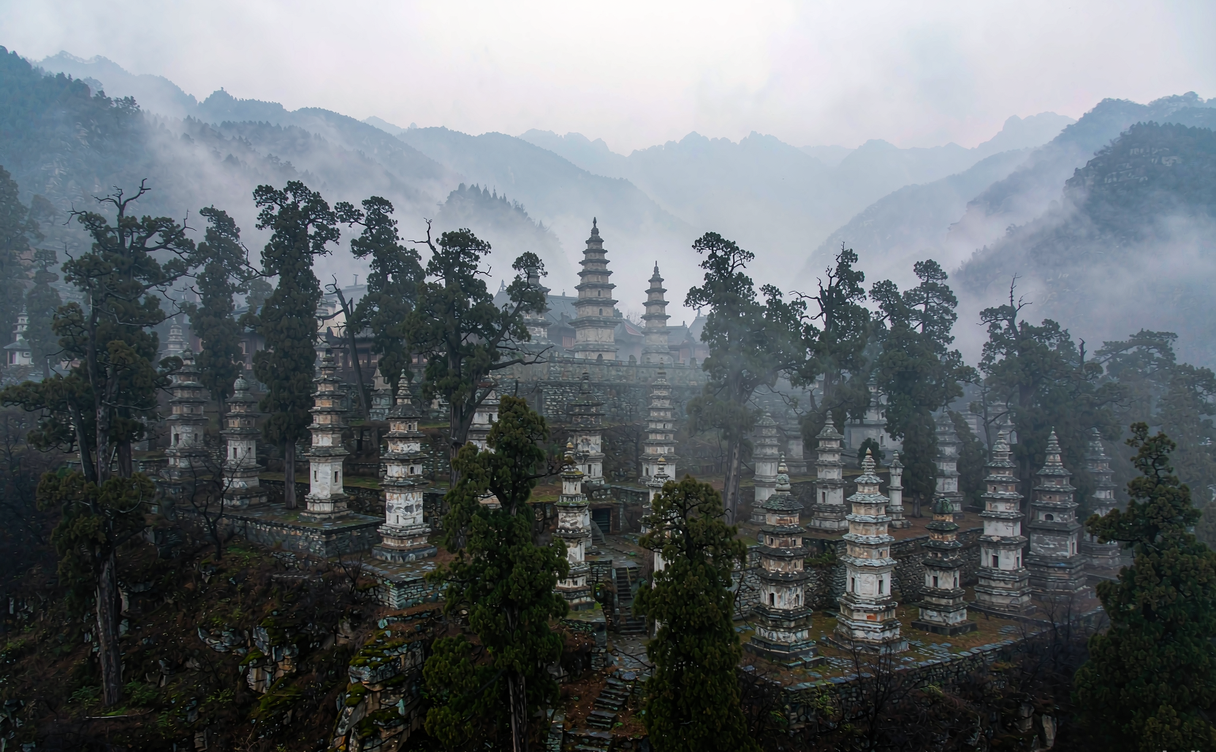
The headline sight is the Shaolin Temple, at the foot of the Shaoshi range. The ¥80 through-ticket covers the temple hall, the Pagoda Forest (the largest collection of Buddhist stupas in China, with more than 240 masonry towers), and the regular kung fu demonstration in the martial arts hall. Things to do at Songshan extend well beyond Shaolin, though. The Songyang Academy, one of the four great academies of classical China, sits against the Taishi slope and charges ¥30. The Zhongyue Temple, the most complete Taoist complex in the Central Plains, is ¥30. And the Gaocheng Astronomical Observatory, built in the 13th century under astronomer Guo Shoujing, is the oldest surviving observatory in China — a quiet, often-empty stop that we love recommending to travelers who have already done the busy temple circuit.
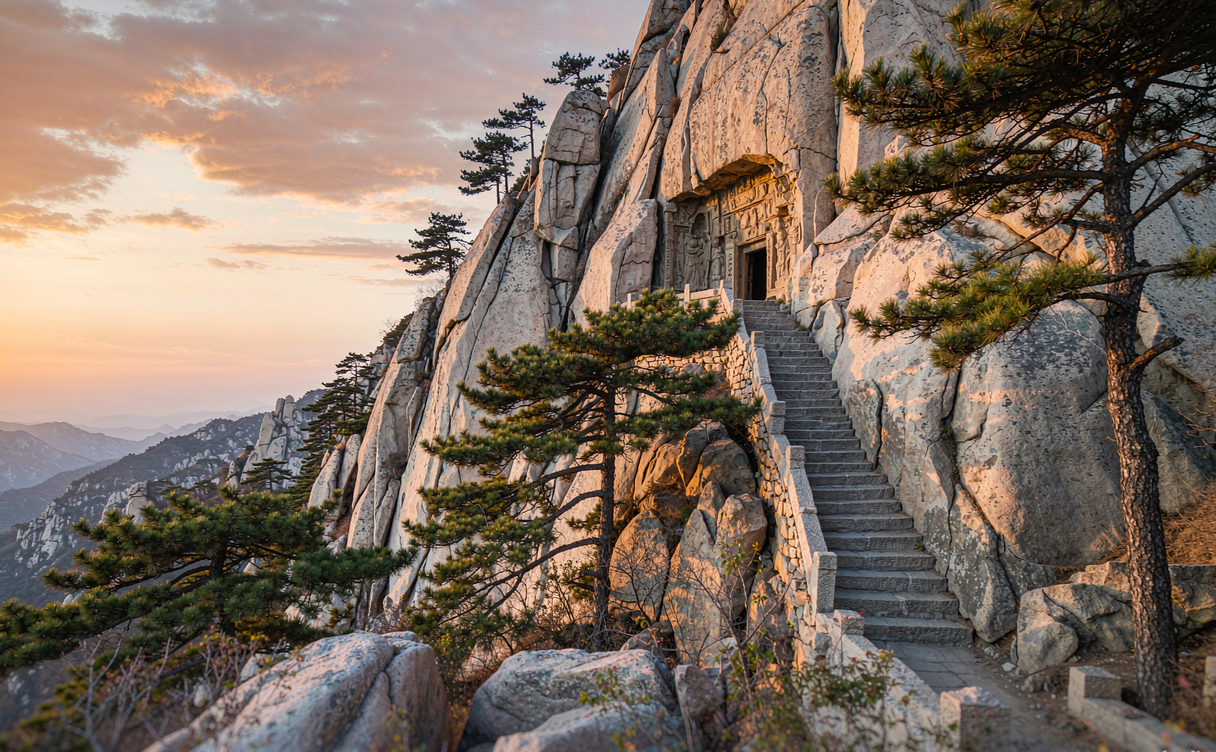
Up the Shaoshi slope you can also walk to the Dharma Cave (达摩洞), where the Indian monk Bodhidharma is said to have faced a wall and meditated for nine years. It is a steep twenty-minute climb above the temple, usually missed by tour groups, and the view back over the monastery roofs is one of the best on the mountain.
Hiking the trails
Songshan hiking trails are the underrated part of any visit. The Taishi range has a well-graded path from the Zhongyue Temple area up to Junji Peak. A fit walker can make the climb in about three to four hours one way; most people take the cable car partway. The Taishi cable car runs from near the base to Zhongyue Summit, with a one-way fare around ¥60 and a round trip near ¥110. From the upper station it is a further 40-minute walk along a stone ridge to Junji Peak itself. The Shaoshi side is gentler and is really about temple visits rather than summiting. If you want a full day on foot, plan the Taishi ascent for the morning when the light is clean and the tour groups have not yet filled the path. Bring water and a windbreaker even in summer — the summit catches a real breeze.
Best time to visit
The best time to visit Songshan is April to May and again September to October. Spring brings new green on the terraces and moderate temperatures around 15–22°C. Autumn is our favorite: the light is crisp, the skies are clear, and the mountain reads as a clean silhouette rather than a hazy blur. Summer (June–August) is hot and can be smoggy in the valley, though the peaks stay cooler. Winter is cold and occasionally snowed in, which closes some upper trails, but the temples against bare branches are genuinely photogenic and the crowds vanish. We schedule most of our group trips for late September, when the grain harvest in the plain below turns the valleys gold.
Tickets, budget, and insider tips
Entry to the Shaolin Scenic Area is ¥80 per person. Songyang Academy and Zhongyue Temple are ¥30 each, and a combined mountain pass that bundles several Taishi sites runs around ¥100. Cable cars are extra. Budget ¥200–300 per person for a full day including transport inside the area, and a little more if you hire a private car from Luoyang or Zhengzhou.
A few things we’ve learned guiding people here. First, arrive at the Shaolin gate before 8 a.m. — the kung fu demo and the Pagoda Forest are peaceful then, and by 10 a.m. the coaches unload. Second, the Pagoda Forest is a working monastic cemetery; keep your voice down and don’t climb the stupas. Third, if you only have one day and want both Luoyang and Songshan, do the Longmen Grottoes early, drive to Dengfeng for a late lunch, and see Shaolin in the afternoon light. For overnight stays, the best hotels in Luoyang give you a comfortable base, or you can stay in Dengfeng itself for early access.
One more note for history buffs: the Dengfeng monuments are recognized by UNESCO as a single World Heritage property, which is why a single mountain holds an observatory, an academy, two temples, and the birthplace of Chan Buddhism all at once. If your route continues east, the Zhengzhou travel guide and the Kaifeng travel guide both sit a short hop from Dengfeng and round out a classic Henan loop.
When it comes to food, Dengfeng is humble but satisfying. The local bowl of Henan huimian (烩面), a thick wheat-noodle soup with lamb broth, costs ¥15–20 and refuels a hiker fast. Several vegetarian restaurants near the Shaolin gate serve imitation-meat banquets built on temple recipes — try the “mock duck” made from soy and mushroom. None of it is fancy, and that is exactly the point after a long day on the ridge.
A sensible two-day plan
If you can spare two days, we suggest splitting the mountain by range. Day one covers the Shaoshi side: Shaolin Temple, the Pagoda Forest, the kung fu demo, and the Dharma Cave, finishing with a vegetarian dinner in town. Day two is the Taishi climb to Junji Peak via the cable car, with the Songyang Academy and Zhongyue Temple on the way down, and the Gaocheng Observatory as a quiet final stop before the bus back to Zhengzhou or Luoyang. This split keeps each day under five hours of exertion and avoids the midday heat in summer. It also means you see both the martial and the scholarly faces of Songshan, which is the whole point of coming here in the first place.
Buy your Shaolin through-ticket online the night before to skip the worst of the morning queue.
Start the Taishi climb before 8 a.m. to have the ridge trail mostly to yourself.
Pair Songshan with the Longmen Grottoes in one loop and sleep in Dengfeng, not the big cities.