

Shaoxing is the city that ferments. An hour south of Hangzhou, it is the home of Chinese yellow wine (黄酒, huangjiu), the mellow, amber drink that has seasoned this region’s food for two thousand years. On our last visit we walked Anchang Ancient Town (安昌古镇) in early winter as families hung rows of sausage and duck to cure in the cold, then warmed a cup of ten-year wine by a canal-side stove. This Shaoxing food guide comes from trips like that, and from the travelers we have sent here to eat slowly between the water towns.
Why Shaoxing tastes of wine
Almost every savory dish in Shaoxing is touched by its own wine. Chicken is drunk in it (醉鸡, zuiji), duck is salted and sauced, pork is braised with preserved mustard greens that were themselves softened by the local liquor. The wine is not just a drink but a pantry staple, the way vinegar is in Shanxi or soy is in Guangdong. To learn what to eat in Shaoxing is to learn how a single fermentation flavors a whole region.
If you are planning a wider food journey, Shaoxing is the mellow, river-town counterpoint to Hangzhou’s lake cuisine and Shanghai’s rush, and it sits a short train ride from both. Our Zhejiang cuisine guide places Shaoxing inside the broader provincial style for travelers who want the full picture, which makes the wine-forward dishes easier to place.
Yellow wine: the local soul
Shaoxing yellow wine is made from fermented rice, not grapes, and aged in urns for years. The famous names are nu’er hong (女儿红, “daughter’s red,” traditionally buried at a girl’s birth), hua diao (花雕, “flower carved,” the carved-urn premium grade) and jia fan (加饭, “added rice,” a richer brew). A small cup at a tavern runs RMB 10 to 30 (USD 1 to 4); a labeled bottle of six-year wine is RMB 40 to 80 (USD 6 to 11). We have sent travelers to the warehouses on the town edge where you can taste three ages side by side and feel the spirit round out as it ages.
Drink it warm in winter, cool in summer, and cook with it year-round. The best food in Shaoxing for a first-timer is a tavern stop: a cup of warm wine, a plate of fennel beans, and an hour by the water, because that single habit explains more about the local table than any banquet.
Stinky tofu and the snacks worth the smell
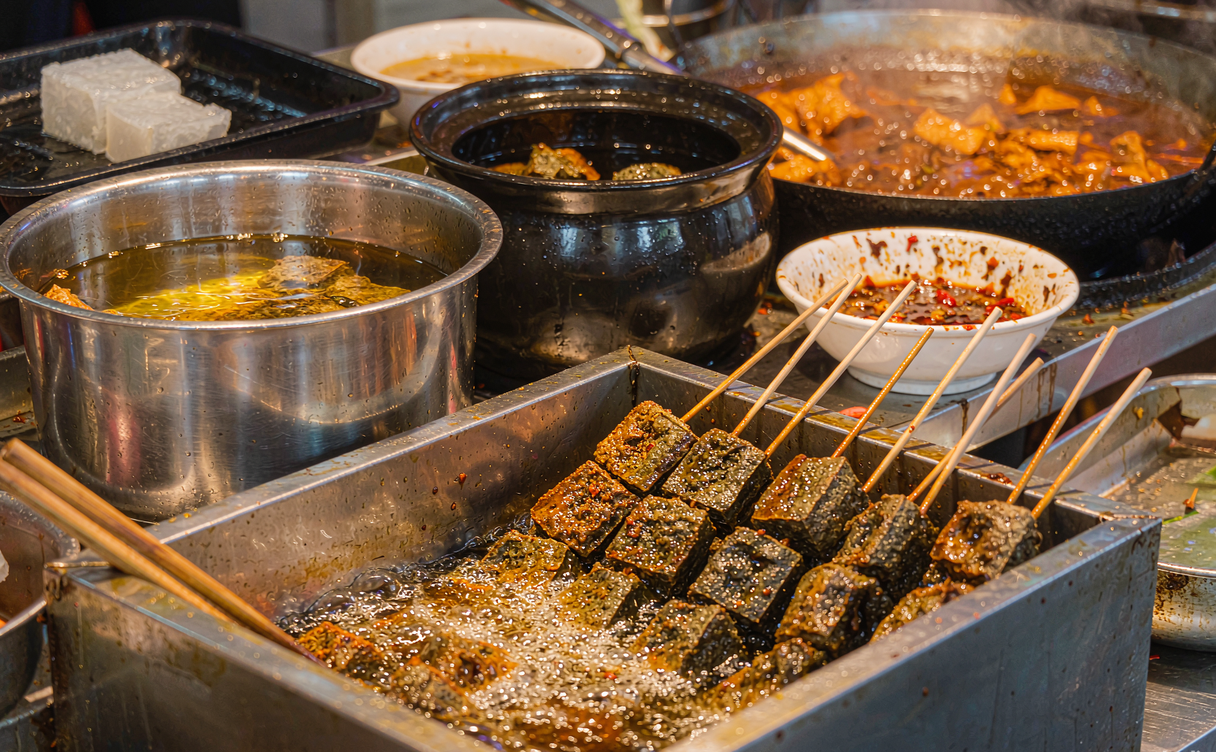
Shaoxing stinky tofu (臭豆腐, chou doufu) is the city’s loudest calling card, fried until the crust is shatter-crisp and the inside stays creamy, then brushed with chili and soy. A paper cone of it costs RMB 5 to 10 (USD 1 to 2) at the night stalls near Lu Xun Native Place (鲁迅故里). The smell is stronger than the taste, and we warn travelers that the first bite is the hardest; almost everyone comes back for a second.
Alongside it, the water-town snacks are gentler. Fennel beans (茴香豆, huixiang dou) are the legume made famous by Lu Xun’s story “Kong Yiji,” salty and anise-scented, RMB 8 to 12 (USD 1 to 2) a bag. Steamed buns, rice cakes and sweet soybean milk fill the morning stalls, and a full graze across a street costs under RMB 40 (USD 6). The contrast between the stink and the gentleness is the real character of Shaoxing food.
Preserved and braised classics
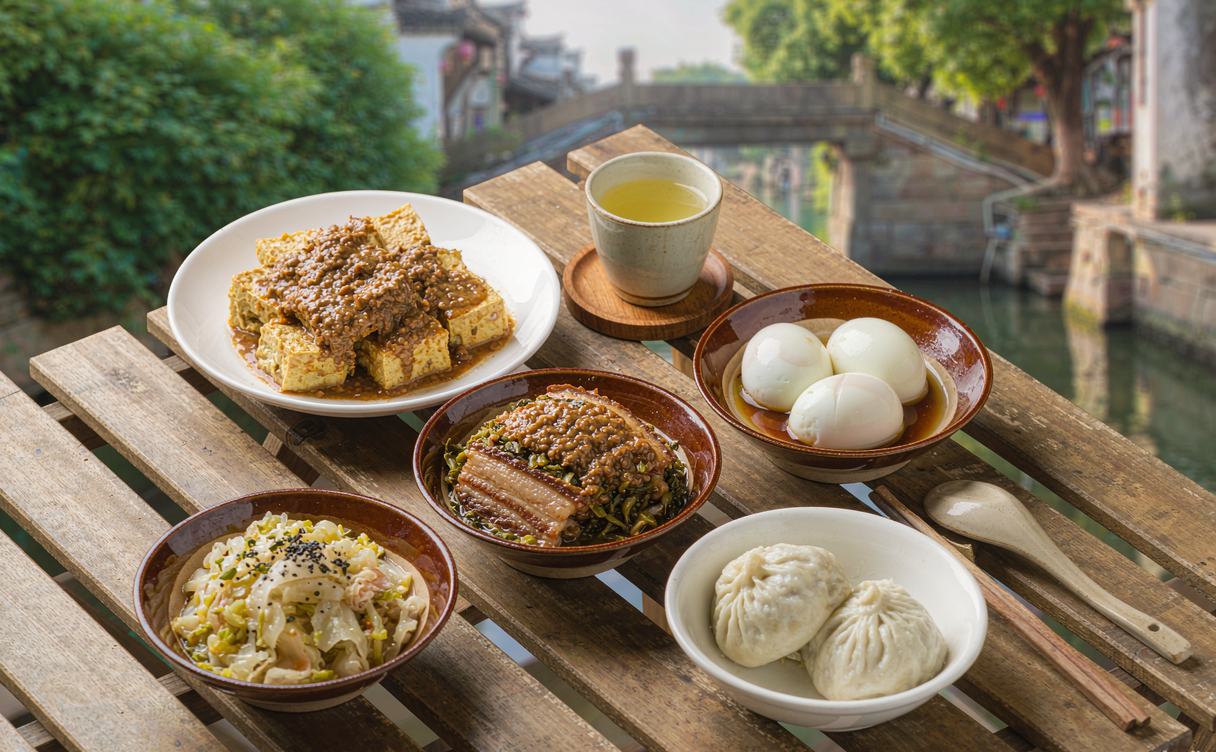
The deeper Shaoxing table, and Shaoxing cuisine as a whole, is built on preservation. Meigan cai (梅干菜, preserved mustard greens) is the signature, steamed under pork belly (梅干菜扣肉, meigan cai kou rou) until the fat turns glassy and the greens are sweet and dark. A clay-pot version is RMB 48 to 78 (USD 7 to 11). Drunken chicken (醉鸡) is poached, cooled and bathed in wine, served cold and fragrant, RMB 38 to 58 (USD 5 to 8). Sauced duck (酱鸭, jiang ya) is hung to dry and eaten in slices, and Xishi tofu (西施豆腐), named for the famous beauty from nearby Zhuji, is a soft, wine-brightened braise.
Anchang Ancient Town is the place to see these foods made. Its sausage (安昌腊肠, anchang lacang) is lean, sweet and lightly smoked, sold by the string for RMB 30 to 50 (USD 4 to 7) a foot, and the town’s rice wine shops will fill a bottle while you watch. We route travelers here in late autumn, when the curing is at its peak and the canal air smells of smoke and ferment, which is the season the food was built for.
Best seasons and timing
Autumn, October to November, is the best window: the Yellow Wine Festival fills the city, the weather is soft, and the preserving begins. Spring, March to May, is the second choice, green and mild along the canals. We check the season before booking, because Shaoxing’s food is seasonal and the water towns are loveliest outside the summer heat, and a few weeks changes both the sausage and the crowd.
Getting there
Shaoxing is about 20 to 30 minutes by high-speed rail from Hangzhou and roughly 1.5 hours from Shanghai, which makes it an easy half-day or overnight stop. For tickets and onboard snacks, our China high-speed train guide for foreigners covers the practicalities. We often pair it with Hangzhou on a single lake-and-town route, because the two cities show Zhejiang’s two moods within an hour of each other, and the contrast is the whole point of the visit.
Where we send people
The best restaurants in Shaoxing for a first visit are the canal-side taverns for wine and drunken chicken, then the night stalls for stinky tofu and fennel beans, which we book in sequence. The next day we take travelers out to Anchang for sausages and a warehouse tasting. That combination covers the city’s sweet, sour and smoked registers without repeating a flavor. We avoid the big hotel banquet rooms and use family places where the wine is poured from a crock, not a bottle, because the crock is the proof of age.
A sample eating day
We suggest this rhythm to newcomers. Morning: a tavern cup of warm wine and a plate of fennel beans by the canal. Late morning: train or drive to Anchang and watch the sausage curing. Lunch: drunken chicken and meigan cai pork at a town table. Afternoon: a warehouse tasting of three wine ages. Dinner: stinky tofu and skewers near Lu Xun Native Place. It is slow by design, and it lets the fermentation thread tie the day together.
Background and authority
For the history of the city’s brewing and canals, the Wikipedia entry on Shaoxing gives a clear, neutral overview we share with travelers who want context before they eat, and it explains why the wine and the water town grew up together.
Final bites
Shaoxing is a slow city that asks you to slow with it. Buy a foot of sausage, warm a cup of ten-year wine, and let the stink of the tofu become the point rather than the obstacle. Eat here and Zhejiang stops being a list of dishes and becomes a place with a smell and a season, which is the rarest thing a food city can give you.