

There is a moment on the road from Shegar to the Everest region of Tibet, China, when the Himalayas suddenly line up like teeth, and at the end of that road sits the highest monastery on Earth. This Rongbuk Monastery guide is for the travelers who told us they came to China to stand under Mount Everest — because Rongbuk, at roughly 5,150 meters, is the closest a vehicle can bring you to the mountain’s north face, and the views from its prayer-flag ridge are the ones you see in every postcard. We have sent dozens of travelers up here, and even the most jaded ones go quiet when the clouds lift.
Rongbuk Monastery Tibet is a small, weathered cluster of stone buildings, founded in the early 20th century as a nunnery and later a monk monastery of the Nyingma tradition. It is not grand like the Potala, but its setting is unmatched: a high desert basin ringed by peaks, with the Rongbuk Glacier spilling down toward the monastery and Everest filling the northern horizon. For the wider context of a plateau trip, our China first-timer travel guide explains how to build Everest into a national itinerary safely.
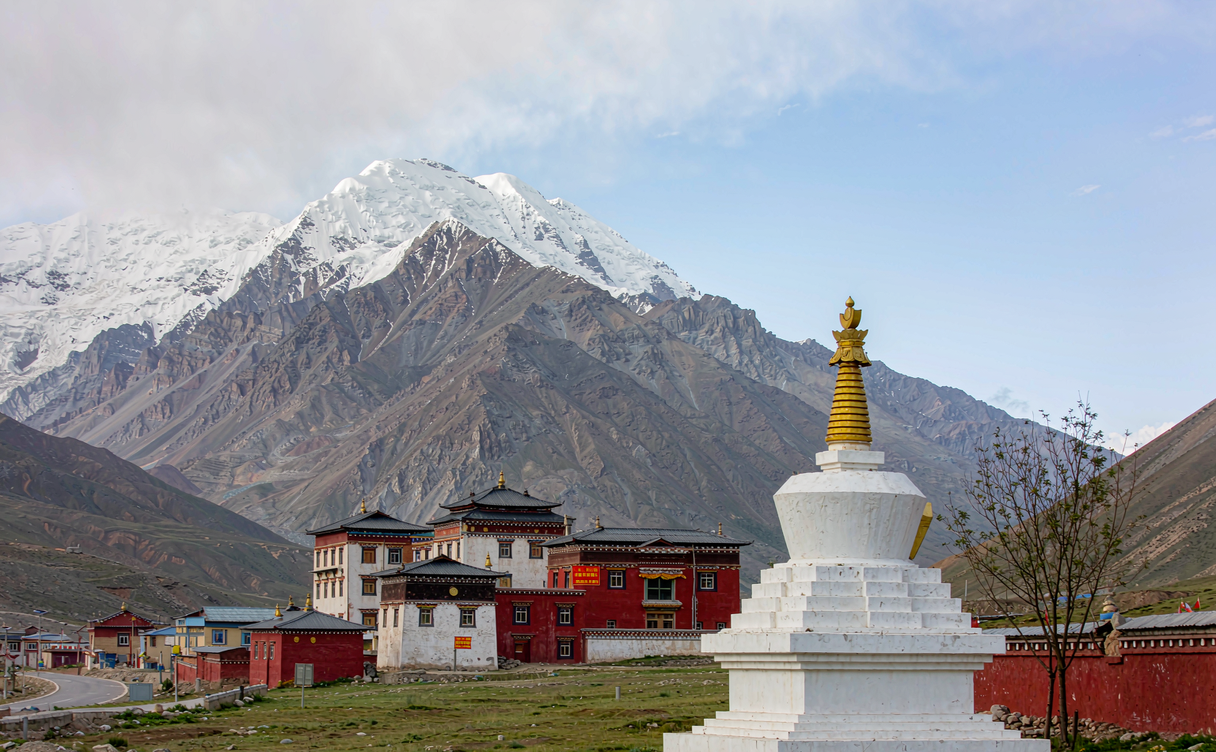
Things to do at Rongbuk Monastery
The best things to do at Rongbuk Monastery are quiet and slow, because at this altitude exertion is expensive. Start with the short walk from the parking area to the monastery’s main hall, where you can watch the nuns and monks chant at dawn — the sound carries strangely far in the thin air. Then walk the kora, the clockwise pilgrim circuit, lined with mani stones and fluttering prayer flags; it takes about 20 minutes and ends at a ridge with the classic Everest photo frame. Many travelers combine the monastery with the Rongbuk Everest base camp, a further 8 kilometers by shuttle bus (or a stiff walk) to the official marker at 5,200 meters.
We always tell our groups to spend the night at the monastery guesthouse or the nearby tent camp rather than rushing back to Shegar. The sunset on Everest is spectacular, but the real prize is the pre-dawn alpenglow, when the summit turns from grey to pink to gold. Bring a headlamp and warm layers — at 5,150 meters the dawn temperature can sit at -5°C even in August. For more ideas on what to pair with the high country, our best things to do in China overview lists plateau and non-plateau experiences side by side.
Best time to visit Rongbuk
The best time to visit Rongbuk is April to early June and September to October. These windows give the clearest chance of an unobstructed Everest view, with dry roads and daytime highs around 5–12°C at the monastery. July and August are the monsoon-influenced months; clouds often hide the summit by midday, though mornings can still be clear. Winter (November–March) is brutally cold — nights plunge below -20°C — but the air is crystalline and the crowds vanish; the access road, however, can close on the high passes after snow.
Timing also collides with permits. The Tibet Travel Permit and the additional Everest border permit are harder to arrange during the Losar (Tibetan New Year) closure each spring, when the whole region shuts to foreign visitors for about two weeks. Our best time to visit China guide lines up these plateau constraints against the rest of the country so you can schedule around them. I personally send most travelers in late September: the monsoon has retreated, the air is sharp, and the barley harvest is finishing in the valleys below.
How to get to Rongbuk
Figuring out how to get to Rongbuk begins in Lhasa or Shigatse, Tibet, China. Most foreign visitors travel by private 4WD with a guide, a roughly 10- to 12-hour drive from Lhasa via the Yamdrok Lake and Gyantse route, or a shorter run from Shigatse. From the Shegar checkpoint you climb to the Pang La pass (roughly 5,150 meters) for a panorama of the Himalaya range, then descend to the Rongbuk turnoff. A shuttle bus runs the final stretch from the tourist center to the monastery and on to the Rongbuk Everest base camp, included in the scenic-area ticket.
Remember the golden rule for this region: foreign travelers cannot self-drive or travel independently in Tibet, China. You must book through a registered operator who arranges the Tibet Permit and the Everest border permit together; budget RMB 200–400 in administrative fees plus the guide and vehicle. For reaching the plateau gateway by rail first, our foreigner high-speed train guide covers the mainland network that feeds the route into Lhasa, Tibet, China.
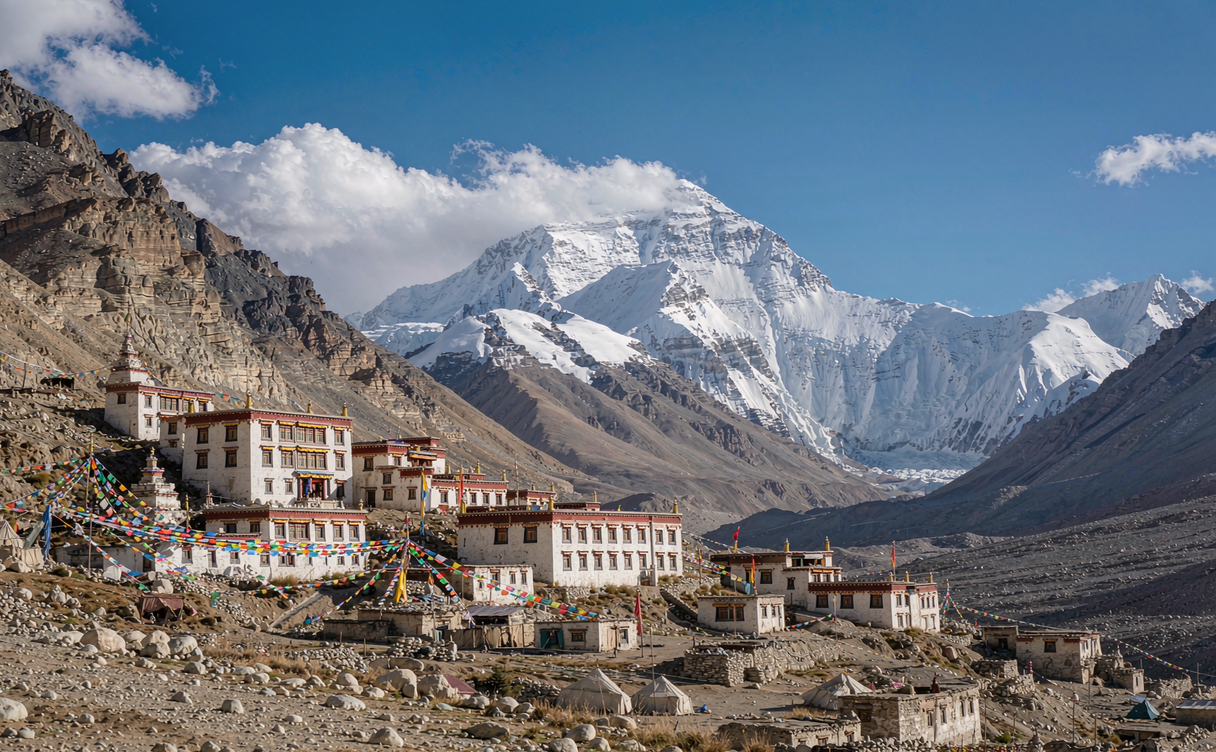
Rongbuk Monastery Tibet and the Everest story
Putting Rongbuk Monastery Tibet in perspective: the monastery was the launching point for early 20th-century expeditions attempting the north face, and the abbot of the day famously blessed climbers heading for the summit. That history gives Rongbuk a unique place in mountaineering lore. For the well-sourced background, the Rongbuk Monastery entry on Wikipedia is a reliable read before you go, with notes on its founders and the climbing connection.
The Rongbuk Everest base camp itself is a collection of tent lodges in season and a stone monument marking the altitude; standing there, you are closer to the summit than any airport or city in the world. We have watched travelers cry at the scale of it, and others simply sit in silence for an hour. That stillness is the real product here — not the photo, but the quiet. If you enjoy this kind of frontier history, our Xinjiang, China travel guide explores another remote, Silk Road–era landscape where the mountains tell equally old stories.
Staying overnight and what it costs
Accommodation at Rongbuk is basic: the monastery guesthouse and the seasonal tent camp offer RMB 100–300 per bed in unheated rooms or shared tents, with communal squat toilets and no shower. The cold is the headline — pack a -10°C sleeping bag liner and thermal layers even in summer. Meals are limited and pricey for the portion: a bowl of noodle soup runs RMB 35–60, and the tent camp sometimes offers simple Tibetan bread and butter tea. Carry plenty of RMB cash; card and phone payment are unreliable this far up.
Entry to the Everest scenic area costs around RMB 180 plus the shuttle bus, and your operator folds the permits into the tour price, which for an Everest-inclusive circuit typically runs RMB 5,000–9,000 per person for a guided week from Lhasa, Tibet, China. That premium buys the permits, the driver, the guide, and the logistics of keeping you safe at altitude.
Our honest take
This Rongbuk Monastery guide would be incomplete without the altitude warning. At 5,150 meters, many travelers feel headaches, breathlessness, and poor sleep. The smart move is to acclimatize with two nights in Lhasa, Tibet, China and a night in Shigatse (3,800 meters) before climbing higher, and to ascend gradually. Our guides carry oxygen and a basic medical kit, and we turn back anyone whose symptoms worsen. Everest is not going anywhere — there is no prize for pushing through altitude sickness.
I still remember a traveler from our group who had climbed mountains on four continents but had never been this high. At the Rongbuk Everest base camp marker he just laughed and said, “I drove to the top of the world.” That is the peculiar gift of Rongbuk: it hands you a summit experience without the climb, and the monastery at your back reminds you that people have worshipped this mountain for centuries longer than they have tried to stand on it.
For travelers who want to balance the cold, thin-air drama with warmer, walkable heritage, our best ancient towns in China guide is the counterweight we recommend — places like Lijiang and Fenghuang, China where the altitude is friendly and the streets are alive. Rongbuk is the exhale; those towns are the breath back in.
One closing logistics note: the road and the weather decide everything at Rongbuk, so build a buffer day into your Everest plan in case snow closes the pass or clouds hide the peak. Patience is the cheapest insurance on the roof of the world. For the seasonal detail we hand every traveler, our best time to visit China guide remains the single best prep before you book the flight to Lhasa, Tibet, China.