

Reed Flute Cave sits about five kilometers northwest of central Guilin, tucked into the foot of Bright Hill (Guangming Shan) in Guangxi, China. We’ve sent dozens of travelers here as a half-day add-on to a Li River trip, and almost every one comes out wide-eyed. The cave earns its nickname, “the Palace of Natural Arts,” honestly: a roughly 500-meter boardwalk winds past stalactites, stone curtains, and columns lit in shifting reds, blues, and greens. This Reed Flute Cave guide pulls together what we tell our own clients before they go — real prices, how the visit actually flows, and the small mistakes that waste time.
The name starts with the reeds. Tall reed grass grows thick around the entrance, and locals traditionally cut it to make flutes — hence “Reed Flute.” Inside, the scale is what surprises people. The main chamber soars to roughly 14 meters in places, and the formations have been building for millions of years as calcium-rich water dripped and evaporated. Tang dynasty visitors scratched poems into the rock as early as 792 AD; you can still see a few near the entrance. The cave was known locally for centuries but only developed for tourism in the early 1960s, opening to the public in 1962.
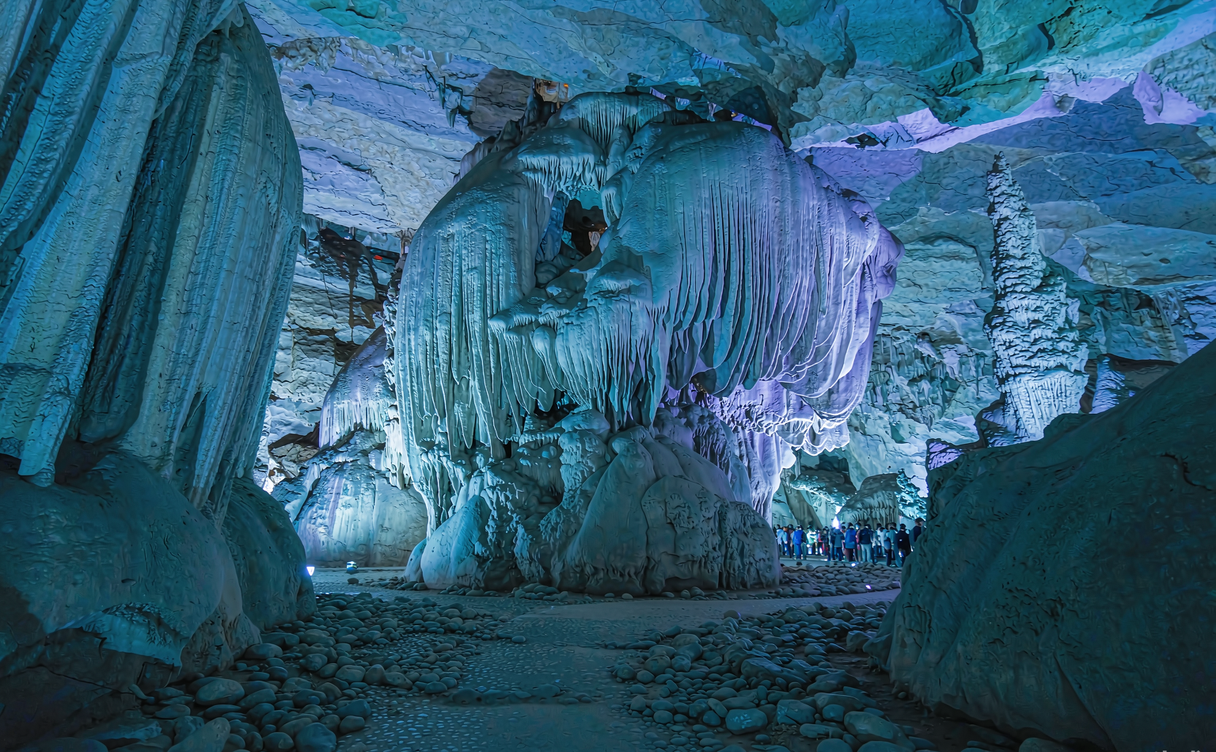
What you are really buying is the light show. Colored uplights turn a plain limestone pillar into something that reads as a castle, a waterfall frozen mid-fall, or a forest of crystal trees. It is theatrical, and in our experience the theatrical part is exactly what families and first-time cave visitors love. If you are a purist who wants raw, unlit geology, manage expectations — this is a dressed-up spectacle, not a wilderness expedition.
Tickets, hours, and what it costs
As of the 2026 season the standard adult ticket is 90 RMB, charged year-round. Children under 1.2 meters enter free, and there is a modest discount for students with a valid ID (bring the physical card; a photo on your phone is often refused). The site opens at 8:00 and the last entry is usually around 17:30, though on busy summer weekends they stretch closing later. There is no separate audio-guide fee if you join a group, but independent travelers can rent a handheld recorder for about 30 RMB, or simply follow the free bilingual signs.
Plan on 60 to 90 minutes inside. The route is one-way and there is no shortcut back, so use the restroom before you enter. Inside, the temperature holds steady near 19°C — a genuine relief in Guilin’s humid summer, and a light jacket is worth packing if you chill easily. Photography is allowed without flash, and the low light is manageable on modern phones; a small tripod is fussy given the moving crowds, so we suggest handheld shots near the railings where the colored pools sit still.
How to get to Reed Flute Cave
The cave is an easy hop from the city. Public bus 3 runs from downtown Guilin past the entrance, and a ride costs 2 RMB; the catch is that the stop leaves you with a 10-minute walk and buses are slow in rush hour. Most of our clients just take a taxi or Didi from Guilin’s city center, which runs 25–35 RMB and takes 20 minutes in light traffic. From Guilin North Railway Station budget closer to 40 RMB; from the older Guilin Railway Station it is about 30 RMB.
If you are basing in Yangshuo, the cave still works as a Guilin-side stop: take the high-speed train or bus to Guilin, then taxi out. We do not recommend trying to do Reed Flute Cave and a full Li River cruise on the same tight day — the logistics get stressful. A cleaner Reed Flute Cave itinerary pairs it with Elephant Trunk Hill and Seven Star Park on a single Guilin city day, which keeps walking manageable and leaves the evening free for the riverside light show. Our Guangxi 7-day itinerary shows how to thread Guilin, the cave, and Yangshuo into one loop without backtracking.
Things to do at Reed Flute Cave
Beyond the obvious walk-through, a few specifics make the visit better:
- Pause at the “Crystal Palace” chamber. This is the widest room and the one most postcards are shot in. Stand near the back railing for the cleanest sightline past the colored pools.
- Look for the Tang poems. Just past the entrance on the left wall, faded carved characters mark that people admired this place over 1,200 years ago.
- Time your entry. Guides shepherd groups in waves. If you enter right after a big group, hang back two minutes and you will have the next stretch nearly to yourself.
- Walk the hill above. A short stair climb from the exit gives you a city-and-karst panorama that is free with your ticket and far less crowded than the cave photos suggest.
Best time to visit Reed Flute Cave
Because it is an indoor cave, the best time to visit Reed Flute Cave is less about weather and more about crowds. Guilin’s peak tourist season runs April through November, and within that window national holidays (May 1–5, the first week of October) are brutal — expect 45-minute queues at the gate. We steer clients toward late March, April, or September, when the light rain keeps the karst misty and the lines short. Winter is the quietest and cheapest, with cool dry days; the cave’s constant temperature makes it a good bad-weather backup activity year-round. If you are still deciding when to travel at all, the best time to visit China overview breaks the country down by season and is genuinely useful for juggling multiple provinces.
Food and logistics nearby
You will not eat inside the cave, but the entrance plaza has a handful of noodle and rice stands with mains around 15–25 RMB. For something more deliberate, Guilin’s beer fish and rice noodles are the local signatures, and our Guangxi cuisine guide maps the dishes worth chasing across the region. Guilin rice noodles in particular are a breakfast ritual: a bowl of springy noodles under a spoon of fried pork, pickles, and chili oil, eaten standing at a corner shop for about 7 RMB. It is the cheapest, most authentic meal you will have in the city, and a good antidote to the tourist pricing at the cave plaza.
Practical tips we give every client
- Go early or late. First entry at 8:00 and the 15:00–16:30 window are the calmest. Midday tour buses pile in.
- Wear grippy shoes. The boardwalk is tiled and can be slick where condensation pools; flip-flops are a regret.
- Bring a light layer. 19°C feels cold after a humid 33°C Guilin afternoon.
- Photograph without flash. Flash kills the colored lighting and annoys everyone behind you; modern phones handle the low light fine.
- Skip the “extra” side chambers if a tout points you to a private cave nearby — they are usually paid add-ons with little to show.
Reed Flute Cave is not the wildest geology in China, but as a polished, air-conditioned, 90-minute spectacle it is one of the easiest wins near Guilin, and a reliable pick even when the weather turns. A good China travel guide for first-timers will tell you the same thing: build your route around a few sure-thing sights like this one, then leave room for the unplanned wanders that end up as the best stories.
For background on the formation and history, the Reed Flute Cave page on Wikipedia is a useful pre-read.