

Most visitors land in Guiyang for the waterfalls and the Miao villages and skip the old town on the city’s doorstep. A good Qingyan ancient town guide makes the case for a half-day there, because Qingyan (青岩) is one of Guizhou’s best-preserved walled towns—Ming-dynasty stone ramparts, narrow lanes of grey flagstone, and a snack street that is genuinely worth the trip. We have sent layover travelers here who had only one free afternoon in Guizhou and came back full of rose-sugar cake and photos of the south gate tower.
Qingyan lies about 30 kilometers south of Guiyang in Huaxi District, built in a basin where two small rivers meet. It was founded in 1378 as a military garrison town during the Ming dynasty, and the grid of lanes, the four stone gates, and the outer wall date from that era. What sets it apart from the polished ancient towns elsewhere is that it is still a working town—people live, cook, and trade inside the walls—so the food scene is real rather than a museum. In our experience the snacks alone justify the visit.
How to Get to Qingyan from Guiyang
The practical question is how to get to Qingyan from Guiyang, and the answer is easy: the town is close and well connected. The simplest route is the metro. Take Guiyang Metro Line 3 to its southern terminus, then a short taxi or bus the final few kilometers to the east gate—total about 70 to 90 minutes from the city center for around 10 to 20 RMB. Alternatively, buses run from Guiyang’s Jinyang and riverside stations to Qingyan in about 1 to 1.5 hours for 15 to 25 RMB. A private car or Didi from central Guiyang is 40 to 70 RMB and takes roughly 45 minutes in light traffic.
We usually tell first-timers to take the metro-plus-taxi combo: it is cheap, avoids Guiyang’s traffic, and drops you right at a gate. For the wider regional picture, our Guiyang travel guide shows how Qingyan fits into a Guizhou base, and our China night markets guide explains the snack culture you will meet inside the walls.
Qingyan Ancient Town Tickets
The Qingyan ancient town tickets come in two forms. Entry to the walled town itself is free to walk—you can enter the lanes and eat without paying. The paid ticket (around 10 to 60 RMB depending on season and whether it bundles the small temples and the wall walk) covers the sights inside: the Zhuangyuan mansion, the Catholic and Buddhist temples, the Han and Yi ancestral halls, and the chance to climb a section of the restored rampart. A through ticket that includes the wall-top walk is the better value if you want the views; buy it at the gate or on the official mini-program.
We tell travelers to buy the combined ticket if it is your first visit, because the south gate tower and the wall walk are the best photo spots, and the small museums explain the garrison history. Keep the paper ticket—staff check it at a couple of the inner gates.
Best Time to Visit Qingyan Ancient Town
The best time to visit Qingyan ancient town is spring (March to May) and autumn (September to November), when Guizhou’s weather is mild (18 to 25°C) and the lanes are comfortable for walking. Summer is warm and humid with afternoon showers, but the town has shade and the snack stalls are at their fullest. Winter is cool and quiet, good for photos without crowds, with daytime highs around 8 to 12°C.
We favor a weekday morning in April or October. The light on the grey stone is soft, the rose-sugar makers are at their stalls early, and you beat both the heat and the tour buses. Avoid the May and October holiday weeks, when the narrow lanes get congested.
Qingyan Old Town Walking Route
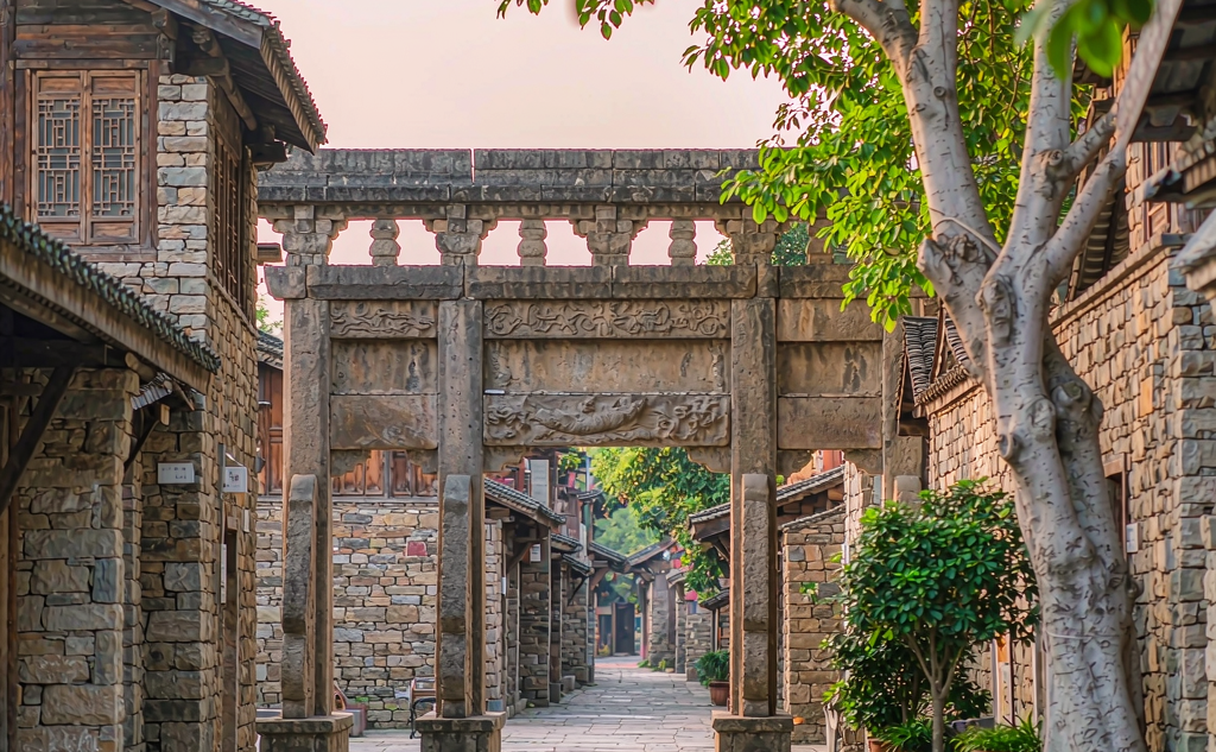
A sensible Qingyan old town walking route starts at the south gate, climbs the tower for a wall overview, then drops into the main flagstone lane past the Zhuangyuan mansion and the temples, cuts through the snack street, and exits at the east gate by the small river. That loop is about 1.5 to 2 kilometers and takes two to three hours with stops. The stone is uneven, so wear flat shoes.
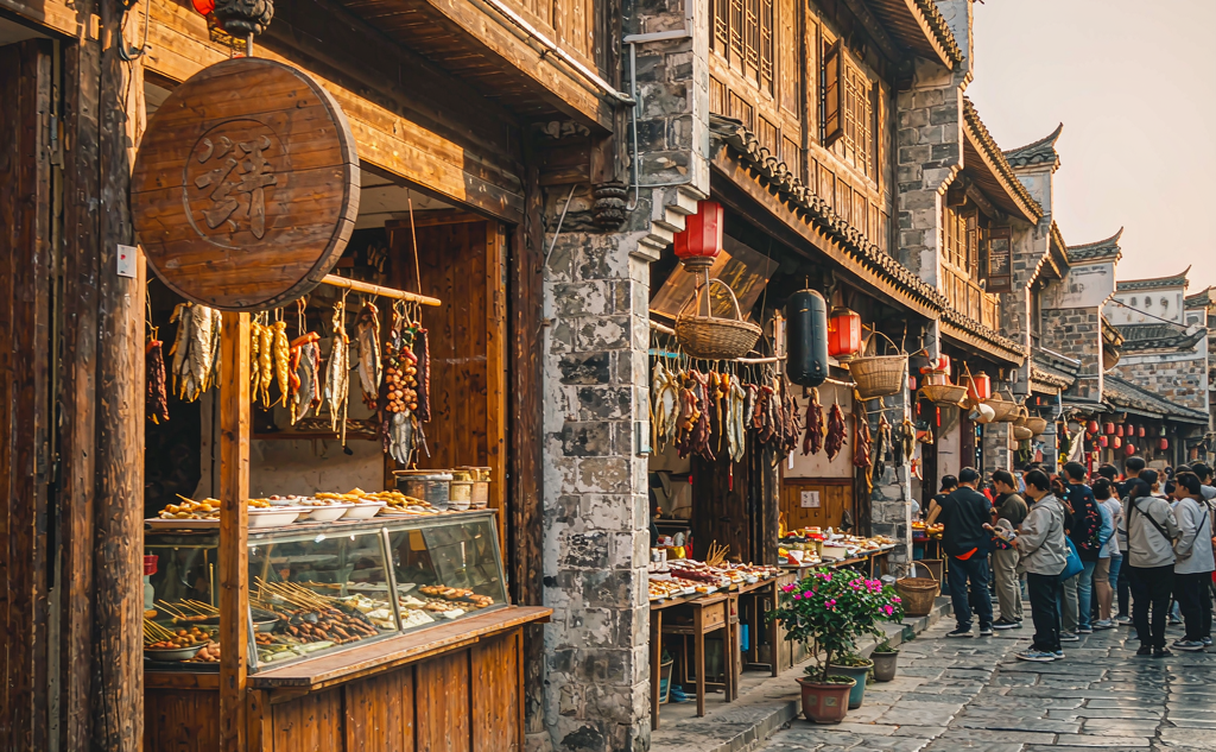
The snack street is the soul of the place. The Qingyan rose sugar cake snack (玫瑰糖) is the signature: a chewy, floral candy made from rose petals, malt, and sesame, sold in slabs for about 10 to 20 RMB. Other staples include the braised pig’s trotter (青岩卤猪脚, around 25 to 40 RMB), tofu balls, and sticky rice cakes. We have watched travelers buy a slab of rose sugar at the first stall and a trotter at the last and call it the best cheap lunch in Guizhou. For a regional comparison, our Guizhou Xijiang Miao village guide covers a very different kind of Guizhou food and fabric culture two hours west.
A Suggested Qingyan Itinerary
A Qingyan itinerary is usually a half-day tagged onto Guiyang. Morning: metro down, walk the route, eat your way along the snack street, climb the wall, and back to the city for lunch. Travelers with a full day can pair it with the Huaxi wetlands or the nearby Tianhe Pool scenic area. If you want a bigger waterfall day instead, our Guizhou Huangguoshu Waterfall guide covers the province’s headline cascade a couple of hours west.
Where to Stay and What to Eat
You do not need to stay overnight—Qingyan is an easy Guiyang day trip—but a few courtyard inns inside the walls run 250 to 450 RMB for the experience of the town after dark. In the town, a snack-and-trotter lunch for two is 60 to 100 RMB; a proper sit-down Bai-Miao style dinner in Guiyang afterward is 120 to 200 RMB. Mobile payment works everywhere; carry a little cash for the oldest snack stalls.
For a broader frame, our best ancient towns in China list ranks Qingyan against restored towns like Shaxi, and our best things to do in China guide flags Guizhou’s food towns as a category of their own.
Background and Practical Notes
Qingyan’s Ming garrison past is part of the wider story of how the central plains administered the Guizhou highlands for six centuries; you can read about that longer regional history on the Wikipedia page for Guizhou, which traces the province’s incorporation and its mix of Han, Miao, and Bouyei cultures. Inside the town, respect the active temples—cover shoulders at the Buddhist and Catholic sites—and do not climb the unrestored wall sections, which are fragile. The lanes are busy and the stone slick after rain, so watch your step and keep your phone handy for mobile payment at the stalls.
English signage is minimal, so have your hotel write “青岩古镇” in Chinese for the driver and download an offline map. The town is safe and small; the only real risk is overeating the rose sugar.
Is Qingyan Worth It?
A Qingyan ancient town guide should be clear that this is a half-day, not a destination in itself. But as the easiest historic town to reach from a provincial capital in Southwest China, with real snacks and a real wall, it is one of the best low-effort stops in Guizhou. If you have a free morning in Guiyang, take it.