

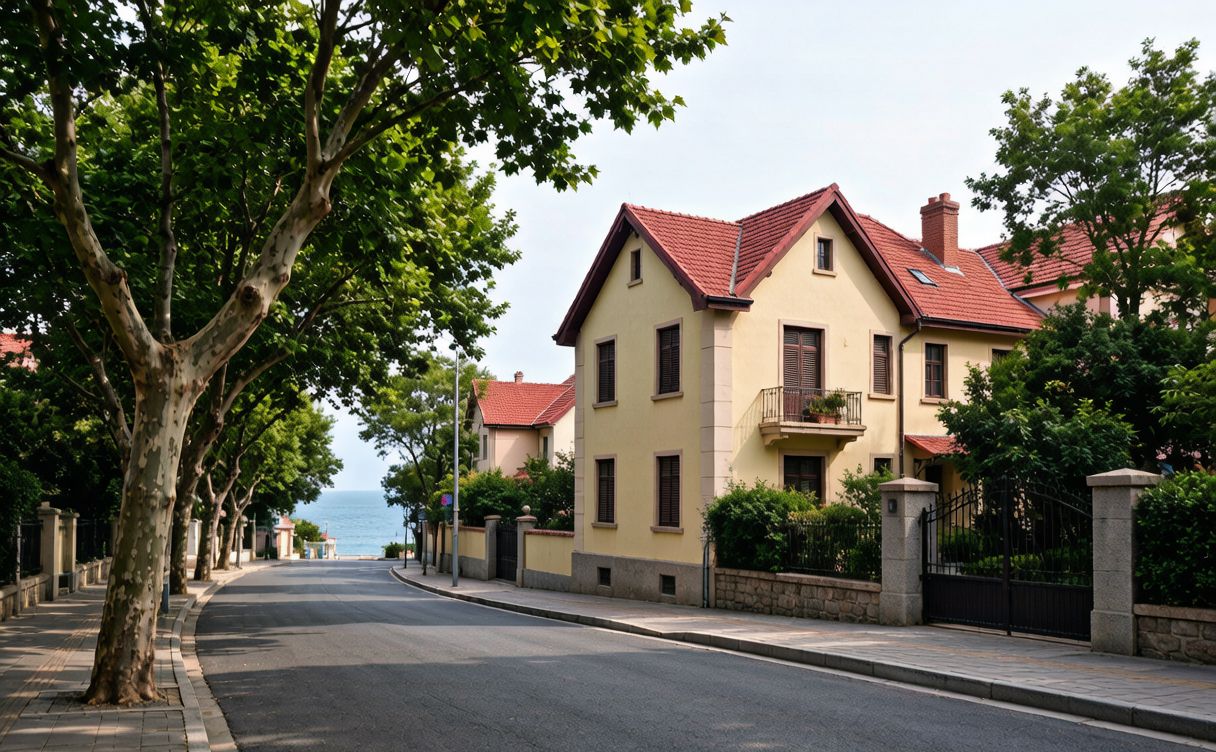
I still remember the first morning I walked into Badaguan. I had come to Qingdao for the beer and the sea, but within ten minutes of turning off the coastal road I was standing on a quiet street of pebble-dash walls, red-tiled roofs, and plane trees so tall they turned the lane into a green tunnel. Badaguan is not a single building and not a museum. It is a whole residential district on the eastern side of Qingdao, near the sea, where more than 200 old villas sit on tree-lined streets, each one built in a different national style. Locals call it the “World Architecture Expo,” and after three visits I understand why. If you are planning a trip to China’s coast, this is one of the easiest and most rewarding places to spend a slow half-day.
Getting There
Badaguan sits in the Shinan District, east of Qingdao’s old city center and right by the coastline that runs toward the Jiaozhou Bay. The simplest way I have found is to take Qingdao Metro Line 3 to Zhongshan Park Station, then walk about ten minutes southeast. The district has no hard border or gate, so you simply drift in on foot. Taxis and ride-hailing apps (Didi) will drop you near the intersection of Ningwu Pass Road and Shaoguan Road, which is a good starting point.
If you are already following our Qingdao travel guide, you will likely pair Badaguan with a walk along the nearby beaches and the Zhanqiao Pier area. I usually arrive around 9 a.m., before the tour groups, and leave by early afternoon when the light gets harsh. Bikes and shared e-scooters are common here too, but the streets are narrow and shaded, so I prefer walking.
What to See
The name Badaguan means “Eight Great Passes,” originally referring to eight streets named after ancient Chinese mountain passes. Over time the number of named lanes grew, but the nickname stuck. What you actually see is a loose grid of quiet roads, each lined with villas that look like they were shipped in from different countries.
I started at the junction of Ningwu Pass Road and looked out toward the sea. From there I wandered without a plan, which is exactly the right approach. The highlights for me were the open lawns near the Princess Lou (a Danish-style villa said to have hosted a visiting royal), the stone tower on Juyong Pass Road, and the small flower beds that change with the season. The district runs down to the water, so you can finish your walk on a rocky beach with a view back at the rooftops.
One thing I appreciate as a visitor is that most villas are still private homes or small guesthouses. You are not herded through ticket lines. You walk the public streets, peek through hedges, and read the small plaque on each building that names its architectural style and year. It feels like a living neighborhood rather than a staged attraction.
The Villa Styles
This is the part that hooked me. Badaguan was developed in the early 1900s, first under German leasing and later with strong Japanese and returning Chinese influence. The result is a single district where you can spot, within a few hundred meters, a German Gothic cottage, a Russian log-style timber house, a Spanish courtyard villa, a British manor, a French chateau, and a Japanese garden residence.
The German influence is the strongest thread. You will see steep gabled roofs, exposed half-timbering, and thick masonry built to weather the coastal wind. The Russian villas use darker wood and pointed rooflines, while the Spanish ones bring pale stucco and arched windows. I am no architect, but the plaques made it easy to tell the difference, and after a while I started guessing the style before reading the sign. That game kept my kids entertained for an hour.
If you enjoy this kind of architecture hunting, it pairs well with the colonial-era streets covered in our Tianjin travel guide, where the Italian and British concessions tell a similar but larger story of foreign architecture in China.
Tips
A few practical things I wish I had known on my first visit. Wear comfortable shoes; the charm is in the walking, and there are no big parking lots or visitor centers. Bring water in summer, because shade is plentiful but the humidity is real. Most villas are private, so do not try to enter fenced gardens, and keep your camera respectful when people are clearly at home.
Food and coffee are easy to find on the edges of the district. I liked grabbing a flat white at a small cafe on the east side, then looping back through the quieter lanes. Public restrooms are sparse inside the residential core, so use the facilities near the beach or the metro station before you go in. If you want photos without crowds, weekdays beat weekends, and early morning beats everything.
For a wider sense of where Badaguan fits among China’s standout sights, browse our China bucket-list attractions. And if old residential architecture appeals to you, our piece on Chengdu Dufu Cottage shows a very different kind of historic dwelling worth comparing.
Best Time
Qingdao has four clear seasons, and Badaguan wears each one differently. I have been in late spring and in early autumn, and both were excellent. Spring brings flowering crabapple and peach trees that the district is famous for; locals say the blossoms are the best in the city. Autumn gives you cool, dry air and golden leaves on the plane trees, with far fewer tourists than summer.
Summer is the peak season because the sea breeze makes Qingdao a escape from inland heat. The district gets busy, but the tree cover keeps it cooler than the open beach. Winter is quiet and a little bleak, with bare branches and grey skies, but photographers who like empty streets will love it. My personal pick is late April or mid-October.
Good to Know
Badaguan is free to enter and open at all hours, since it is a residential area rather than a gated park. The official Qingdao tourism information is published by the municipal tourism board, which lists the district among the city’s protected historic areas and notes conservation rules for the villas. You can check current visitor guidance on the Qingdao government tourism site. There is no single ticket office, so any “guided tour” offered on the street is informal; I found a self-guided walk perfectly satisfying.