

Jiyuan is a small city in northern Henan Province that most itineraries skip, which is a mistake. It sits at the foot of Wangwu Mountain, one of China’s ancient sacred Taoist peaks, and right on the Yellow River beside the Xiaolangdi Dam — the engineering site whose annual flood-discharge spectacle draws crowds across Henan. I used Jiyuan as a base between Luoyang and Zhengzhou and found it the calmest, cheapest, and most interesting of the three. This Jiyuan travel guide explains exactly when to go, how to get there, and what to do, with the prices and booking details that matter.
How to get to Jiyuan
Jiyuan has no airport of its own; the gateways are Luoyang (about 60 km southwest) and Zhengzhou (about 120 km east). Both have airports and high-speed rail. From Luoyang Longmen station, a frequent bus or DiDi to Jiyuan takes 1–1.5 hours and costs 40–70 yuan; from Zhengzhou it is 1.5–2 hours by bus (50–80 yuan) or a hired car (300–450 yuan). The city also has a high-speed rail stop on the Zhengzhou–Jiaozuo line, with services from Zhengzhou in about 40 minutes (second class 25–40 yuan). If you are new to the network, our China high-speed train guide for foreigners walks through buying tickets and using the stations. Jiyuan itself is compact; local buses are 1–2 yuan, DiDi covers everywhere, and the sights spread along the river and up the mountain, so a car is only needed for the far scenic areas.
Best time to visit Jiyuan
The headline event is the Xiaolangdi flood discharge, usually staged for a few weeks in late June to early July, when the dam releases water to flush sediment from the Yellow River. The plumes and mist are genuinely dramatic, and the riverfront gets busy (free to view from designated banks; arrive early for a spot, before 9 am). Outside that window, spring (April–May) and autumn (September–October) are best: 18–26°C, clear, and good for Wangwu Mountain hikes. Summer is hot and humid (often 35°C+); winter is cold and grey but the mountain temples are quiet. Plan the season against our best time to visit China page if you are stringing several cities together, and remember that the discharge dates shift slightly each year with the river’s flow.
Things to do in Jiyuan
- Wangwu Mountain (Wangwushan): the main natural draw, a Taoist sacred peak with cable cars (up 60 yuan, down 45 yuan) and a cluster of temples including the Yangtai Temple at the summit. Allow half a day; the hike down on foot takes 2–3 hours through pine forest, and the summit clears fog most mornings after 10 am.
- Xiaolangdi Scenic Area: the reservoir and dam with a visitor walkway; free or 30–60 yuan depending on zone, and the discharge period is the time to come. The on-site museum explains the sediment-flushing in charts.
- Wulongkou Scenic Area: hot springs and macaque troops in the hills east of the city (entry 50–80 yuan; the monkeys are bold, secure your bags and never feed them).
- Jiyuan Museum and the old town lanes: small, free, and a good rainy-afternoon filler, with a modest collection of Yellow River stone tools.
- Yellow River riverside park: an evening stroll spot where locals dance and fish; best light is 5–7 pm, and the sunset over the water is the town’s calmest view.
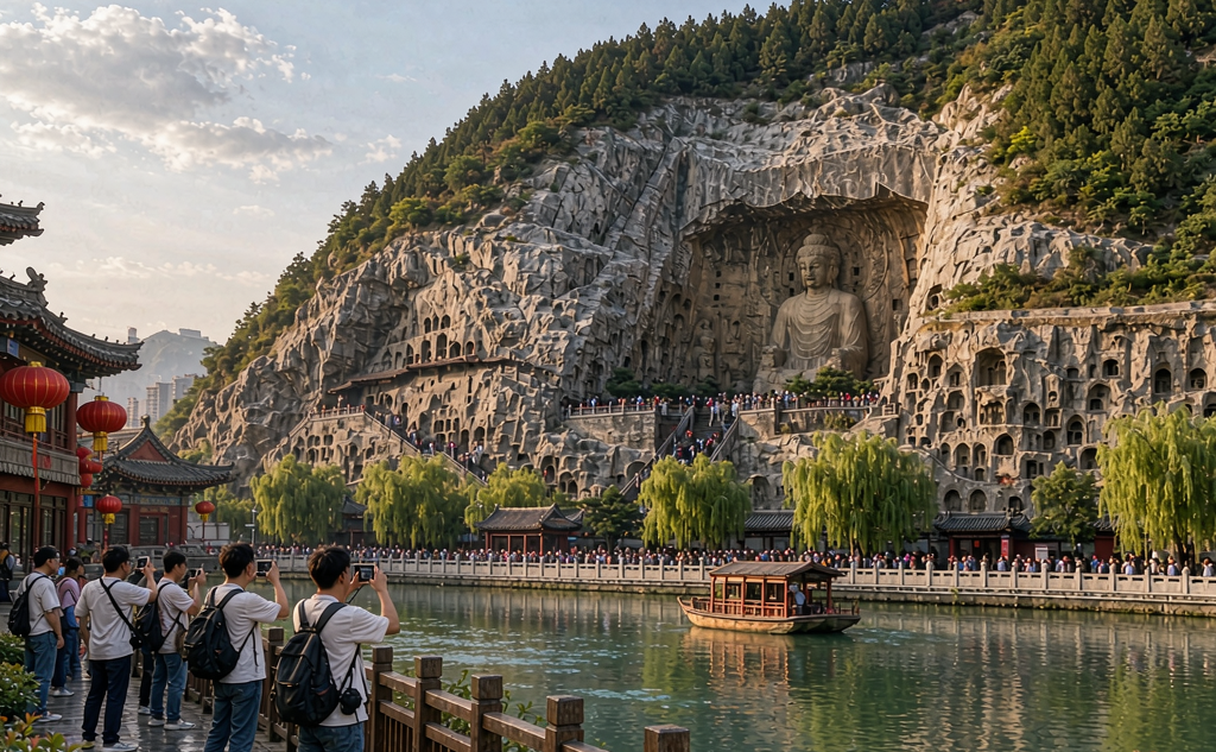
If you want the bigger cultural context, our Luoyang travel guide covers the Longmen Grottoes and the eastern anchor of this region, while the Zhengzhou travel guide handles the provincial capital end and its Henan Museum.
The Yellow River and why it matters here
The Yellow River is the cradle of Chinese civilization, and Jiyuan sits on a stretch that was historically both fertile and disastrous — hence the massive control works at Xiaolangdi. Standing on the dam, you understand why the river shaped dynasties. The visitor center explains the sediment-flushing in plain charts; it is worth 20 minutes even if your Chinese is limited, because the scale is hard to grasp otherwise. The river here is silty and brown most of the year, turning a startling jade during the post-discharge drawdown — a detail worth timing a photo around.
Base yourself in Jiyuan and day-trip to Luoyang — open our Luoyang travel guide to line up the grottoes, the dam, and the mountain in one route.
Food in Jiyuan
Henan cooking is noodle- and carb-forward, milder than Sichuan but heartier than you expect. Try Huimian (braised noodle soup, 12–20 yuan), Xiaolongbao-style steamed buns, and Jiyuan’s own spiced goat dishes in winter (60–100 yuan for a hotpot for two). The night market by the riverfront runs 6–10 pm; a full street meal is 30–50 yuan. For the regional table in full, our Henan Yu cuisine guide lays out the dishes and the etiquette, including how to order huimian the local way.
First time navigating Henan by rail? Read our China travel guide for first-timers before you go, and keep your passport handy for every ticket check.
Wangwu Mountain: the trail in detail
From the lower cable car station, the ride up takes about 12 minutes and drops you a 20-minute walk from Yangtai Temple. If you walk instead of ride, the paved path switchbacks through pine for roughly 90 minutes; there are two rest pavilions with spring water along the way. The summit ridge has a short loop past the Taoist hermit caves and a viewpoint over the Yellow River plain on clear days. Descending on foot is easier on the knees than the climb and takes 2–3 hours, but start by 2 pm so you are off the mountain before dusk, because the last shuttle down also stops around then.
A 2-day Jiyuan plan
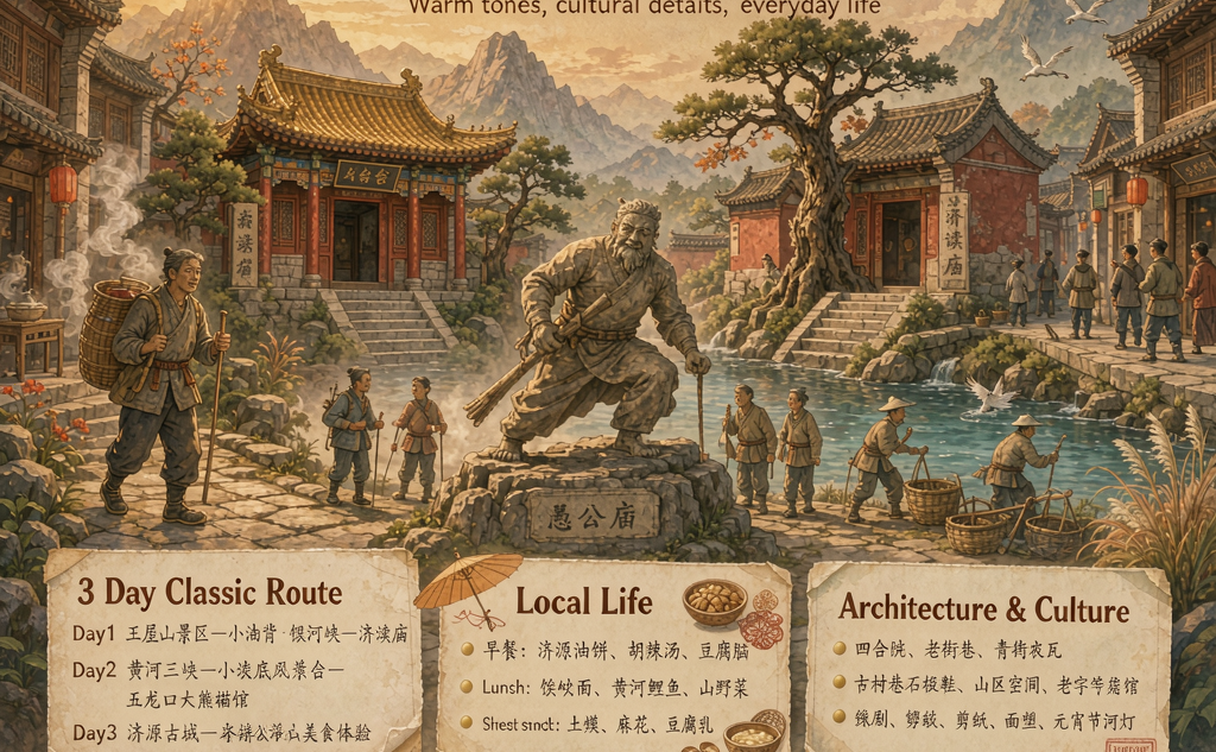
Day 1: Xiaolangdi Dam and riverside park, evening at the night market. Day 2: Wangwu Mountain half-day, then Wulongkou hot springs if your legs allow. If the discharge is running, flip day 1 to the dam at first light and save the mountain for the cooler afternoon. The city is small enough that nothing needs more than a 40-minute hop, so you rarely lose time to transit.
Side trips from Jiyuan
The big draws are an easy run: Luoyang’s Longmen Grottoes are about 90 minutes southwest, and Zhengzhou’s Henan Museum about 90 minutes east. Both work as day trips if you base in Jiyuan, though each deserves its own night if your schedule allows. Our Luoyang and Zhengzhou guides lay out the timings so you are not backtracking.
Costs at a glance
A day in Jiyuan runs cheap: budget 200–350 yuan covering a mid-range room, two meals, local transport, and one paid sight. The dam and riverside park are free; Wangwu cable cars (105 yuan return) and Wulongkou (50–80 yuan) are the main outlays. The discharge weeks are the only time prices nudge up, and even then only for rooms near the riverfront. Eat at the night market and you can keep food under 50 yuan a day without trying, which makes Jiyuan one of the better-value bases in northern Henan.
Where to stay and practical notes
Jiyuan has solid mid-range hotels (180–320 yuan/night) near the rail and bus stations, and a few riverside options (300–500 yuan) worth it for the view. Book ahead only during the dam discharge weeks and National Day. Practicalities: carry cash for temple donations and village stalls, download offline maps, and expect limited English — your hotel’s WeChat is your best help desk. The city is safe to walk at night and small enough that you rarely need a car inside town. Bring a light jacket for the mountain even in summer, because the summit breeze drops the temperature fast.
Add Jiyuan to a Luoyang–Zhengzhou loop and let the dam and the mountain surprise you — start with our Henan Yu cuisine guide so you eat well while you are there.