

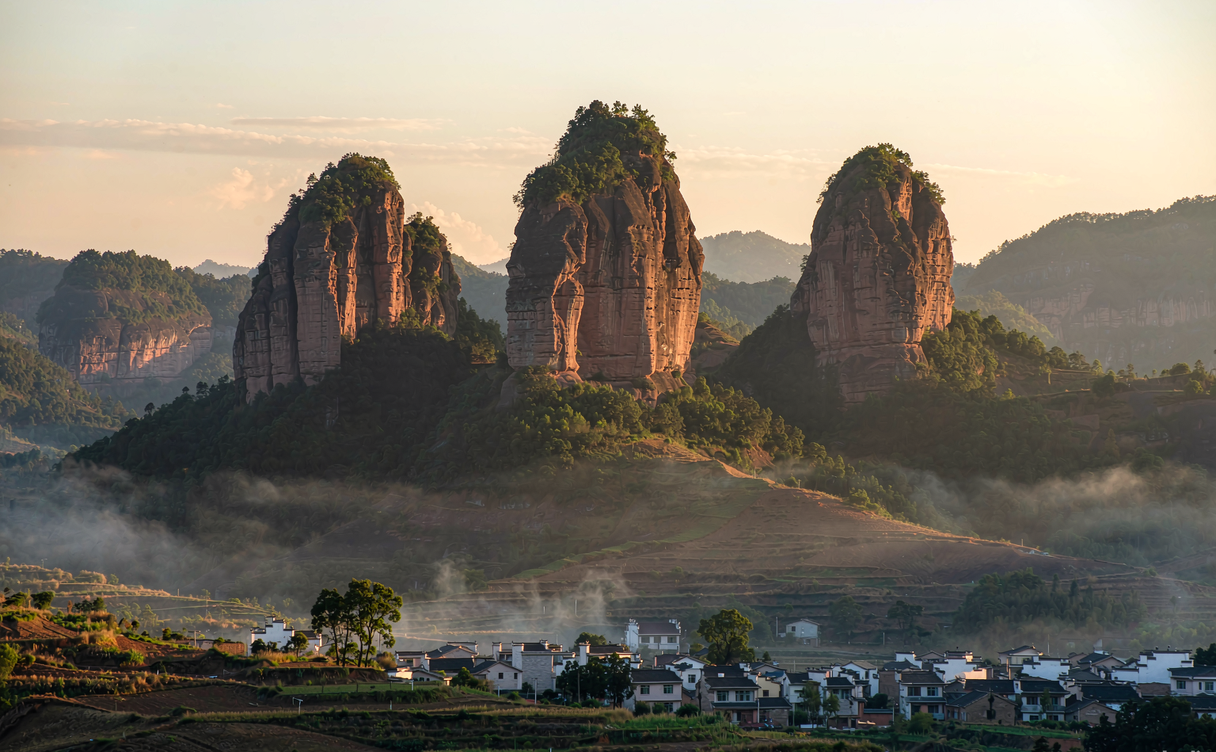
Most travellers who pass through Zhejiang are chasing West Lake or the water towns, but two hours southwest of Hangzhou a different kind of sight rises straight out of the farmland. Jianglangshan is a Danxia massif near Jiangshan city in Quzhou prefecture, best known for three sheer red rock towers — the “Three Stones” (三爿石) — that stand more than 350 metres tall and lean toward each other like a stone gate. We’ve sent travellers here as a half-day stop between Hangzhou and Wuyishan, and the reaction is always the same: photos do not prepare you for how abruptly these pillars erupt from flat rice country. This Jianglangshan guide covers the tickets, the notorious One Line Sky staircase, the hiking difficulty, and exactly how to get to Jianglangshan from Hangzhou without a private car.
Why Visit Jianglangshan
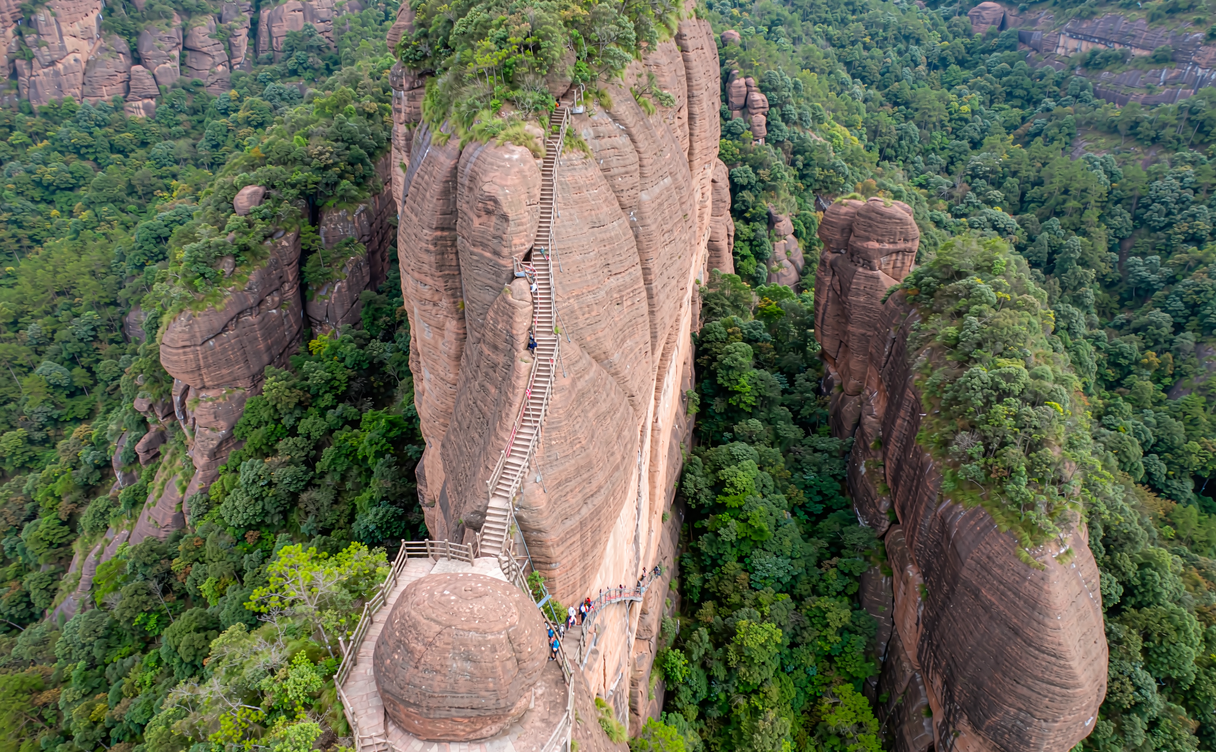
Jianglangshan (江郎山) is one of the smaller components of the UNESCO “China Danxia” serial World Heritage property, inscribed in 2010. What makes it worth the detour is scale and geometry: the three towers — Langfeng, Yaofeng and Lingfeng — are among the largest freestanding Danxia pillars in the country, and the cleft between two of them, the One Line Sky (一线天), is one of the narrowest and longest such fissures in China, about 298 metres high and in places barely shoulder-width. You do not need to be a climber to enjoy it; a stone staircase climbs the eastern tower, and there is a sightseeing bus for the gentle valley approach. For a first-timer to Chinese geoparks, it reads as more dramatic and less crowded than the famous Zhangjiajie or Huangshan crowds. It pairs naturally with a slower Zhejiang loop, and our Quzhou travel guide explains how to use the city as a base for Jianglangshan plus the nearby Nianbadu ancient town.
Best Time to Visit Jianglangshan
April to June — the best window. 18–28°C, green terraces, and good light on the red rock. This is the best time to visit Jianglangshan for photography and for the climb, because the stairs are dry and the valley is lush.
September to October. 16–26°C, clear skies, autumn colour on the lower slopes. Avoid the 1–7 October National Holiday, when the bus queue and the One Line Sky both get packed.
July to August. Hot (30–37°C) and humid, with afternoon thunderstorms. Do the climb before 10:00. The shade in the fissure is a relief, but the open staircases are exposed.
November to March. Cool to cold (3–12°C), occasional frost. The off-season ticket is cheaper and the site is nearly empty, but the upper stairs can be slick after rain.
How to Get to Jianglangshan from Hangzhou
Jianglangshan sits about 25 km from Jiangshan city, which is on the Hangzhou–Changsha high-speed line. The practical routing is train to Jiangshan, then a short road transfer.
| From | Mode | Duration | Approx. cost |
|—|—|—|—|
| Hangzhou East → Jiangshan | High-speed train (G/D) | 1 hr 40 min – 2 hr 10 min | ¥80–130 (US$11–18) |
| Shanghai Hongqiao → Jiangshan | High-speed train | 2 hr 30 min – 3 hr | ¥130–200 (US$18–28) |
| Jiangshan station → Jianglangshan | Taxi | 30–40 min | ¥60–90 (US$8–13) |
| Jiangshan station → Jianglangshan | Public bus | 45–60 min | ¥8–12 (US$1–2) |
| Within scenic area | Shuttle bus | 10 min | ¥15 (US$2) included in some tickets |
From Hangzhou we normally book clients on a morning G-train to Jiangshan; the station has a taxi rank and the drive is straight highway. If you are coming from Wuyishan or Fujian, the reverse works — Jiangshan is the natural rail gateway. Trains must be booked with your passport on 12306 or via a hotel concierge. Our China high-speed train guide for foreigners walks through the app and the passport rule.
Things to Do at Jianglangshan
The Three Stones and the Summit Climb
The signature experience is the climb of Langfeng, the eastern tower. From the shuttle drop-off a long stone staircase (roughly 1,500 steps) switchbacks up the ridge, passes a small temple, and reaches a viewing shelf partway up where you look straight across the gap at the other two pillars. The full summit is closed to unprotected climbers, but the mid-mountain balcony gives the money view. Allow 2–3 hours round trip, more in heat. We tell clients with knee issues to take it slowly: the descent is harder than the ascent on the knees.
One Line Sky (一线天)
The fissure between Yaofeng and Lingfeng is the headline. You enter at the base and walk the narrow cleft upward for about 20–30 minutes; in the tightest section the walls are maybe 30–40 cm apart and you shuffle sideways. It is cool, dripping and genuinely thrilling. Go early — by midday the One Line Sky backs up and the shuffle stalls. This is a real highlight in our China hiking treks guide for travellers who want a short, dramatic walk rather than a multi-day trek.
The Valley and the Literary Trail
Below the towers, a flat path loops past a spring, a scholar’s rock, and the modest Jianglang Temple, with poems carved by the Song official and poet Xin Qiji’s era visitors. It is an easy 40-minute stroll and good for anyone not attempting the stairs. The whole valley is peaceful outside holidays.
Nianbadu Ancient Town (add-on)
About 40 km deeper into the mountains, Nianbadu is a preserved Ming–Qing trade town on the old Jiangxi–Fujian–Zhejiang border, with a mix of regional architecture and almost no tourists. We often pair it with Jianglangshan as a full-day private-car loop out of Jiangshan (car ¥400–600 for the day). It is covered in the Quzhou travel guide as part of the same prefecture.
Jianglangshan Tickets and Hours
- Peak season (Mar–Nov): about ¥100 (US$14) entry, plus ¥15 shuttle.
- Off season (Dec–Feb): about ¥70 (US$10) entry.
- Opening hours: roughly 08:00–17:00; last entry 16:00. The shuttle stops running about an hour before close.
- Payment: on-site ticket machines and counters take Alipay/WeChat and cash; foreign card acceptance is patchy, so carry ¥200.
- Jianglangshan hiking difficulty: moderate-to-hard for the tower stairs (1,500 steps, exposed), easy for the valley loop. Not suitable for strollers on the upper route.
For the World Heritage context of the wider Danxia landscape, the serial property is documented at Wikipedia’s China Danxia page, which lists all six component sites including Jianglangshan.
Where to Stay
Jiangshan city (¥180–400 / US$25–56). The practical base: clean business and chain hotels near the station, 30–40 minutes from the gate. Good for an early start.
Mountain-foot guesthouses (¥150–300 / US$21–42). A few family lodges just outside the scenic entrance; basic but convenient if you want dawn light on the towers.
Quzhou city (¥260–600 / US$36–84). One hour north by train; better dining and hotels if you want a proper city night. The Quzhou travel guide has the restaurant picks.
What to Eat
Quzhou cooking is the spicy end of Zhejiang — closer to Jiangxi and Hunan than to Hangzhou’s sweet notes.
- Quzhou duck head (衢州鸭头) and braised trotters, ¥15–30 a plate, peppercorn-hot.
- Jiangshan copper pot (江山铜锅), a rustic hotpot of pork, tofu and mountain veg, ¥60–120 for two.
- Cold noodles with chili (搁袋饼), a local street breakfast, ¥8–15.
- Mountain bamboo shoots in spring, ¥28–45.
Sample Itinerary: One Day from Hangzhou
- 07:30 G-train Hangzhou East → Jiangshan
- 09:40 taxi to Jianglangshan (30–40 min)
- 10:30 shuttle in, valley stroll and Jianglang Temple (45 min)
- 11:30 One Line Sky, then climb to the mid-mountain balcony (2 hr)
- 14:00 lunch in Jiangshan
- 15:00 optional Nianbadu ancient town (2 hr) or return
- 18:00 train back to Hangzhou
Practical Tips
- Order of the climb. Do One Line Sky before the tower stairs, or first thing — the fissure jams after 11:00.
- Footwear. The stairs are polished stone; wear grippy shoes, not sandals.
- Water and sun. Carry 1 L; the upper stairs have no shade.
- Passport. Needed for the train and any hotel.
- Combine regions. Jianglangshan is a southern hinge of the China UNESCO World Heritage guide loop if you are collecting Danxia and karst sites.
- Guide or not. Signs are in Chinese only; a translation app covers it, but for the geology and the poem-carvings a local guide (¥200–300) adds a lot.
FAQ
Is Jianglangshan worth visiting?
Yes, if you like dramatic geology and hate crowds. The three towers and the One Line Sky are genuinely unique, and it is an easy rail detour. Skip it only if your trip is already packed with Huangshan or Wuyishan.
How long do I need?
Half a day for the mountain alone; a full day if you add Nianbadu. From Hangzhou it is a comfortable day trip by train.
How hard is the climb?
Moderate-to-hard: about 1,500 stone steps, exposed at the top. The valley loop is easy. People with serious knee or heart issues should skip the upper stairs.
Can I do it without a car?
Easily. High-speed train to Jiangshan, then a taxi or the public bus to the gate. A private car only pays off if you add Nianbadu.
When is the light best?
Early morning, when the low sun lights the east face of Langfeng. Late afternoon also works from the valley.
Written by Karl, China Travel Places — updated August 2026.