

Most people who talk about the Taihang Mountains have only seen them from the plain, a blue smear on the southern horizon. To actually stand inside them, you go to Huguan — a county in the southeast of Shanxi where the range splits open into a 50-kilometre system of gorges, waterfalls, and hanging villages. This is the Huguan travel guide we hand to readers who want the dramatic, physical side of Shanxi rather than another courtyard mansion.
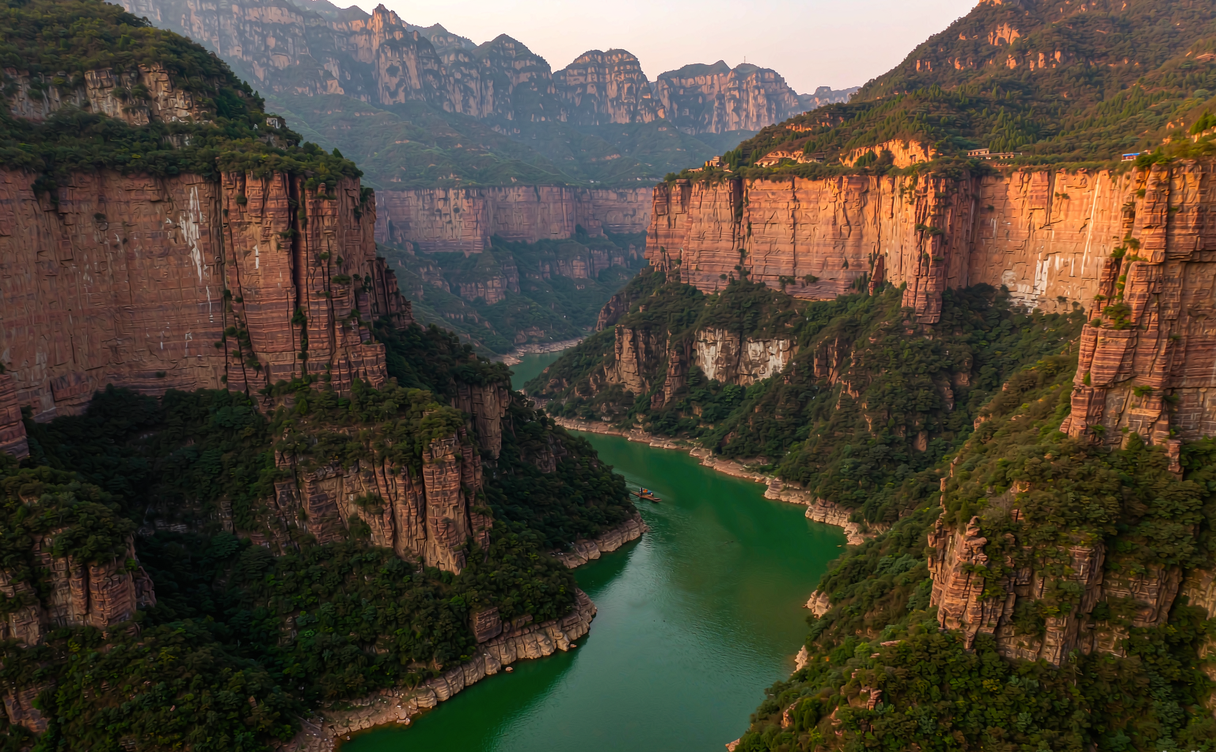
Huguan sits in Changzhi prefecture, hard against the Henan border, where the Taihang range is at its most fractured. Its banner attraction is the canyon country officially known as the Taihang Grand Canyon (太行山大峡谷), a collection of named gorges — Baquan, Hongdou, Qinglong, and others — threaded by the river that carved them. We have sent hikers, photographers, and families with small children here, and all of them came back with the same word: “big.” The encyclopaedic entry on the Taihang Mountains explains the fault-block geology that produced these walls.
Best time to visit Huguan
The best time to visit Huguan is late spring through mid-autumn, with two windows we trust. Late May to June is green, mild (16–25°C), and uncrowded — ideal for the gorge hikes. Late September to mid-October is the showstopper: the cliff-side trees turn red and gold and the light in the gorges is extraordinary for photography. We rate it the single best time to be in the canyon.
July and August are warm but comfortable at altitude and bring the highest water levels for the boat rides and waterfall pools — but they are also domestic-peak, so the Baquan Gorge cable car and elevators can queue. Avoid the May and October national holidays. Winter closes some gorge access and ices the higher roads; we steer first-timers to other seasons. For the wider picture, our best time to visit China guide maps out the trade-offs across the country.
How to get to Huguan
Working out how to get to Huguan is straightforward once you know the hub. There is no airport or high-speed station in the county, so:
- Fly or train to Changzhi, then drive or bus: Changzhi has an airport (CZX) and a high-speed station; from there it is about 90 minutes by road up to the canyon entrance at 桥上乡 (Qiaoshang). Our Changzhi travel guide covers the transfer.
- Rail to Taiyuan or Jincheng, then bus: Long-distance buses run to Huguan town and on to the gorge. The China high-speed train guide for foreigners explains booking the rail legs.
- Self-drive: Strongly recommended. The gorges are strung along a loop road, and a car lets you start at first light before the shuttle buses run.
Inside the scenic area, a through-ticket (¥140–¥180 depending on season) covers the shuttle buses between gorges; the individual cable cars, boats, and elevators are priced separately (typically ¥30–¥120 each). Allow a full day, or two if you want to hike rather than ride.
Things to do in Huguan
The centrepiece of things to do in Huguan is Baquan Gorge (八泉峡), the largest and best-equipped part of the Taihang Grand Canyon Huguan is built around. The standard route is a clever vertical loop: a boat ride up the flooded canyon, a cable car partway up the wall, a cliff-hugging walkway, and finally a glass elevator (the “Sky Elevator,” 208 metres) that drops you back to the base — a genuinely thrilling sequence and, in our experience, worth every yuan of the ~¥300 all-in ticket. Allow 4–5 hours.
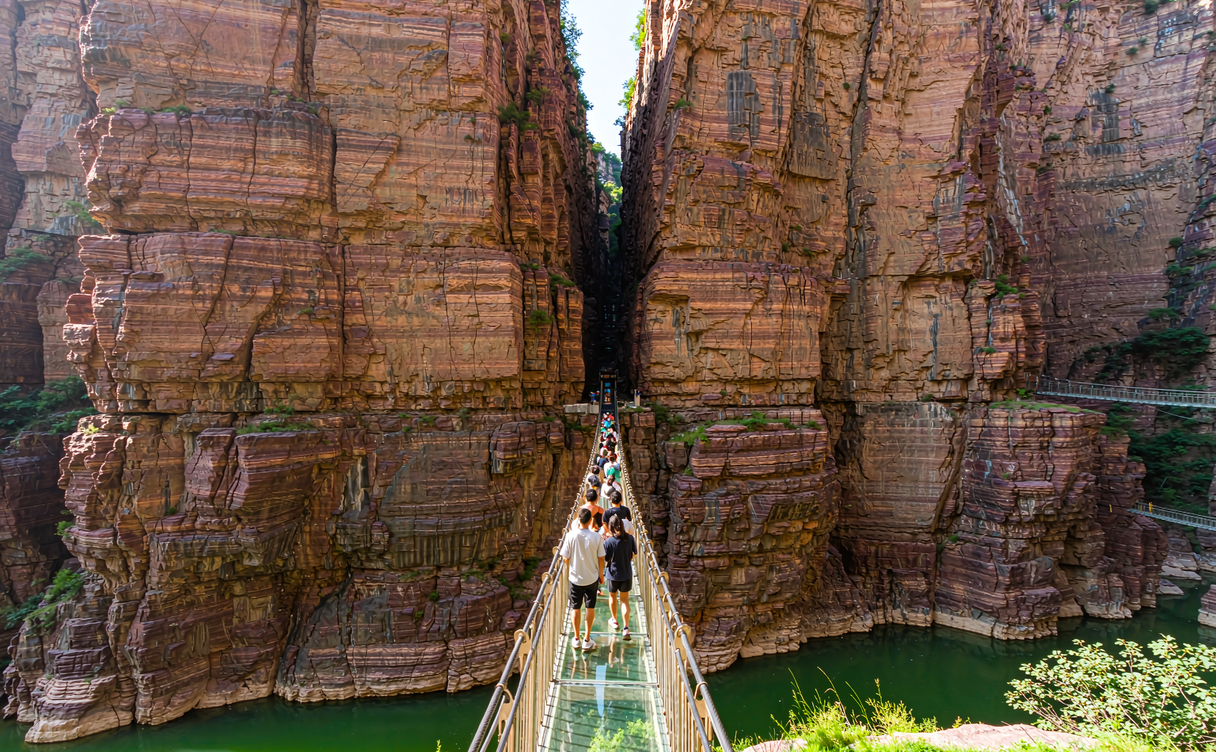
Hongdou Gorge (红豆峡), named for the wild red-bean trees that line it, is quieter and more natural, with a stream-level trail and a rope bridge. Qinglong Gorge (青龙峡) offers rafting in summer and a hanging walkway over the water. Heilongtan (黑龙潭) is a series of plunge pools good for a cooling dip in July. For a human note, the hanging villages built into the cliff faces — reachable on foot from the upper trails — show how people have lived in this terrain for centuries.
For more on the province’s standout sights, our best things to do in China roundup ranks the Taihang gorges among Shanxi’s most underrated natural wonders.
Inside the canyon
The Huguan Shanxi canyon system is bigger than a single day allows, so we usually advise readers to pick one gorge deeply rather than skim all four. Baquan is the obvious first choice for the infrastructure and the wow-factor loop. If you want solitude, skip it on a weekend and walk Hongdou instead, where the only sounds are the stream and the birds.
A practical note: the gorge floors are shaded and cool even in August, but the cliff walkways and the elevator tops are fully exposed. Carry 1.5 litres of water per person, a sun hat, and a light layer for the boat ride, which can be chilly in the spray. Photographers should plan the boat segment for the morning, when the light rakes down the western wall; by mid-afternoon the gorge is in shadow.
Where to stay and eat
The best base is Qiaoshang (桥上乡), the village at the main gorge entrance, where guesthouses run ¥120–¥250 a night and a few newer hotels reach ¥400–¥600 in peak season. Staying here puts you at the trailhead for first light. Huguan town (the county seat, an hour down the road) has cheaper, larger hotels (¥150–¥300) but adds a transfer.
Food is robust northern Shanxi mountain cooking. 壶关羊汤 (Huguan lamb soup, ¥15–¥25 a bowl) is the local breakfast of choice and will fuel a day on the trails. 炒凉粉 (fried cold jelly), 小米饭 (millet rice), and mountain mushrooms (¥40–¥70 a dish) round out dinner; a couple can eat well for ¥70–¥120. The gorge-entrance strip has the most options; inside the scenic area, food is limited and priced for captives, so eat before you enter.
Practical tips before you go
Lessons from our own trips: buy the through-ticket online in advance in summer to skip the gate queue; wear proper trainers, not sandals, because the walkways are long and wet in places; and keep some RMB, since card machines fail on the mountain. Signal is patchy inside the gorges, so screenshot your hotel address and the bus timetable before you descend.
If this is your first time in the region, our China travel guide for first-timers covers the payment apps, SIM cards, and transport basics that make a remote county like Huguan far less daunting.
Pairing Huguan with the cities
Huguan is almost always a stop on a wider Shanxi loop. Changzhi is the natural launch point and has enough museums and 上党 temples for a half-day. Taiyuan, two hours north by rail, makes a logical bookend with the Jinci Temple and the provincial museum. Our Taiyuan travel guide explains how to use the capital as your entry or exit.
What to do beyond the obvious
Once the marquee gorges are done, two quieter rewards remain. The Taihang Mountain grand canyon hiking trail that links the gorge tops is a full-day walk for fit travelers, with ridge views back down into Henan — start at the Baquan upper station and allow 6 hours. And the small Zituan Mountain (紫团山), near the Hongdou entrance, has a cave temple and spring that almost no tour groups reach.
Final thoughts
Huguan is the answer to anyone who says Shanxi is only temples and coal. Inside the Taihang Grand Canyon, the scale is humbling and the engineering of the gorge loop is a small marvel in itself. We keep steering readers here because it delivers a kind of China — vertical, wild, and quiet — that the headline cities never show.